Saudi Arabia condemns ‘criminal’ Kabul bombing

1 / 2
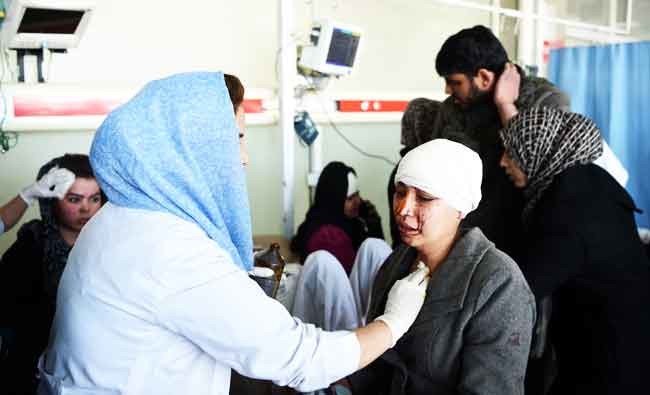
Afghan medical staff treat a wounded women, after a car bomb exploded near the old Interior Ministry building, at Jamhuriat Hospital in Kabul on Saturday. (AFP)
2 / 2
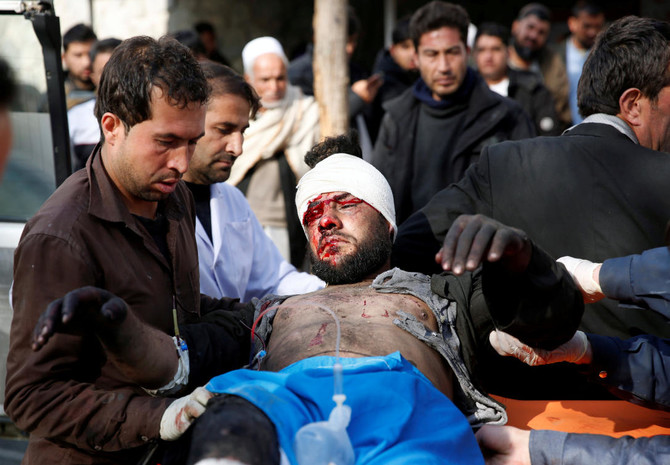
An injured man receives medical assistance after a blast in Kabul, Afghanistan January 27, 2018. (Reuters)
Updated 28 January 2018
Follow

Saudi Arabia condemns ‘criminal’ Kabul bombing

LONDON: Saudi Arabia’s King Salman condemned the Kabul bombing that left at least 95 killed and 158 wounded on Saturday.
King Salman shared his condolences in a cable to Afghanistan’s President Mohammed Ashraf Ghani on the victims of a blast in the Afghan capital.
“We denounce and disapprove such a sinful criminal act,” King Salman said as cited by the state-owned Saudi press agency, SPA.
The king wished for a “speedy recovery” for those who were injured in the blast and affirmed the kingdom stands “alongside the Islamic Republic of Afghanistan against all machinations that may target its security and stability.”
Saudi Crown Prince Mohammed bin Salman also sent his condolences to the people of Afghanistan and condemned the attack, calling it a terror act that targeted innocent people.
The bombing, claimed by the Taliban, took place a week after a deadly attack on the Intercontinental Hotel in the city.


Saudi crown prince receives 2025 Nobel Prize in Chemistry winner Omar Yaghi

Saudi Crown Prince Mohammed bin Salman receives Professor Omar Yaghi in Riyadh on Wednesday. (SPA)
Updated 28 January 2026
Follow

Saudi crown prince receives 2025 Nobel Prize in Chemistry winner Omar Yaghi

  • Crown prince congratulated Yaghi on receiving the prize and wished him continued success

RIYADH: Saudi Crown Prince Mohammed bin Salman received 2025 Nobel Prize in Chemistry winner Professor Omar Yaghi in Riyadh on Wednesday.
The crown prince congratulated Yaghi on receiving the prize and wished him continued success, Saudi Press Agency reported.
The professor was awarded the 2025 Nobel Prize in Chemistry, sharing it with Richard Robson of the University of Melbourne, Australia, and Susumu Kitagawa of Kyoto University, Japan.
The scientists were cited for creating “molecular constructions with large spaces through which gases and other chemicals can flow. These constructions, metal-organic frameworks, can be used to harvest water from desert air, capture carbon dioxide, store toxic gases or catalyze chemical reactions.”
Yaghi expressed his gratitude to the crown prince for the meeting and the support he has received in his work.