ANKARA: As Turkey’s Operation Olive Branch entered its second week on Saturday, Ankara said military action against the Kurdish People’s Protection Units (YPG) militia and its political wing the Democratic Union Party (PYD) in Syria’s Afrin would continue until the threat is “neutralized.”
But despite Ankara’s claims that it has no wish to take territory from another country, and that control of Afrin will be handed over to the Syrian regime at the end of the operation, the offensive has inevitably complicated the already chaotic regional dynamics still further.
The official aim of Olive Branch is to establish stability along Turkey’s border with Syria and to remove not only the YPG/PYD — regarded by Ankara as an offshoot of the outlawed Kurdistan Workers’ Party (PKK), which has waged an insurgency against the Turkish state for more than three decades — but also Daesh from the area.
Turkey’s military reported that 343 terrorists have so far surrendered, or been killed or captured, and that 333 targets have been destroyed. The operation’s scope now extends around 7.5 kilometers into Syria, with 11 villages captured.
Turkey has lost three soldiers so far, while one Syrian refugee was killed and 13 others wounded as two rockets launched from Afrin hit the Turkish border city of Kilis on Wednesday.
No casualties were reported after another rocket struck a marketplace in the border town of Reyhanli on Friday.
Overall, the operation has garnered the approval of the Turkish public and the support of the international community, with NATO recognizing Turkey’s “right to self-defense like all other countries.”
Washington, too, has released sympathetic statements recognizing “Turkey’s security concerns about the PKK, a US-designated foreign terrorist organization.”
Russia has supported the operation by allowing Turkey access to Afrin’s airspace, although it is not yet clear whether Russia’s will allow unlimited access or whether it will impose similar restrictions to those applied during Turkey’s cross-border Euphrates Shield Operation, which ran from August 2016 to March 2017.
Washington’s offer to Ankara this week to establish a 30 km safe zone in Syria, along with an increased number of meetings between US and Turkish officials, have been seen by many experts as a move by Western powers to re-establish ties with their longtime NATO ally. But the Turkish regime remains skeptical of US offers — a sign of the current distrust between the two countries.
However, the Syrian regime considers Turkey’s operation to be an invasion and an attack to Syrian sovereignty. In an interview with the BBC on Thursday, Deputy Foreign Minister Faisal Mekdad said Syria will “act accordingly” to defend itself, explaining that could involve the use of its aerial defense systems.
Also on Thursday, the PYD/YPG-led administration of Afrin canton released a statement calling on Bashar Assad and his regime to protect the city.
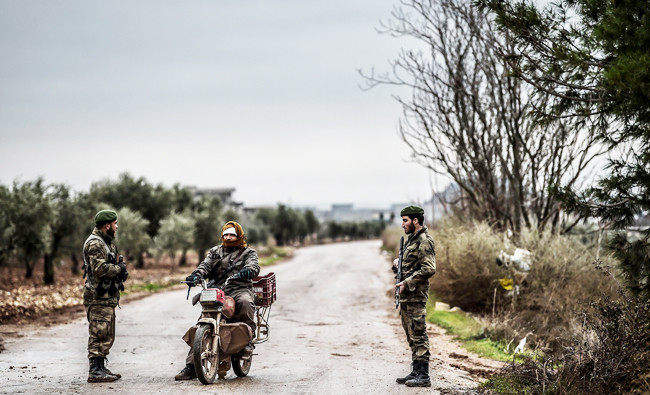
Erol Bural, a former military officer and a terrorism expert at the 21st Century Turkey Institute, said the Turkish military, with the assistance of Free Syrian Army fighters, had encircled Afrin by opening multiple front lines.
“Barseya mountain, in the north of Azaz, is a primary target for Turkey because of its critical location overlooking Afrin’s urban center. The PKK/PYD used it as a major hideout for years, with fortifications against aerial and ground attacks,” Bural told Arab News.
Bural expects an effective siege on Afrin’s urban center once this mountain has been cleared of any terrorist threat, which will also prevent the YPG from targeting Turkey’s border towns with rockets and mortars.
“I don’t expect the Syrian regime to react positively to the YPG’s call, considering that Assad previously called the US-backed Kurdish fighters traitors, and considering the regime also wants the PYD presence cleaned out from this region,” he said.
At the end of the operation’s first week, the expansion of Olive Branch to Manbij, a city captured from Daesh in 2016 by the Kurdish militias, is still on the table. But the presence of American forces there complicates the situation.
“I think the main focus for now should be to wind up the military operation and hand complete control to local forces, while conducting diplomacy with regional actors,” Bural said.
According to Bural, the US is holding Manbij as its “trump card” against Turkey, in an attempt to weaken Russia’s influence on Ankara and to protect the “PKK statelet” America has established on the western flank of the River Euphrates.
“Now Turkey has two options: Either launch an operation on Manbij regardless of the US military presence, or conduct diplomatic maneuvers to convince the US to withdraw their soldiers,” he said.
According to Galip Dalay, research director at Al-Sharq Forum in Istanbul, “Operationally, the Afrin operation is progressing slowly but smoothly.”
Dalay thinks Operation Olive Branch is unlikely to progress at the same speed as Euphrates Shield, “at least in its early phases.”
“Nevertheless, Turkey hasn’t incurred many casualties,” he told Arab News.
On the diplomatic front, despite US concerns, the international community has so far been supportive of the operation, he said, adding that the objections it has faced thus far are “manageable.”
On the political front, though, Dalay said the goal of the operation “is still opaque.”
He explained: “It isn’t clear yet what will be acceptable to Turkey in Syria. If Turkey keeps the pressure on the YPG for too long, the YPG will invite the Assad regime to Afrin.
“Despite Turkey’s public discourse, Turkey doesn’t have much objection to such an outcome,” he continued. “Nevertheless, that would bode ill for Turkey, as well as the Syrian opposition’s image, as their actions will appear to play into the hands of the regime. This is one of the major dilemmas of this operation.”


One week on, Operation Olive Branch helps Turkey seize many initiatives
One week on, Operation Olive Branch helps Turkey seize many initiatives



Why Jordanians are flocking to Damascus as Syria reopens roads, skies and rails
- Tour buses, budget flights and reopened crossings signal renewed civilian travel between Jordan and postwar Syria
- Officials say mobility revival reflects deeper regional reintegration as Damascus sheds isolation and rebuilds tourism sector
DUBAI: Ask nearly any Jordanian over the age of 40 about Damascus and you are likely to be met with a nostalgic tale of days gone by when weekend trips to the old city were as common as those to the Dead Sea.
Such memories were confined to the pits of nostalgia by the onset of the Syrian civil war, which turned the once-famed journey into an ordeal of derelict rest stops, militia checkpoints, sudden closures and the possibility of violence.
However, over the last year, tour buses have reappeared on the centuries-old trade route. Private drivers are booking permits to take the road north and a new generation of Jordanian travelers, eager for regional rediscovery, are getting back on the road to Damascus.
Statistics released by Syria’s Ministry of Tourism show that Jordanians are by far the largest group of tourists represented in Syria, with 394,871 arrivals in 2025 alone — some 93 percent more than the previous year and eclipsing any other nation, including those with substantial Syrian populations like Turkiye and Germany.
FASTFACT
395K
Jordanians who visited Syria in 2025, up 93% on the previous year, making them the country’s largest tourist group.
These figures represent “not only the reactivation of tourism flows, but a deeper strategic recovery extending beyond the economic domain,” Mazen Al-Salhani, Syria’s minister of tourism, said in a statement.
“It signals a transition to organized, civilian-driven mobility and a restored perception of Syria as a safe, attractive and culturally rich destination.”
Jordan and Syria share not only a border, but also centuries of cultural, familial and economic ties. The Nasib-Jaber crossing on the Damascus-Amman highway was one of the busiest gateways in the region before the civil war.

That crossing’s reactivation is symbolic of a wider lifting of barriers. While the border was closed intermittently in late 2024 amid renewed conflict, the crossing has now been revitalized, streamlining the process of getting permissions for vehicles and border patrol checks.
Hamzeh Battieh, executive manager of Sharif House Handcrafted Travel and Events, a tourism operator based in Damascus, told Arab News the crossing had become substantially easier to navigate, transforming from somewhere that was once quite hostile into something quite welcoming.
“Following the liberation of Syria, the situation at the crossing changed fundamentally for the better,” he said.
“The time required to complete entry or exit procedures no longer exceeds 10 minutes, whereas under the former regime it used to take many hours and involved widespread bribery and favoritism.
“Visitors are now received with warm hospitality. Many travelers have repeatedly heard officers at the crossing say to passengers: ‘Welcome home, you have illuminated our country’.”

Jordanian tour operators, who for years pivoted travelers to Istanbul, Cairo, or Beirut, now report growing inquiries for tours that include Damascus’ ancient souks, the Umayyad Mosque and day trips to historic sites such as Bosra.
Meanwhile, a growing number of independent travelers are making the Amman-Damascus bus route part of their itineraries, sharing tips online about passports, bus times and border crossing formalities.
Battieh said the fall of the Bashar Assad regime had made Syria a substantially freer and easier country to navigate.
“Tourism has indeed begun to return to Syria, but with a new spirit, free of the difficulties and complications that were imposed during the era of the former regime,” he said.
“Starting from border and airport police and extending to public roads, today, procedures for entering Syria have become smoother and far more welcoming.”
Syria’s comparable affordability as a destination is reportedly another appeal that is attracting Jordanians to venture north.
According to Hussein Halaqat, a spokesperson for the Jordan Hotels Association, domestic tourism in Jordan declined during the first three days of the last Eid Al-Adha holiday due in part to the lower-cost travel on offer across the northern border.
“Prices in Syria are lower than in Jordan, particularly compared with Jordan’s five-star seaside hotels in Aqaba and the Dead Sea, which not everyone can afford,” he told Erem News.
He said the queues at coach stops in the capital, Amman, for services heading to Syria, which can cost as little as 15 Jordanian dinars ($21) per passenger, were indicative of the rising competition that regional integration could bring.
Battieh said Jordanians were particularly drawn to Damascus and Aleppo for their historical significance and famed cuisine. Many of Damascus’ most famous restaurants had moved to Amman during the war, creating a local following.
“A visitor can easily spend at least one full week in Damascus alone, exploring landmarks such as the Umayyad Mosque, Al-Azem Palace, and famous traditional markets like Al-Hamidiyah Souq and Al-Buzuriyah,” he said.
“They also really love the city’s diverse cuisine, Damascene ice cream, traditional cafes such as Al-Nawfara Cafe and historic public bathhouses like Hammam Al-Malik Al-Zahir.”
As the road to Damascus is reconnected with its southern neighbor, so too are its skies. In early January, a Royal Jordanian commercial flight landed at Damascus International Airport, marking the restoration of the Amman-Damascus air corridor after a 14-year hiatus.
The flight, organized as a technical trial, carried a Jordanian delegation of aviation experts tasked with assessing the airport’s readiness to resume regular operations.
While modest in scale, the flight was heavy with symbolism — a sign that Damascus was once again reentering regional airspace after more than a decade of isolation.
Since then, travel has surged, with Royal Jordanian offering four weekly flights between the two capitals. With a flight time of just 25 minutes, the route is intended to close the gap for road-weary travelers, while giving Syrians access to more destinations through an Amman transit.
Moreover, perhaps more ambitiously, the two countries have agreed to restore a historic rail link that once connected Damascus and Amman. The Hijaz Railway project aims to have passengers traveling between the two cities as early as this year.
Although the timeline remains unclear, Zahi Khalil, director-general and deputy chairman of the Jordan Hijaz Railway at the Jordanian Ministry of Transport, told Arab News that plans are well underway.
“Regarding the connection process — the link between Damascus and Amman — it could be ready by the end of 2026.”
Historically, the Hijaz Railway was part of the Ottoman rail network and served as a major link between Damascus and Makkah, reducing a journey that once took 40 days to just five.
Seen by the sultan at the time as a symbol of Islamic unity and progress, the railway holds deep historical and cultural significance across the region.
Khalil said much of the historic track would be rehabilitated, upgraded for modern trains and reused, with large sections of the original route still intact.
“Once Syria is linked to the Turkish rail lines, Amman will be connected all the way to Istanbul,” he said.
For Jordanian tourists, these developments reinforce a sense that Syria is no longer a place visited only out of necessity or for nostalgia, but one that is once again accessible by choice.
For Syrians like Battieh, these changes represent something far deeper — a reclaiming of mobility after years of enforced paralysis, and a signal that reintegration into the region is no longer theoretical, but operational.
“Syria has room for all who love her,” Battieh said. “Welcome to the new Syria. As the French archaeologist Andre Parrot once said: ‘Every civilized person has two homelands: Their own, and Syria’.”


