Agreement reached on ceasefire in Eastern Ghouta in Vienna peace talks

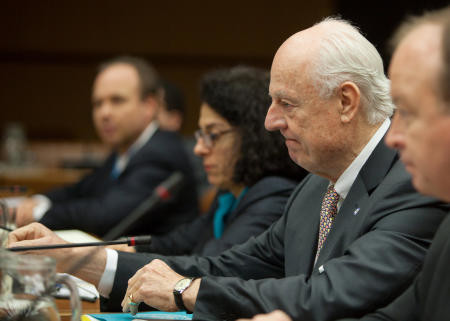
UN envoy Staffan de Mistura (C) looks on before the start of talks on Syria in Vienna on January 25, 2018. (REUTERS)
Updated 26 January 2018
Follow

Agreement reached on ceasefire in Eastern Ghouta in Vienna peace talks

VIENNA: A Syrian opposition spokesman says the opposition and government have signed a cease-fire agreement over the fighting in the suburbs of Damascus.
Ahmad Ramadan says the agreement was signed on Friday, on the second and last day of a UN-mediated round of peace talks in Vienna.
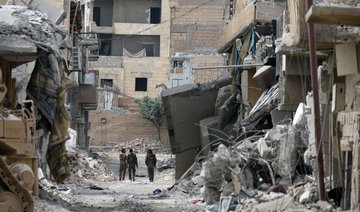
The opposition-held eastern Ghouta region outside Damascus has seen more than two months of heavy fighting since rebels tried to break a strict government blockade that has depleted food and medical supplies for nearly 400,000 people trapped inside.
The Britain-based Syrian Observatory for Human Rights says at least 286 civilians in eastern Ghouta and Damascus have been killed in shelling and airstrikes in the last month because of the fighting.
Reports suggest agreement was also reached on allowing aid organisations to have access to the most beseiged areas as well as a prisoner exchange.


Israel decided to kill Khamenei in November, defense minister says

Updated 5 sec ago
Follow

Israel decided to kill Khamenei in November, defense minister says

  • “The prime minister (Benjamin Netanyahu) set the goal of eliminating Khamenei,” Katz told Israel’s N12 TV news
  • The timing was set for mid-2026

JERUSALEM: Israel took the decision to kill Iran’s Supreme Leader Ali Khamenei in November and was planning to carry out the operation around six months later, Defense Minister Israel Katz said on Thursday.
Khamenei was killed in the first hours of the US-Israeli air campaign that began on Saturday in the first assassination of a country’s top ruler by an airstrike.
The joint air assault ⁠is nearing the ⁠end of its first week after opening salvos killed the country’s leaders and set off a regional war, with Iranian attacks in Israel, the Gulf and Iraq, and Israeli attacks against Iran’s ally ⁠Hezbollah in Lebanon.
“Already in November we were convened with the prime minister in a very tight forum and the prime minister (Benjamin Netanyahu) set the goal of eliminating Khamenei,” Katz told Israel’s N12 TV news. The timing was set for mid-2026, he said.
The plan was eventually shared with the Washington and brought forward around January after ⁠protests ⁠broke out Iran, when Israel was concerned its pressured clerical rulers might launch an attack against Israel and US assets in the Middle East, Katz said.
Israel has said its aim is to eliminate the existential threat it sees in Iran’s nuclear program and ballistic missile project, and to bring about regime change. Iran’s rulers have so far shown no sign of relinquishing power.