East Timor president calls for new election to end impasse

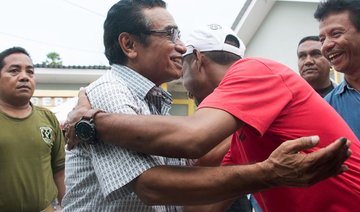
East Timor President Francisco Guterres said on Friday that ‘only the people can help solve the new challenges’ and asked the people to vote again in fresh elections. (Reuters)
Updated 26 January 2018
Follow

East Timor president calls for new election to end impasse

DILI: East Timor President Francisco “Lu Olo” Guterres said on Friday he will dissolve parliament and call for new elections in a bid to end a prolonged political impasse in the tiny country since polls last year.
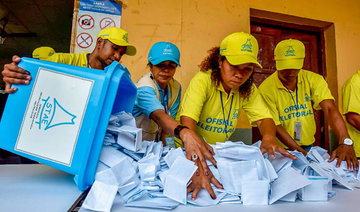
The 2017 election produced no clear winner, with the Fretilin party of Prime Minister Mari Alkatiri winning just 0.2 percent more votes than the National Congress for Timorese Reconstruction (CNRT), the party of independence hero Xanana Gusmao.
Guterres asked Alkatiri, a political ally, to form government but a legislative stalemate ensued after a CNRT-led coalition, with the majority of seats in parliament, refused to pass his program.
The standoff led to Alkatiri accusing the opposition of an attempted coup, while the CNRT’s coalition described the government as unconstitutional.
“Only the people can help solve the new challenges we face. Humbly, the president asks the people to vote again in fresh elections,” Guterres told reporters.
The president said the election date would be determined according to regulations in the constitution.
Damien Kingsbury, an Australia-based East Timor expert who will act as an international observer, said it would take place in April at the earliest.
East Timor’s legislature will still function until the election date is set and campaigning begins.
Even so, the political ructions could delay any ratification of an agreement between Australia and East Timor over an estimated $40 billion in oil and gas reserves in the Timor Sea.
A new agreement on the maritime boundary was due to be signed in March, although negotiations are continuing.
As well as an agreed sea border, East Timor wants the oil and gas to be processed at a facility on its southern coastline, a proposal that has been resisted by the joint venture with development rights over the field led by Woodside Petroleum .
Kingsbury said the political rhetoric of recent months was “highly inflammatory and confrontational.”
Police raided the premises of Gusmao’s daughter, Zenilda Gusmao, last week in relation to alleged unpaid taxes, according to media reports. The government denied the raid was politically motivated.
The new election could stoke tensions further, although Kingsbury noted that the military and police remained largely disciplined and neutral.
East Timor has been unsettled by bouts of violence and political instability since it became independent from Indonesia in 2002. Members of the military and police mutinied in 2006.
“The question is whether the parties can control their members. I am sure they have the will to do so but whether they can (remains uncertain),” Kingsbury said.
The CNRT and its partners could run as a unified coalition, which some observers believe would see them as favorites to win the new election.
Senior CNRT leader Aderito Hugo said by phone the president needed to better explain his reasons for dissolving parliament before the party would accept it.
Luis Roberto from KHUNTO, a junior member of the opposition coalition, said his party would “obey” the president’s decision.


Philippines eyes closer cooperation on advanced defense tech with UAE

Updated 7 sec ago
Follow

Philippines eyes closer cooperation on advanced defense tech with UAE

  • Philippine-UAE defense agreement is Manila’s first with a Gulf country
  • Philippines says new deal will also help modernize the Philippine military

MANILA: The Philippines is seeking stronger cooperation with the UAE on advanced defense technologies under their new defense pact — its first such deal with a Gulf country — the Department of National Defense said on Friday.

The Memorandum of Understanding on Defense Cooperation was signed during President Ferdinand Marcos Jr.’s visit to Abu Dhabi earlier this week, which also saw the Philippines and the UAE signing a comprehensive economic partnership agreement, marking Manila’s first free trade pact with a Middle Eastern nation.

The Philippines-UAE defense agreement “seeks to deepen cooperation on advanced defense technologies and strengthen the security relations” between the two countries, DND spokesperson Assistant Secretary Arsenio Andolong said in a statement.

The MoU “will serve as a platform for collaboration on unmanned aerial systems, electronic warfare, and naval systems, in line with the ongoing capability development and modernization of the Armed Forces of the Philippines,” he added.

It is also expected to further military relations through education and training, intelligence and security sharing, and cooperation in the fields of anti-terrorism, maritime security, and peacekeeping operations.

The UAE’s Ministry of Foreign Affairs has described security and defense as “very promising fields” in Philippine-UAE ties, pointing to Abu Dhabi being the location of Manila’s first defense attache office in the Middle East.

The UAE is the latest in a growing list of countries with defense and security deals with the Philippines, which also signed a new defense pact with Japan this week.

“I would argue that this is more significant than it looks on first read, precisely because it’s the Philippines’ first formal defense cooperation agreement with a Gulf state. It signals diversification,” Rikard Jalkebro, associate professor at the Anwar Gargash Diplomatic Academy in Abu Dhabi, told Arab News.

“Manila is widening its security partnerships beyond its traditional circles at a time when strategic pressure is rising in the South China Sea, and the global security environment is (volatile) across regions.”

Though the MoU is not an alliance and does not create mutual defense obligations, it provides a “framework for the practical stuff that matters,” including access, training pathways, procurement discussions and structured channels” for security cooperation, he added.

“For the UAE, the timing also makes sense, seeing that Abu Dhabi is no longer only a defense buyer; it’s increasingly a producer and exporter, particularly in areas like UAS (unmanned aerial systems) and enabling technologies. That opens a new lane for Manila to explore capability-building, technology transfer, and industry-to-industry links,” Jalkebro said.

The defense deal also matters geopolitically, as events in the Middle East and the Indo-Pacific region have ripple effects on global stability and commerce.

“So, a Philippines–UAE defense framework can be read as a pragmatic hedge, strengthening resilience and options without formally taking sides,” Jalkebro said.