Malala Yousafzai lauds feminism, equality at WEF in Davos

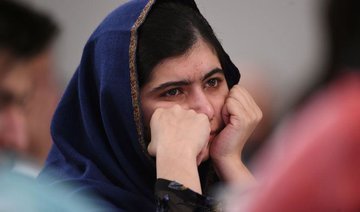
Nobel laureate Malala Yousafzai speaks during a panel discussion at the World Economic Forum in Davos. (AP)
Updated 26 January 2018
Follow

Malala Yousafzai lauds feminism, equality at WEF in Davos

DAVOS: Nobel peace laureate Malala Yousafzai on Thursday urged women to “change the world” without waiting for the help of men, as she addressed an audience of the global, and mostly male, elite at the World Economic Forum in Davos.
The 20-year-old global education campaigner spoke not long before the arrival in Davos of US President Donald Trump, who reached the White House a year ago despite revelations of inappropriate conduct toward women.
On Saturday across the United States, thousands of demonstrators took to the streets in a Women’s March to mark a year to the day since his inauguration.
The annual Davos conference, which unites the world’s business and political elite, also takes place this year in the shadow of the feminist #MeToo campaign that shook Hollywood and spread across the globe in 2017.

“We won’t ask men to change the world, we’re going to do it ourselves,” said Yousafzai.
“We’re going to stand up for ourselves, we’re going to raise our voices and we’re going to change the world,” she said.
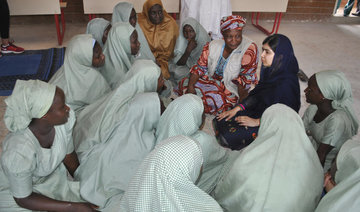
Yousafzai, who was shot and nearly killed by the Taliban in her native Pakistan in 2012 for insisting on the right of girls to go to school, has become a global sensation, pleading for the education of women.
Winner of the Nobel Peace Prize in 2014, she has continued her campaigning while pursuing her studies at Oxford University.
“Feminism is just an other word for equality ... and no one will object to equality,” she said.
“It is very simple, it’s not as complicated as some people have made it.”

Cuba says a 5th person died after people on a Florida-flagged speedboat opened fire on soldiers

Updated 56 min 14 sec ago
Follow

Cuba says a 5th person died after people on a Florida-flagged speedboat opened fire on soldiers

  • Authorities in Cuba said that on Feb. 26 Cuban soldiers confronted a speedboat carrying 10 people as the vessel approached the island and opened fire on the troops
  • The shooting threatened to increase tensions between US President Donald Trump and Cuban authorities

HAVANA: Cuba said a fifth person has died as a consequence of a fatal shootout last month involving a Florida-flagged speedboat that allegedly opened fire on soldiers in waters off the island nation’s north coast.
The island’s interior ministry said late Thursday in a statement that Roberto Álvarez Ávila died on March 4 as a result of his injuries. It added that the remaining injured detainees “continue to receive specialized medical care according to their health status.”
Authorities in Cuba said that on Feb. 26 Cuban soldiers confronted a speedboat carrying 10 people as the vessel approached the island and opened fire on the troops. They said the passengers were armed Cubans living in the US who were trying to infiltrate the island and “unleash terrorism”. Cuba said its soldiers killed four people and wounded six others.
“The statements made by the detainees themselves, together with a series of investigative procedures, reinforce the evidence against them,” the Cuban interior ministry said in its statement, adding that “new elements are being obtained that establish the involvement of other individuals based in the US”
Earlier this week, Cuba said it had filed terrorism charges against six suspects that were on the speedboat. The government unveiled items said to have been found on the boat, including a dozen high-powered weapons, more than 12,800 pieces of ammunition and 11 pistols.
Cuban authorities have provided few details about the shooting, but said the boat was roughly 1.6 kilometers (1 mile) northeast of Cayo Falcones, off the country’s north coast. They also provided the boat’s registration number, but The Associated Press was unable to readily verify the details because boat registrations are not public in the state of Florida.
The shooting threatened to increase tensions between US President Donald Trump and Cuban authorities. The island’s economy was until recently largely kept economically afloat by Venezuela’s oil, which is now in doubt after a US military operation deposed then-Venezuelan President Nicolás Maduro.