ZURICH: Saudi Basic Industries Corp. (Sabic) bought a 25 percent stake in Clariant, ending the Swiss speciality chemical group’s fight with activist investors but raising further questions about its future.
US activists David Winter, David Millstone and hedge fund investor Keith Meister on Thursday announced they had unloaded their stake to Sabic, a surprise given their previous insistence they were long-term Clariant investors.
Sabic, the world’s number four chemical firm, said it had no current plans to launch a full takeover of Clariant. However, the move stoked uncertainty about Clariant as Saudi Arabia seeks to diversify its economy and reduce its reliance on oil.
“The story likely isn’t over,” Bank Vontobel analysts said in a note to investors. “This step makes strategic sense for Sabic.”
Sabic is 70 percent owned by Saudi Arabia’s sovereign wealth fund, Public Investment Fund.
The activists last year blocked Clariant’s $20 billion merger with US peer Huntsman, saying it undervalued the Swiss company and did not make strategic sense.
The Swiss had also snubbed their demands for an independent strategic review and three seats on its board.
Clariant shares had risen by nearly a third since their then 7.2 percent investment became public in July. The stock slid more than 9 percent in European trading.
Sabic did not say how much it paid, but the stake is worth around $2.4 billion based on market capitalization.
Middle Eastern energy players have been eager to expand into more advanced downstream chemicals operations like the catalysts that Clariant produces to help speed up processes at chemicals plants.
State oil company Saudi Aramco in 2015 bought half the synthetic rubber business of Germany’s Lanxess for around €1.2 billion.
“Clariant AG is complementary to Sabic’s existing specialties business and is well in line with Sabic’s strategy of opening up new growth opportunities in specialty chemicals,” Sabic CEO Yousef Al-Benyan said in a statement.
Al-Benyan had told Reuters in November that the chemicals maker planned to spend $3-10 billion on acquisitions and was looking at two producers of speciality plastics with operations in Europe, the Middle East and China.
Some analysts do not expect SABIC to stop now. It could seek to convince the second-biggest shareholder group, a family linked to Germany’s Sued-Chemie that Clariant bought in 2011, to sell out.
“Sabic is not known to be satisfied with minority stakes,” said Baader Helvea analyst Markus Mayer. “As a consequence, I think they’ll try to get the Sued-Chemie families’ 14 percent holding and then make an offer for the rest.”


Sabic buys quarter of Clariant as activists cash in
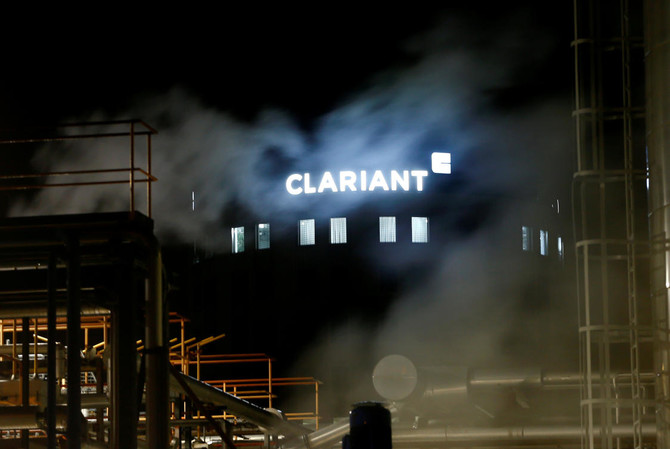
Sabic buys quarter of Clariant as activists cash in

Acwa signs key terms to develop 5GW of renewable energy capacity in Turkiye
JEDDAH: Saudi utility giant Acwa has signed key investment agreements with Turkiye’s Ministry of Energy and Natural Resources to develop up to 5 gigawatts of renewable energy capacity, starting with 2GW of solar power across two plants in Sivas and Taseli.
Under the investment agreement, Acwa will develop, finance, and construct, as well as commission and operate both facilities, according to a press release.
The program builds on the company’s first investment in Turkiye, the 927-megawatt Kirikkale Independent Power Plant, valued at $930 million, which offsets approximately 1.8 million tonnes of carbon dioxide annually, the statement added.
A separate power purchase agreement has been concluded with Elektrik Uretim Anonim Sirketi for the sale of electricity generated by each facility.
Turkiye aims to boost solar and wind capacity to 120GW by 2035, supported by around $80 billion in investment, while recent projects have already helped prevent 12.5 million tonnes of CO2 emissions and reduced reliance on imported natural gas.
Turkiye’s energy sector has undergone a rapid transformation in recent years, with renewable power emerging as a central pillar of its strategy.
Raad Al-Saady, vice chairman and managing director of ACWA, said: “The signing of the IA (implementation agreement) and PPA key terms marks a pivotal moment in Acwa’s partnership with Turkiye, reflecting the country’s strong potential as a clean energy leader and manufacturing powerhouse.”
He added: “Building on our long-standing presence, including the 927MW Kirikkale Power Plant commissioned in 2017, this step elevates our partnership to a new level,” Al-Saady said.
In its statement, Acwa said the 5GW renewable energy program will deliver electricity at fixed prices, enhancing predictability for grid planning and supporting long-term industrial investment.
By replacing imported fossil fuels with domestically generated clean energy, the initiative is expected to reduce Turkiye’s exposure to global energy market volatility, strengthening energy security and lowering long-term power costs.
The company added that the economic impact will extend beyond the anticipated investment of up to $5 billion in foreign direct investment, with thousands of jobs expected during the construction phase and hundreds of high-skilled roles created during operations.
The energy firm concluded that its existing progress in Turkiye reflects a strong appreciation for Turkish engineering, construction, and manufacturing capacity, adding that localization has been a strategic priority, and it has already achieved 100 percent local employment at its developments in the country.


