Erupting Philippine volcano still swelling with magma below

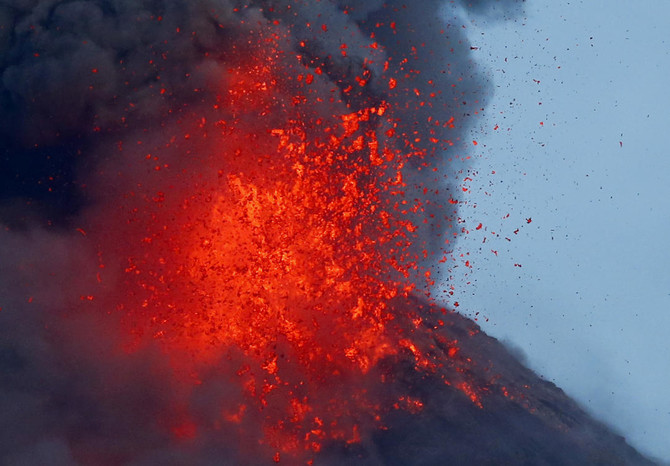
Mayon volcano spews molten lava during its sporadic eruption early Thursday, Jan. 25, 2018 as seen from a village in Legazpi city, Albay province, around 340 kilometers (200 miles) southeast of Manila, Philippines. The Philippine Institute of Volcanology and Seismology said the volcano that’s been erupting for almost two weeks still appears to be swelling with magma under the surface. More than 74,000 people are staying in dozens of emergency shelters as Mount Mayon continues to belch lava, ash and superheated gas and rocks. (AP/Bullit Marquez)
Updated 25 January 2018
Follow

Erupting Philippine volcano still swelling with magma below

LEGAZPI, Philippines: A volcano that’s been erupting for almost two weeks in the Philippines still appears to be swelling with magma under the surface, scientists said Thursday.
More than 74,000 people are staying in dozens of emergency shelters as Mount Mayon continues to belch lava, ash and superheated gas and rocks. Officials are worried the eruption may last months, affecting the education, health and livelihoods of people in its shadow.
The Philippine Institute of Volcanology and Seismology said tremors, pyroclastic flows and emissions of sulfur dioxide were detected Wednesday and early Thursday.
Lava erupting up to 500 meters (1,640 feet) high was spilling down the slope, with one lava flow extending 3 kilometers (1.8 miles) from the crater. Ash plumes still rising up to 5 kilometers (3 miles) high have spread ash onto farms and towns nearby, darkening the skies and forcing villagers to wear masks.
The institute said GPS and other measurements indicated a sustained swelling or inflation of the mountain surface, which was consistent with magma rising and creating pressure.
The alert level for Mayon remains four on a scale of five, indicating a violent eruption may be imminent.
There have been no reports of injuries, but law enforcers have struggled to keep villagers and tourists from sneaking into the danger zone, which extends 8 kilometers from the crater.
Although Mayon, in northeastern Albay province, has erupted about 50 times in the last 500 years, it has remained popular among climbers and tourists.
In 2013, an ash eruption killed five climbers who had ventured near the summit despite warnings.
The Philippines has about 22 active volcanoes. The explosion of Mount Pinatubo in 1991 was one of the biggest volcanic eruptions of the 20th century, killing hundreds.


China foreign minister blasts Middle East war, urges US to manage ties

Updated 57 min 3 sec ago
Follow

China foreign minister blasts Middle East war, urges US to manage ties

  • Wang Yi: ‘A strong fist does not mean strong reason. The world cannot return to the law of the jungle’

BEIJING: China’s top diplomat condemned on Sunday the war in the Middle East and urged the United States to iron out its differences with Beijing.
Foreign Minister Wang Yi told a press conference in the Chinese capital that the war, which was sparked by US and Israeli strikes on Iran, “should never have happened.”
“A strong fist does not mean strong reason. The world cannot return to the law of the jungle,” he told reporters.
He was speaking during China’s annual political gathering, which began this week, known as the “Two Sessions.”
The parallel meetings of China’s parliament and political consultative body are closely watched for clues as to the priorities of top leaders, in the face of a precarious geopolitical landscape
Wang addressed a range of issues, including a trade war with the United States, regional tensions in the South China Sea, as well as wars in the Middle East and Ukraine.
“This year is indeed a big year for Sino-US relations,” Wang said.
‘Manage differences’
Ties between China and the United States have been strained since US President Donald Trump returned to the White House last year, followed by a trade war that saw the two countries impose tit-for-tat tariffs on each other’s products.
“We observe certain country erecting tariff barriers and pursuing decoupling and supply chain disruption,” Wang said on Sunday.
“These actions are akin to trying to extinguish a fire with fuel. Ultimately, they will backfire and harm itself.”
While China and the United States “cannot change each other,” he said, “we can change the way we interact with each other.”
Wang urged both sides to “create a suitable environment, manage existing differences, and eliminate unnecessary interference.”
But a wide range of disagreements remain.
Beijing has blasted US and Israeli military strikes on Iran, with which it has diplomatic and trade ties.
It has in particular condemned the killing of the country’s supreme leader Ayatollah Ali Khamenei.
Wang also maintained that China’s relations with Moscow, which have been criticized by Western countries for sustaining the war in Ukraine, remained “steadfast and unshakeable.”
China ‘gym’
China has sought to profit off Trump’s volatile foreign policies, positioning itself as a reliable alternative to once traditional US allies.
Leaders from France, Canada, Finland and the United Kingdom, among others, have flocked to Beijing, recoiling from Trump’s bid to seize Greenland and tariff threats against fellow NATO members.
Wang welcomed the visits on Sunday, saying “we have noticed that more and more insightful Europeans agree that China is not a competitor, but a global partner.”
“We welcome our European friends to step out of the ‘small attic’ of protectionism and come to the ‘gym’ of the Chinese market, where they can strengthen their muscles and enhance their competitiveness,” he said.
In the spirit of warming relations, China has doled out visa-free travel agreements to around 50 countries including France, Germany, and the United Kingdom.
Beijing has also agreed to reduced tariffs with Ottawa and London in their exports to China.
Wang also addressed relations between China and Japan, which have been locked in a spat after comments by Prime Minister Sanae Takaichi in November that Tokyo could intervene militarily in any attack on self-ruled Taiwan.
Takaichi’s comments enraged Beijing, which views Taiwan as its territory and has not ruled out taking by force.
Wang emphasized on Sunday that Beijing “will never allow anyone or any force to separate Taiwan … from China once again.”
He warned Japan against “repeating the same disastrous mistakes,” adding that China “will never allow anyone to stand up for colonialism,” in an apparent reference to Tokyo’s actions during World War II.
The issue of Taiwan, he insisted, is “at the heart of China’s core interests” and “a red line that must not be crossed or trampled on.”