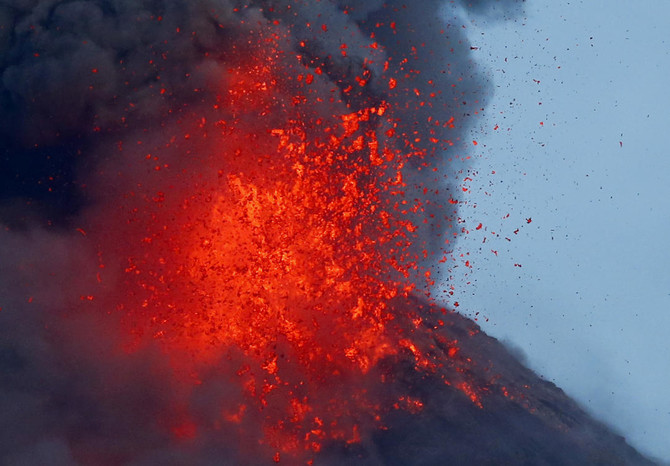
LEGAZPI, Philippines: A volcano that’s been erupting for almost two weeks in the Philippines still appears to be swelling with magma under the surface, scientists said Thursday.
More than 74,000 people are staying in dozens of emergency shelters as Mount Mayon continues to belch lava, ash and superheated gas and rocks. Officials are worried the eruption may last months, affecting the education, health and livelihoods of people in its shadow.
The Philippine Institute of Volcanology and Seismology said tremors, pyroclastic flows and emissions of sulfur dioxide were detected Wednesday and early Thursday.
Lava erupting up to 500 meters (1,640 feet) high was spilling down the slope, with one lava flow extending 3 kilometers (1.8 miles) from the crater. Ash plumes still rising up to 5 kilometers (3 miles) high have spread ash onto farms and towns nearby, darkening the skies and forcing villagers to wear masks.
The institute said GPS and other measurements indicated a sustained swelling or inflation of the mountain surface, which was consistent with magma rising and creating pressure.
The alert level for Mayon remains four on a scale of five, indicating a violent eruption may be imminent.
There have been no reports of injuries, but law enforcers have struggled to keep villagers and tourists from sneaking into the danger zone, which extends 8 kilometers from the crater.
Although Mayon, in northeastern Albay province, has erupted about 50 times in the last 500 years, it has remained popular among climbers and tourists.
In 2013, an ash eruption killed five climbers who had ventured near the summit despite warnings.
The Philippines has about 22 active volcanoes. The explosion of Mount Pinatubo in 1991 was one of the biggest volcanic eruptions of the 20th century, killing hundreds.

Erupting Philippine volcano still swelling with magma below
South Sudan officers face court martial over civilian massacre
- The increasingly unstable country is seeing a surge of fighting between government and opposition forces
JUBA: South Sudanese soldiers, including two officers, will face a court martial over a civilian massacre last month, the army spokesman said Wednesday.
The increasingly unstable country is seeing a surge of fighting between government and opposition forces, much of it in eastern Jonglei state where at least 280,000 people have been displaced since December according to the UN.
At least 25 civilians, including women and children, were killed in Ayod County in Jonglei state on February 21, according to the opposition.
Army spokesman Lul Ruai Koang said that two officers, including a major, and several non-commissioned officers, had been arrested and would face charges in the capital Juba, “before they are arraigned before a competent military court martial.”
He said the deaths were attributed to “some elements” under Gen. Johnson Olony, who was filmed in January ordering troops to “spare no lives” in Jonglei.
Koang said the soldiers had “moved out without the knowledge or authorization of the division commander.”
He also said they had been part of a militia group allied to opposition forces, parts of which had not yet been fully integrated into the army.
Military integration was among the core principles of a peace agreement that ended South Sudan’s five-year civil war in 2018 between President Salva Kiir and his long-time rival, Riek Machar, but it was never implemented.
Koang said the army regretted the loss of lives, adding: “We would like to once again remind our forces that their mandate is to protect civilians and their property, not to do the opposite.”
It followed an impassioned plea from the Sudan and South Sudan Catholic Bishops’ Conference on recent civilian killings — in Ayod, and also in Abiemnom County near the Sudan border where at least 169 people were killed on Sunday.
“We implore you to deploy resources to protect vulnerable populations and foster a climate of dialogue and reconciliation instead of violence and revenge, consoling the bereaved and supporting the afflicted,” it said in a statement.