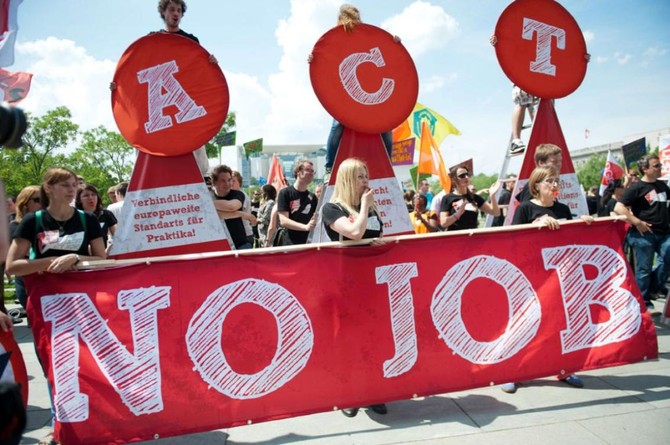
WASHINGTON: Declining incomes for European youth since the global financial crisis are dimming their prospects, and IMF chief Christine Lagarde on Wednesday urged governments to take action to ensure they do not fall further behind.
A new International Monetary Fund study showing that while average income inequality in the EU “has remained broadly stable there since 2007,” Lagarde said the data reveal “a worrying trend: the gap between generations in Europe has widened significantly.”
“Working-age people, and especially the young, are falling behind. Without action, a generation may never be able to recover,” Lagarde said in a blog post that accompanied the release of the report.
Strong European safety nets helped older workers, whose pensions were also protected, but incomes for young people declined due to high unemployment, which spiked to 24 percent in 2013, and one-in five are still looking for work.
IMF research shows that an employment gap can lead to longer-term wage loss or “scarring” that erodes potential earnings, she said. A worker with less experience is less likely to find a job, and those lost wages cannot be saved.
“Wages not earned and savings not put aside can be extremely difficult, if not impossible, to recover later in a person’s career,” she warned.
That gap also can lead to rising levels of poverty among younger workers.
The solution, Lagarde said, is replicating policies such as those used in Germany and Portugal, including apprenticeship and training programs, and exempting first-time job holders from social security taxes for three years.
Measures to “create jobs and incentivize work” could include reducing taxes on low-wage workers, investing in education and training, and protecting younger workers with unemployment and non-pension benefits, she said.
Another strategy would be to focus on wealth taxes, which she said are lower today than they were in 1970, including inheritance taxes, to fund programs for younger citizens.
“Let me underline again: this is not about one age group versus another,” Lagarde said. “Building an economy that works for young people creates a stronger foundation for everyone” since young people with jobs with productive contribute to social safety nets.
“We can help heal the scars of the crisis.”

IMF’s Lagarde urges action to improve prospects for EU youth
CMA CGM, global carriers suspend Gulf transits on security fears
RIYADH: Shipping and logistics across the Middle East were disrupted after major carriers halted routes and ordered vessels to seek shelter following joint US-Israeli attacks on Iran and Tehran’s warning restricting transit through the Strait of Hormuz.
At least 150 tankers, including crude oil and liquefied natural gas vessels, dropped anchor in open Gulf waters beyond the Strait of Hormuz, while dozens more were stationary on the other side of the chokepoint, shipping data showed on March 1, Reuters reported.
The tankers were clustered in open waters off the coasts of major Gulf oil producers, including Iraq and Saudi Arabia, as well as LNG giant Qatar, according to Reuters estimates based on ship-tracking data from the MarineTraffic platform.
This comes as French shipping giant CMA CGM instructed vessels operating in the Gulf to move to safe shelter and suspended some Suez Canal transits as security risks escalated along one of the world’s busiest trade routes.
The Strait of Hormuz, a narrow waterway between Iran and Oman, is one of the world’s most critical energy chokepoints, carrying about 30 percent of global oil supplies along with significant volumes of liquefied natural gas.
The world’s third-largest container line said all vessels currently inside or bound for the Persian Gulf had been instructed to proceed immediately to safe shelter, while certain canal transits were halted until further notice and ships were rerouted via the Cape of Good Hope, according to a statement.
The precautionary move comes as shipping companies reassess operations across the region following military strikes and retaliatory attacks that have heightened security risks along critical maritime corridors linking Asia, Europe, and the Middle East.
“This decision is dictated by safety considerations and is made in compliance with our Bill of Lading Terms and Conditions,” the statement said.
It added: “Customers will be contacted as soon as we have more details of the possible alternative ports where their cargo could be discharged.”
The UK Maritime Trade Operations warned that the regional maritime security environment remains unstable, citing heightened military activity across key shipping lanes.
“The maritime security environment across the Arabian Gulf, Gulf of Oman, North Arabian Sea, Bab al Mandab and the Strait of Hormuz remains highly volatile, with ongoing regional military activity contributing to an elevated threat to commercial shipping,” UKMTO said in an advisory.
The agency added that mariners should expect disruption to navigation and communications systems.
UKMTO said there is “significant military presence and activity across the region” and warned vessels of an increased risk of miscalculation or misidentification near sensitive maritime infrastructure.
Despite circulating reports, the agency said “no official closure of the Strait of Hormuz has been formally communicated to the maritime industry through recognized maritime safety channels.”
Separately, Japanese shipping companies have also begun restricting movements near the Strait of Hormuz, Reuters reported.
Nippon Yusen instructed vessels to halt transit in the area on Feb. 28, while Mitsui O.S.K. Lines said its ships were remaining in safe waters, citing crew and cargo safety as its top priority.
Kawasaki Kisen Kaisha said several of its vessels in the Persian Gulf were placed on standby, noting that, unlike other maritime routes, there are limited diversion options for ships operating near the strait.
“Until the situation stabilizes, we will not attempt to send vessels through the strait, nor dispatch additional ships towards the area,” a spokesperson said.
German shipping group Hapag-Lloyd has also suspended all vessel transit through the Strait of Hormuz until further notice because of the evolving security situation, it said.
This comes as a Palau-flagged oil tanker was hit off Oman’s Musandam peninsula on March 1, injuring four crew members, the country’s Maritime Security Centre said, following drone strikes on the Gulf nation’s commercial port of Duqm, Reuters reported.
The incidents mark the first time targets in or near Oman have been struck since Tehran launched retaliatory attacks across Gulf states after joint US-Israeli strikes on Iran.
The 20-member crew of the Skylight tanker was evacuated after the attack, which occurred about five nautical miles north of Khasab Port in Musandam, according to the maritime authority in a post on X. The centre did not specify what hit the vessel but said four crew members, among them 15 Indian and five Iranian nationals, suffered injuries of varying severity.
Oman’s Musandam peninsula shares control of the Strait of Hormuz with Iran, a strategic chokepoint through which roughly one-fifth of global oil consumption passes.
Earlier in the day, Oman’s state news agency reported that Duqm commercial port was struck by two drones, injuring one expatriate worker. Debris from another drone fell near fuel storage tanks, though no additional casualties or material damage were recorded.