

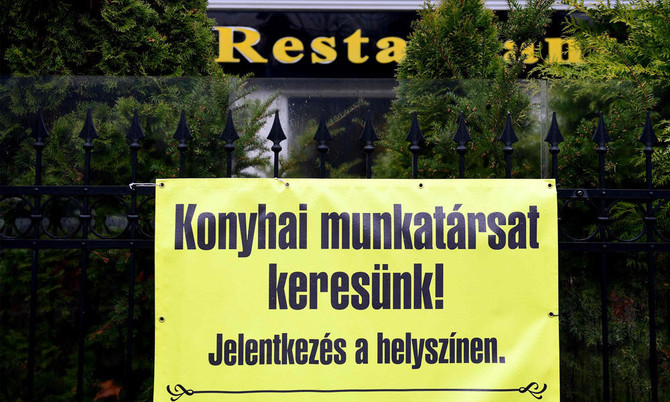
BUDAPEST, Hungary: A decade ago, business was booming for Hungarian construction firm owner Geza Borgulya.
He was making an annual profit of some five million euros ($5.4 million) and had around 60 staff including surveyors and bricklayers.
Now, the 44-year-old has barely a dozen employees left.
“I’m glad if I make a million in earnings,” he told AFP in the central town of Rackeve.
Borgulya largely blames the decline on Hungarian workers heading to neighboring Austria where wages are significantly higher.
“Those who work in western Europe easily earn 70 euros a day, we can’t keep up with that here,” said Borgulya.
Once an eldorado of cheap labor, companies in eastern and central Europe are struggling to fill thousands of jobs as workers up sticks and head to wealthier EU nations.
A staggering 20 million people have moved from the region to western Europe since the early 1990s, many of them headed for Germany and Britain, according to the International Monetary Fund (IMF).
The exodus, coupled with low birth rates and rapidly aging populations, has left gaping holes in job markets across the region.
From health care and computer technologies to manufacturing and food industries, few sectors have been exempt from the drought.
The diaspora, which began with the fall of the Iron Curtain, was exacerbated by ex-communist countries’ accession to the EU and the financial crisis.
Some 400,000 Hungarians have emigrated from the nation of 10 million since 2008, official figures show.
“I have lost at least twelve people over the past three years, who have gone to England, Austria and Sweden,” said a restaurant owner in Budapest, who did not want to be named.
Hospitals suffer
The situation is even more acute in neighboring Romania, the EU’s second-poorest country after Bulgaria.
Three million Romanians, or 15 percent of the population, have left in recent years, with a majority of working age. Hospitals are particularly hard hit.
“We don’t know what to do anymore to attract new recruits,” said Ionela Danet, who runs a hospital in the city of Curtea de Arges in southern Romania.
She has been trying to hire at least 20 doctors.
“We have state-of-the-art equipment, we’re on a tourist route, the region is beautiful and not far from Bucharest. Yet no one’s applying,” Danet told AFP.
The exodus from the region has “exacerbated shortage” of labor and “lowered potential growth” in workers’ home countries, the IMF found in a report last year.
It’s also forced companies to bump wages, increasing costs without boosting productivity.
Although eastern and central states have the EU’s fastest-growing economies and unemployment rates are relatively low, employers fear that the labor shortage will soon turn into a serious obstacle for foreign investment.
While the Czech Republic has 140,000 vacant jobs primarily in the manufacturing sector, car-making hub Slovakia needs technicians while Bulgaria is desperate for engineers.
“Large companies are worried that if the issue isn’t resolved, it will create... insuperable problems for their future projects,” Bulgaria’s economy ministry warned this month.
Generous perks
To remedy the situation, corporations are trying to lure back workers with generous perks.
In Hungary, burger giant McDonald’s is offering free accommodation to out-of-town staff, while cashiers can earn close to 1,000 euros at German budget supermarket chain Lidl — a salary equivalent to that of an expert in chemical engineering.
Meanwhile Polish companies have turned to foreign workers from Ukraine to help fill the void left by the recent departure of some 2.4 million nationals.
An estimated one million Ukrainians are residing in Poland, making up a large chunk of restaurant and shop employees in the capital Warsaw.
“Without the Ukrainians, the Polish economy would be in deep trouble, particularly regarding less skilled positions,” said Maciej Witucki, president of Work Service, one of Poland’s largest employment agencies.
However emigration isn’t the only cause for the labor drought.
A lack of investment in education and training has also left tens of thousands of young people without formal skills or employment.
In response, governments have rolled out apprentice schemes and teamed up with private businesses to draw recruits, in the hope that they’ll take up domestic jobs.
The EU plans to toughen migrant labor rules and Britain’s decision to quit the bloc might also drive down the number of arrivals.
Following last year’s so-called “Brexit” vote — spurred by a divisive debate on immigration — eastern workers face an uncertain future in Britain.
Until now, only a modest fraction of them have returned home, according to IMF data, but that could change in the coming years.


