UNITED NATIONS, United States: Russia rejected Tuesday fresh US accusations that it bears responsibility for recent chemical attacks by the Syrian government, calling instead fora new “truly impartial” international investigation.
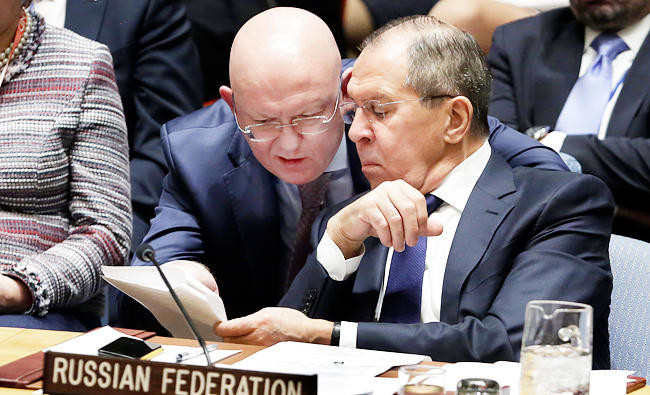
During a last-minute United Nations Security Council meeting he called, Russian envoy Vassily Nebenzia lashed out at American Secretary of State Rex Tillerson for having “hastily accused the Syrian — as they call it — ‘regime’” of the reported attack in Eastern Ghouta that left its victims struggling to breathe.
“Now they are trying to drag Russia into this as well,” Nebenzia added.
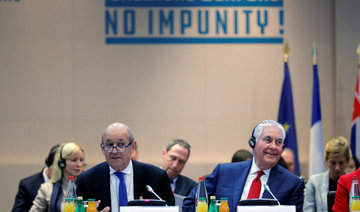
His comments came as diplomats from 29 countries met in Paris to push for sanctions and criminal charges against the perpetrators of chemical attacks in Syria.
Russia and China have blocked Western-backed efforts at the UN to impose sanctions on Damascus over their use.
“Does it not seem strange to anybody that this episode — the episode of which has yet to be confirmed — somehow coincided with the meeting in Paris and the forthcoming conference in Sochi? This is a strange coincidence,” Nebenzia added.
During the Security Council meeting, Nebenzia called again for establishing a “new international investigative body which, on the basis of irrefutable information, would be able to establish evidence to identify perpetrators in the use of chemical weapons.”
His plan would replace a chemical weapons panel known as the Joint Investigative Mechanism, whose mandate could not be renewed due to Russian vetoes.
Moscow is also circulating a draft resolution that would establish the new investigative body that would be “truly impartial, independent, professional and credible.” Russia has repeatedly contested the JIM’s legitimacy.
US envoy Nikki Haley quickly indicated the Russian proposal had no chance of being adopted. The United States also holds veto power at the Security Council.
“We’re not going to accept any Russian proposal that undermines our ability to get to the truth or that politicizes what must be an independent and impartial investigation,” she said.
“If they want to work in good faith toward that goal, we are ready to re-establish the JIM, with its original independent and impartial mandate, right now. But anything less is unacceptable.”
She argued that Moscow had supported the JIM as long as its investigators pointed the finger at the so-called Daesh group, but challenged their conclusions when they blamed the Syrian regime.
“That is not how independent investigations work. You don’t get to question the findings when they don’t go your way,” Haley said.
Damascus has been repeatedly accused of using chemical weapons, with the United Nations among those blaming government forces for an April 2017 sarin gas attack on the opposition-held village of Khan Sheikhun that left scores dead.
There have been at least 130 separate chemical weapons attacks in Syria since 2012, according to French estimates, with the Daesh group also accused of using mustard gas in Syria and Iraq.
A new round of peace talks is due to take place in Vienna on Thursday and Friday, while Moscow has organized negotiations in the Russian city of Sochi next week aimed at ending Syria’s civil war.


![]()
Russia says it’s not behind Syria chemical attacks
Russia says it’s not behind Syria chemical attacks

Latest updates


© 2026 SAUDI RESEARCH & PUBLISHING COMPANY, All Rights Reserved And subject to Terms of Use Agreement.