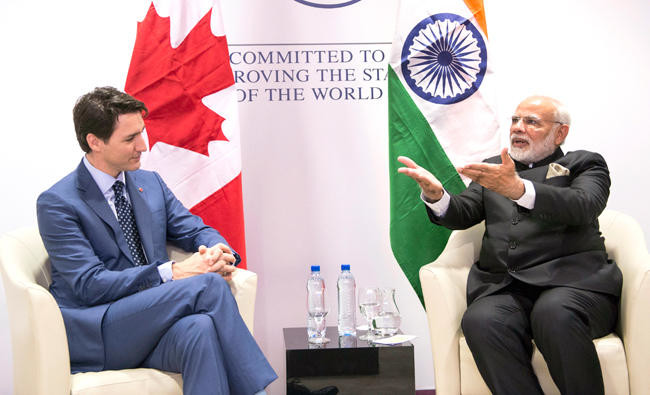
DAVOS: Indian Prime Minister Narendra Modi kicked off the opening of the World Economic Forum (WEF) in Davos with a rallying cry for free trade and a warning against the threat posed by climate change.
In the first address at Davos by an Indian leader for two decades, he talked of the need for “creating a shared future in a fractured world” — with a warning that technological changes “can create fault lines that can inflict a very painful wound,” — ticking the box marked “fourth industrial revolution,” the core of the WEF cannon.
But he also sprang to the defense of global free trade and laissez-faire economics with a reference to the “forces of protectionism” in a thinly veiled hit at US President Donald Trump, who is expected to expound his “America First” message on Friday.
“The solution to this worrisome situation against globalization is not isolation. Its solution is in understanding and accepting change,” he said. Modi ranked protectionism among the three biggest challenges to global stability, along with climate change and terrorism.
Indeed, the specter of Trump — due on Friday — loomed everywhere on the first day. Prime Minister Justin Trudeau of Canada — one of the WEF’s favorites for a number of reasons, not least his physical and philosophical contrast to the American — took the opportunity of his special address to announce that Canada and 10 trade partners had signed an agreement to advance the Trans-Pacific Partnership, the trade treaty Trump renounced as one of his first acts in office.
Like Modi, he too linked protectionism with the other challenges the WEF perceives: Technological disruption, gender inequalities and climate change.
Norwegian Prime Minister Erna Solberg struck a note familiar with Saudi Arabian attendees at the WEF, when she called for a new global crackdown on global corruption.
“We need to see who is taking money, who is bribing others, and show that this is unacceptable in all our societies,” she said, proposing a #MeToo campaign against corruption, which she said was fueling terrorism and making it harder for emerging countries to develop their economies.
Middle East issues were on display at the meeting too, with behind-closed-doors sessions on the strategic condition of the region and geopolitics. Executives from Middle East corporations were involved in an apparently endless series of bilateral briefings.
Participants at the 48th annual meeting of the WEF had struggled through huge snow drifts and transport problems to get to the event.
At one stage, even the helicopters could not land — an event unprecedented for most WEF veterans.
But they did not let those wintry problems dim their enthusiasm for the basic message that Davos likes to hear: Liberal globalism in all its forms.


![]()
At Davos, Modi puts free trade first
At Davos, Modi puts free trade first


Latest updates




© 2026 SAUDI RESEARCH & PUBLISHING COMPANY, All Rights Reserved And subject to Terms of Use Agreement.