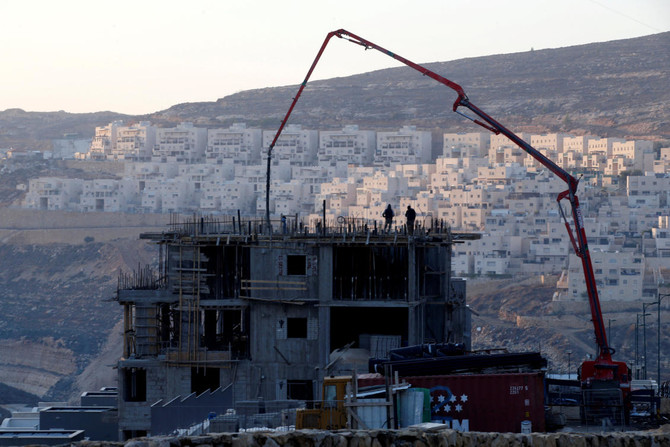
JERUSALEM: The Jewish population of the Israeli-occupied West Bank grew by 3.4 percent to 435,708 in 2017, the main organization representing the settlers said on Tuesday.
The figures, released by the Yesha Council, exclude the estimated 200,000 Israelis living in occupied and annexed east Jerusalem.
The overall number of Israeli citizens has been growing by an average of two percent annually.
A statement by the council welcomed the latest growth figures while lamenting what it called a “silent freeze” in construction of settler homes.
“The government announces construction in Judaea and Samaria but we do not see the results on the ground,” it said, using the Hebrew biblical term for the West Bank.
On January 11 authorities approved more than 1,100 new West Bank homes for Israelis, settlement watchdog Peace Now said.
That followed approval of 6,742 settler building projects last year, the NGO said, the highest figure since 2013.
Israel faced sharp criticism from the administration of former US president Barack Obama over settlement construction.
But that has not been the case under his successor Donald Trump, and Israeli officials have sought to take advantage.
The Yesha Council is made up predominantly of ultra-Orthodox Jews, who account for the overwhelming majority of residents of the two biggest settlements.
They are Modiin Ilit, west of Ramallah, with a population of 70,119, and Beitar Ilit, southwest of Jerusalem, with 56,485 inhabitants.
The ultra-Orthodox comprise about 10 percent of the overall Israeli population.
The third most populated settlement in the West Bank is Maaleh Adumim, east of Jerusalem, with a mixed population of 40,996 secular and religiously observant Jews.
Israeli settlements are seen as illegal under international law and major obstacles to peace as they are built on land the Palestinians see as part of their future state.
Prominent members of Netanyahu’s right-wing government openly oppose Palestinian statehood and the settler lobby has strong political influence.
Some 600,000 Israeli settlers live in the West Bank and annexed east Jerusalem in often confrontational proximity to nearly three million Palestinians.

West Bank Jewish numbers up 3.4% in 2017: settlers
Israel’s hostage forum releases AI-generated video of last Gaza captive
- The Gaza ceasefire, which came into effect in October, remains fragile with both sides alleging violations, and mediators fearing that Israel and Hamas alike are stalling
JERUSALEM: An Israeli group representing the families of Gaza hostages released on Tuesday an AI-generated video of Ran Gvili, the last captive whose body is still being held in the Palestinian territory.
The one-minute clip, created whole cloth using artificial intelligence, purports to depict Gvili as he sits in a Gaza tunnel and appeals to US President Donald Trump to help bring his body back to Israel.
“Mr President, I’m asking you to see this through: Please bring me home. My family deserves this. I deserve the right to be buried with honor in the land I fought for,” says the AI-generated image of Gvili.
Gvili was 24 at the time of Hamas’s October 7, 2023 attack on Israel.
He was an officer in Israel’s Yasam elite police unit and was on medical leave when he learnt of the attack.
He decided to leave his home and brought his gun to counter the Hamas militants.
He was shot in the fighting at the Alumim kibbutz before he was taken to Gaza.
Israeli authorities told Gvili’s parents in January 2024 that he had not survived his injuries.
The AI clip was released by the Hostages and Missing Families Forum, the main group representing those taken captive to Gaza.
The Forum said it was published with the approval of Gvili’s family.
“Seeing and hearing Rani speak in his own voice is both moving and heartbreaking. I would give anything to hear, see and hold him again,” Gvili’s mother Talik said, quoted by the Forum.
“But all I can do now is plead that they don’t move to the next phase of the agreement before bringing Rani home — because we don’t leave heroes behind.”
The Gaza ceasefire, which came into effect in October, remains fragile with both sides alleging violations, and mediators fearing that Israel and Hamas alike are stalling.
In the first stage, Palestinian militants were expected to return all of the remaining 48 living and dead hostages held in Gaza.
Since the ceasefire came into effect on October 10, militants have released 47 hostages.
In the next stages of the truce, Israel is supposed to withdraw from its positions in Gaza, an interim authority is to govern the Palestinian territory instead of Hamas, and an international stabilization force is to be deployed.
Israeli Prime Minister Benjamin Netanyahu is expected to meet Trump in Florida later this month to discuss the second phase of the deal.