HASSA,Turkey: The Turkish army on Tuesday clashed with Kurdish militia in Syria in an operation that has already left two of its soldiers dead, as the United States voiced alarm the offensive could endanger attempts to end the Syrian civil war.
Speaking at the funeral of the first of two Turkish soldiers to be killed so far in the four day cross-border campaign, President Recep Tayyip Erdogan vowed that Ankara would emerge victorious.
Turkey on Saturday launched operation "Olive Branch" aimed at rooting out the Kurdish People's Protection Units (YPG) militia, which Ankara sees as a terror group, from its Afrin enclave in northern Syria.
The campaign has caused ripples of concern among Turkey's NATO allies, especially the United States which is still working closely with the YPG to defeat Daesh militants in Syria.
In his strongest comments yet on the offensive, US Defense Secretary Jim Mattis called for Turkey to show "restraint" and warned it could harm the fight against the rebel group.
He warned the offensive "disrupts what was a relatively stable area in Syria and distracts from the international effort to defeat" Daesh, on a visit to Indonesia.
Turkish artillery on Tuesday pounded targets of the YPG inside Syria, the state-run Anadolu news agency said.
Meanwhile, Turkish drones were also carrying out attacks, state television said.
The Britain-based Syrian Observatory for Human Rights monitor said fighting was "very violent" northeast, northwest and southwest of Afrin.
The Observatory said the offensive took control of two villages so far.
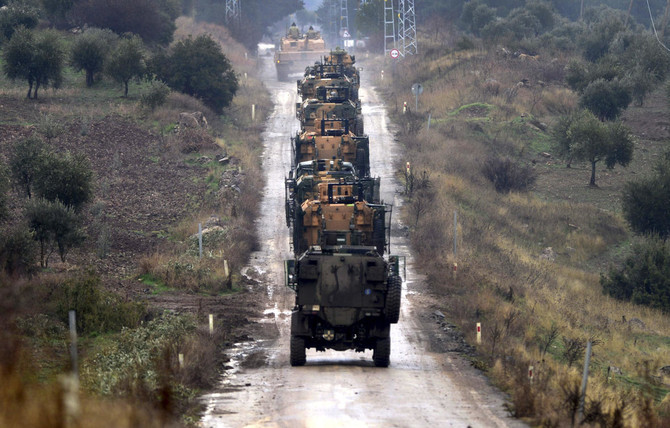
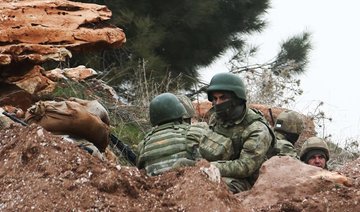
As well as the artillery and air strikes, Turkish ground troops and Ankara-backed Syrian rebels have punched over the border several kilometres (miles) into Syrian territory, taking several villages, according to state media.
After intense exchanges, Turkey's forces took control of the hill of Barsaya, a key strategic point in the Afrin region.
The Observatory said 43 Ankara-backed rebels and 38 Kurdish fighters had been killed in the fighting so far. It has also said 28 civilians have been killed on the Syrian side but this is vehemently rejected by Turkey which says it is only targeting militants.
Sergeant Musa Ozalkan, 30, the first Turkish military fatality of the operation, was laid to rest with full honours in a ceremony in Ankara attended by the Turkish leadership.
"We will win and reach victory in this operation together with our people, together with Free Syrian Army," Erdogan assured mourners, referring to the Ankara-backed rebels.
"We have full confidence," he added.
A second Turkish soldier was killed in Syria Tuesday in clashes with the YPG, the military said in a statement. He was named as First Lieutenant Oguz Kaan Usta.
The campaign -- which Erdogan has made clear has no fixed timetable -- is fraught with risks for Turkey.
Two civilians have been killed inside Turkey in border towns in the last two days by rocket fire from Syria blamed on the YPG.
"This operation will continue until the last terrorist is eliminated," Turkish Prime Minister Binali Yildirim said.
The leaders of the YPG-controlled enclave meanwhile announced a "general mobilisation", calling up civilians to defend Afrin against Turkish attack.
The offensive against the YPG is also fraught with diplomatic sensitivities with Western capitals particularly concerned that it will take the focus away from eliminating Daesh.
France and the European Union have made similar comments to those made by Mattis.
But Ankara has expressed impatience with such sentiments, arguing that the YPG is the Syrian offshoot of the Kurdistan Workers' Party (PKK) which has waged a bloody three-decade insurgency against the Turkish state.
Critical is the opinion of Russia, which has a military presence in the area and a cordial relationship with the YPG but is also working with Turkey to bring an end to the seven-year Syrian civil war.
Erdogan said Monday that the offensive had been agreed with Russia but this has not been confirmed by Moscow.
However many analysts argue that Turkey would never have gone ahead with the offensive without the Kremlin's blessing.
Turkey's previous incursion into Syria was the Euphrates Shield campaign in August 2016-March 2017, targeting both the YPG and Daesh in an area east of Afrin.
The Turkish security forces have meanwhile imposed a clampdown against anyone suspected of disseminating "terror propaganda" against the operation on social media.
Ninety-one people were detained in 13 provinces in Turkey, state media reported on Tuesday, after 24 people had been detained in other cities on Monday.

Turkey in deadly Kurdish militia clashes as US sounds alarm
Yemeni border security chief reveals drug smuggling networks linked to Houthis
- Al-Wadiah security force foils attempt by Houthi leader to enter Saudi Arabia using forged Umrah visa
- Col. Osama Al-Assad: Saudi security measures are strong, the level of vigilance is high, and we coordinate with them on smuggling cases that are being closely monitored
AL-WADIAH, Yemen: Most of the drug-smuggling networks from Yemen to Saudi territory are directly linked to the preventive security apparatus affiliated with the Houthi terrorist group.
This is according to Col. Osama Al-Assad, commander of Yemen’s Security and Protection Battalion at the Al-Wadiah border crossing.
Al-Assad told Asharq Al-Awsat that the battalion recently arrested a Houthi leader while he was trying to enter Saudi Arabia using a forged passport and Umrah visa, suggesting that the motives for his entry were of a security nature, and not to perform religious rites as he claimed.
Al-Assad said the battalion faced several patterns of smuggling attempts, foremost among them prohibited items, in addition to people smuggling, forgers, and persons of unknown identity.
But, he said, that the battalion’s high cumulative expertise enabled them to thwart these illegal activities.
Al-Assad added that the level of coordination with the Saudi side was conducted at the highest levels. He expressed gratitude to the Kingdom for its continuous support to Yemen in general, and to the battalion in particular, in a manner that contributed to strengthening border security between the two countries.
He said the battalion’s mission was focused on securing and protecting the crossing, and combating various forms of smuggling, whether prohibited items or people smuggling, noting that the battalion apprehended about 10 people a day in possession of forged Umrah visas.
Al-Assad said that the battalion’s security coverage extended to “the crossing and its surroundings for a distance of 30 km westward up to the borders of Al-Rayyan in Al-Jawf.”
He added that among the battalion’s tasks was to arrest wanted members of Al-Qaeda, in addition to persons fleeing the implementation of judicial rulings issued against them.
He said the majority of smuggling operations were directly linked to the preventive security apparatus of the Houthi group in Sanaa, explaining that investigations with the detainees revealed direct connections to this apparatus.
Al-Assad said that “during one operation to stop a smuggling vehicle, a network linked to the Houthis offered a sum of SR1 million ($266,650) in exchange for releasing only the smuggler, while relinquishing the vehicle and the confiscated goods.”
Investigations revealed that smugglers affiliated with the Houthi preventive security apparatus held meetings in the border areas with Oman, indicating that some secret meetings were held in the city of Al-Ghaydah in the Al-Mahra Governorate (eastern Yemen).
He said that a man called Ali Al-Harizi had strong connections to smuggling operations and was considered a leader in this network.
“Saudi security measures are strong, the level of vigilance is high, and we coordinate with them on smuggling cases that are being closely monitored,” he said
He thanked the Kingdom for the “efforts and sacrifices it is making to restore the Yemeni state, combat Persian expansionism, and sever the arms of Iran and its supporters inside Yemen.”
He added: “We particularly appreciate the Kingdom’s backing for the Al-Wadiah security battalion through the support it provides at the logistical, financial, and other levels, which positively reflects on the battalion’s performance and its security tasks.”
Al-Assad revealed that the Al-Wadiah protection battalion recently arrested a Houthi commander who was trying to enter Saudi Arabia with a forged Umrah visa, describing the arrest operation as “dramatic.”
He said: “About a month and a half ago, one of the battalion members recognized the Houthi commander, as the soldier himself was a former prisoner of the Houthis. When he saw him, he asked him: ‘Where to, Abu Assad?’ The Houthi commander was startled and replied fearfully: ‘I’m at your mercy. Watch out for me, and you can have whatever you want.’”
He added: “The soldier firmly replied: ‘You will not advance a single step,’ and he was immediately arrested.”
According to Al-Assad, the Houthi commander was a communications officer in the Central Security prison in Sanaa and was using a forged passport issued by the Houthi-controlled areas themselves.
Al-Assad said Al-Wadiah Battalion also arrested four other Houthi operatives at different times, in addition to apprehending 15 murder suspects. A suspect believed to be affiliated with the terrorist organization Al-Qaeda was also detained.
He said that the Houthi group, acting as an Iranian proxy, had moved toward establishing drug-production facilities in Sanaa and Saada following the fall of the Bashar Assad regime in Syria.
He said Yemen’s Ministry of Interior foiled, several months ago, a drug factory in Al-Mahrah Governorate.
“According to available intelligence, the factory was under the direct supervision of Al-Harizi, with a production capacity of approximately 10,000 pills per hour,” he said.
Al-Assad noted that “the facility was seized after intensive surveillance and precise intelligence operations,” and that “security agencies continue to monitor and investigate the case to uncover further details and links.”
The most significant challenges facing the unit are limited resources and capabilities, he said, underlining that operations rely primarily on manual effort and human expertise.
“Our personnel have years of accumulated experience that enable them to identify suspicion even from the way a person speaks or from subtle features of a vehicle,” he said. “We have requested the provision of heavy machinery and equipment to establish an earthen security belt and to dig trenches to curb internal smuggling activities.”
Of smuggling methods, he said that trafficking networks constantly changed and refined their techniques, yet security forces remained vigilant. “In some cases, smugglers modify the vehicle itself, hiding contraband in the dashboard, beneath seats, between the roof and interior lining, inside pillars, and even in public transport buses, where prohibited items are concealed in places one would never expect,” he said.
“On one occasion, they dismantled the vehicle’s frame, opened the metal rocker panel at the base, hid the goods inside, and then welded everything back together.”
Al-Assad emphasized that operations at the Al-Wadiah border post were characterized by a high level of integration and coordination among all relevant agencies, foremost among them the National Shield Forces, alongside passport and customs authorities, an approach that significantly enhanced the effectiveness of joint security efforts.