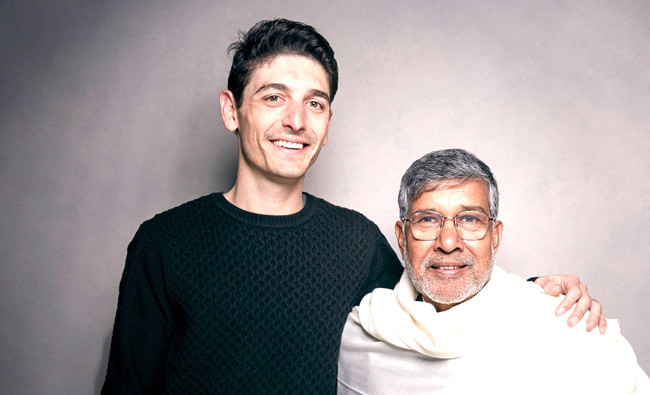
NEW YORK: Forget jargon-filled monologues, raids to rescue enslaved Indian children inject drama into a documentary about Nobel Laureate Kailash Satyarthi, who hopes the film will inspire viewers to play a part in the global fight to eradicate modern slavery.
“Kailash,” which premiered last week at the US-based Sundance Film Festival, charts Satyarthi’s rise from domestic anti-trafficking figurehead to Nobel Peace Prize winner.
Satyarthi, 64, whose charity Bachpan Bachao Andolan has been credited with freeing at least 80,000 child slaves in India over 30 years, said the film might shock audiences and spur them to take action such as refusing to buy goods made with slave labor.
“Many people have never thought that slavery still exists in its cruelest form,” Satyarthi told the Thomson Reuters Foundation by phone from Sundance, the independent film industry’s premiere US gathering — now in its 33rd year.
“I always feel that consciousness-raising is the first step to societal change,” added Satyarthi, joint winner of the 2014 Nobel Peace Prize with Pakistani schoolgirl Malala Yousafzai.
In an early scene of the documentary, one of many filmed with handheld cameras, activists working under Satyarthi’s lead storm into a New Delhi apartment housing several child laborers. After one campaigner breaks down a padlocked door, his frantic colleague eventually unearths stunned-looking children from under piles of plastic bags where they had been hidden.
Filmmaker Derek Doneen spent two years shooting scenes with Satyarthi’s team, which the American director said had enabled him to avoid making a film dominated by data and talking heads.
“I didn’t want to make the sad child-slavery movie that you see and maybe it affects you but you don’t want to ... talk about it because it’s too heavy,” said the Kailash director.
Countless children across India are trafficked and enslaved every year — either forced to work or sold into sexual slavery.
About 60 percent of the more than 23,000 trafficking victims rescued in India were children in 2016, government data shows.
But activists say slavery figures are hugely underestimated in the socially-conservative society, where the fear of being blamed, shamed or stigmatized means victims and their families often keep quiet and choose not to report the abuses they face.
Worldwide, about 10 million children were living as modern slaves last year — either trapped in forced labor or forced marriages — according to the United Nations International Labor Organization and human rights group Walk Free Foundation.

Nobel laureate Satyarthi’s film exposes India child slavery
Arts festival’s decision to exclude Palestinian author spurs boycott
- A Macquarie University academic who researches Islamophobia and Palestine, Abdel-Fattah responded saying it was “a blatant and shameless act of anti-Palestinian racism and censorship,” with her lawyers issuing a letter to the festival
SYDENY: A top Australian arts festival has seen the withdrawal of dozens of writers in a backlash against its decision to bar an Australian Palestinian author after the Bondi Beach mass shooting, as moves to curb antisemitism spur free speech concerns.
The shooting which killed 15 people at a Jewish Hanukkah celebration at Sydney’s Bondi Beach on Dec. 14 sparked nationwide calls to tackle antisemitism. Police say the alleged gunmen were inspired by Daesh.
The Adelaide Festival board said last Thursday it would disinvite Randa Abdel-Fattah from February’s Writers Week in the state of South Australia because “it would not be culturally sensitive to continue to program her at this unprecedented time so soon after Bondi.”
FASTFACTS
• Abdel-Fattah responded, saying it was ‘a blatant and shameless act of anti-Palestinian racism and censorship.’
• Around 50 authors have since withdrawn from the festival in protest, leaving it in doubt, local media reported.
A Macquarie University academic who researches Islamophobia and Palestine, Abdel-Fattah responded saying it was “a blatant and shameless act of anti-Palestinian racism and censorship,” with her lawyers issuing a letter to the festival.
Around 50 authors have since withdrawn from the festival in protest, leaving it in doubt, local media reported.
Among the boycotting authors, Kathy Lette wrote on social media the decision to bar Abdel-Fattah “sends a divisive and plainly discriminatory message that platforming Australian Palestinians is ‘culturally insensitive.'”
The Adelaide Festival said in a statement on Monday that three board members and the chairperson had resigned. The festival’s executive director, Julian Hobba, said the arts body was “navigating a complex moment.”
a complex and unprecedented moment” after the “significant community response” to the board decision.
In the days after the Bondi Beach attack, Jewish community groups and the Israeli government criticized Prime Minister Anthony Albanese for failing to act on a rise in antisemitic attacks and criticized protest marches against Israel’s war in Gaza held since 2023.
Albanese said last week a Royal Commission will consider the events of the shooting as well as antisemitism and social cohesion in Australia. Albanese said on Monday he would recall parliament next week to pass tougher hate speech laws.
On Monday, New South Wales state premier Chris Minns announced new rules that would allow local councils to cut off power and water to illegally operating prayer halls.
Minns said the new rules were prompted by the difficulty in closing a prayer hall in Sydney linked to a cleric found by a court to have made statements intimidating Jewish Australians.
The mayor of the western Sydney suburb of Fairfield said the rules were ill-considered and councils should not be responsible for determining hate speech.
“Freedom of speech is something that should always be allowed, as long as it is done in a peaceful way,” Mayor Frank Carbone told Reuters.