

UN readies aid as Turkey attacks Kurdish enclave in Syria

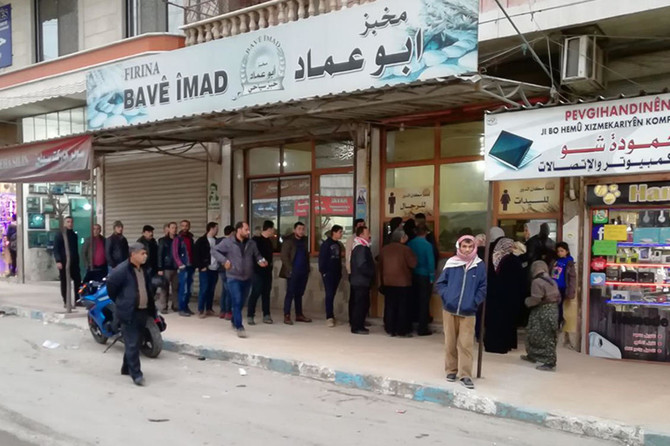
People stand in a queue to enter a bakery in the Syrian northwestern town of Afrin, located in a Kurdish region bordering Turkey, on January 22, 2018. The United Nations said it is ready to help people who might flee from the Afrin enclave, where Turkish troops are on the offensive against Kurdish fighters. (AFP)
Updated 22 January 2018
Follow

UN readies aid as Turkey attacks Kurdish enclave in Syria

DAMASCUS: The United Nations is ready to help people who might flee from the Afrin enclave, where Turkish troops are on the offensive against Kurdish fighters, the top UN official in Syria said Monday.
Ali Al-Za’tari told The Associated Press in his office in western Damascus that they are following the news but “it is still not clear” if people are fleeing the region.
On Saturday, Turkey began an offensive aimed at driving out a US-allied Kurdish militia, which Ankara views as a threat because of its links to Kurdish insurgents fighting in Turkey. Turkey says it aims to create a 30-kilometer (20-mile) deep “secure zone” in Afrin.
“If and when we have verification of people in need, wherever they move to we will be able to assist,” Al-Za’tari said.
Elsewhere in Syria, Al-Za’tari described conditions in the besieged rebel-held Damascus suburbs known as eastern Ghouta as “terrible,” saying that no aid has entered the area since December.
“Access sometimes is very difficult, or even near impossible because of ongoing fighting,” he said.
Government forces have been pounding eastern Ghouta for weeks, killing and wounding dozens of people. Insurgents have fired shells into Damascus, also killing and wounding dozens, including nine dead on Monday alone, including a three-year old child, according to hospital officials and state media.

Last month, Syria’s government allowed the evacuation of nearly 30 critically ill people from eastern Ghouta, where hundreds requiring medical treatment have been prevented from reaching hospitals minutes away.
Government forces had recently tightened their siege on the area, home to some 400,000 people, leading to severe shortages of food, fuel and medicine as winter set in, according to opposition activists.
“For people who are civilians I can only say that it’s quite difficult because the access that they have to basic necessities is rather constrained, the prices of commodities are high (and) medical services are low,” said Al-Za’tari. “We need to get assistance into Ghouta regardless of the control party or authority in that region.”
Al-Za’tari said there are currently about 500,000 people living in 10 besieged areas around Syria. He added that if those who are hard to reach are added, the figure rises to about 3 million.
The UN official said there are about 6 million Syrians who are internally displaced. Another 5 million have fled to neighboring countries.
“We don’t have yet the conducive environment for refugees to return to Syria,” Al-Za’tari said, citing difficulties related to security, documentation and housing.
He said the UN spent $1.7 billion in Syria last year through the humanitarian response plan. He said they plan to spend $3.5 billion this year.
One killed in attack on oil tankers off Iraq, rescue operation ongoing: authorities

Updated 7 sec ago
Follow

One killed in attack on oil tankers off Iraq, rescue operation ongoing: authorities

  • Iraq’s oil ministry said in a statement on Thursday it had “deep concern” about incidents involving oil tankers in the Gulf, without providing details

BAGHDAD: An attack on two oil tankers near Iraq killed at least one crew member, authorities said on Thursday, as Iran carries out a campaign to disrupt global energy markets.
Farhan Al-Fartousi, from Iraq’s General Company for Ports, told state television that one crew member had been killed and 38 rescued while the “search continues for the missing.”
He did not specify the crew members’ nationalities or provide details on who was behind the attack, which occurred roughly 50 kilometers (31 miles) from the coast.
The Iraqi government’s media cell told national news agency INA that “two tankers were subject to sabotage.”
Iraq’s oil ministry said in a statement on Thursday it had “deep concern” about incidents involving oil tankers in the Gulf, without providing details.
“The safety of navigation in international maritime corridors and energy supply routes must remain free from regional conflicts,” the ministry added.
The Strait of Hormuz — the waterway carrying a fifth of the world’s oil — remains closed to almost all oil tankers, and Iran has vowed that not one liter of oil would be exported from the Gulf while its war with the United States and Israel continues.
US President Donald Trump said Wednesday that US forces have struck 28 Iranian mine-laying vessels more than a week into the Middle East war.
Images of a ship at sea with plumes of smoke rising from a huge fire, were broadcast by state television channel Al-Ikhbariya. AFP could not verify the images.
An employee at Iraq’s Basra oil terminal told AFP that it was unclear “whether it was a drone attack or explosive-laden boats.”
The Iraqi State Organization for Marketing of Oil (SOMO) confirmed in a statement that two oil tankers were attacked, without providing details on how.
Maltese-flagged oil tanker ZEFYROS was attacked as it was preparing to enter the port of Khor Al-Zoubair, where it would have taken on board an additional 30,000 tons of liquid naphtha — primarily used in petrochemicals, SOMO said.
The second targeted vessel, SAFESEA VISHNU, was sailing under the Marshall Islands flag and was chartered by an Iraqi company, according to SOMO.
The incidents come just hours after the US embassy in Baghdad warned that Iran and Tehran-backed Iraqi armed groups might target US-owned oil facilities in Iraq.