Pakistani actress Saba Qamar breaks Bollywood

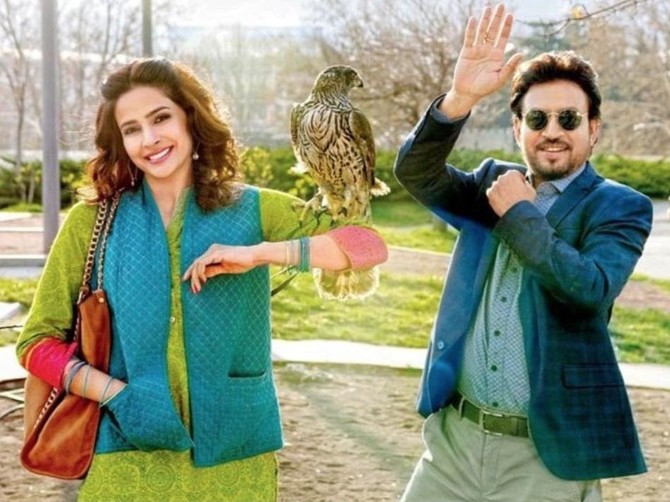
Saba Qamar was not able to be as hands on with her promotions for “Hindi Medium” as she would have liked. (Photo courtesy: Twitter)
Updated 22 January 2018
Follow

Pakistani actress Saba Qamar breaks Bollywood

LAHORE: A number of Pakistan’s top talent have crossed the border to act in Bollywood, however, relations between the countries took a negative turn last year and Pakistanis were loudly told that they and their acting prowess would not be welcomed in India.
After Fawad Khan’s massively successful turn in “Khoobsurat” and “Kapoor and Sons,” it seemed as though a new tide was turning with the sharing of talent from both sides of the border. Following the ban by the Indian Motion Picture Producers’ Association (IMPPA) on Pakistani actors, singers and technicians from working on Indian films, Pakistani actress Mahira Khan was famously not able to attend promotions for her debut in “Raees.” Sajal Aly and Adnan Siddiqui were also held back from their promotions for the critically-acclaimed “Mom” and Saba Qamar too was not able to be as hands on with her promotions for “Hindi Medium” as she would have liked.
Despite the controversy of asking Pakistani actors to vacate the premises, Qamar continued filming Hindi Medium, a film that went on to become a major box office success and was loved by critics with a tremendous amount of praise coming Qamar’s way for her role as a middle class woman wanting to keep up with the Jones’ and get her daughter into a posh school.
That praise, those box office numbers and the appreciation of fans on both sides of the Pakistan-India border all resulted in Qamar being the first Pakistani actress to score a Leading Actor nomination at India’s Filmfare Awards.
The recognition by the Filmfare Awards, held by the Times Group and in its 63rd year, is not a small one. Often dubbed as the Indian Oscars, the awards celebrate artistic and technical excellence across Bollywood’s booming film industry. For actors from Pakistan who head to India to make films, backlash has always been swift and quick.
Qamar, whose talents are largely undisputed in her home country, was not spared the fan hate for heading over and shooting her film. When the film was slated for release in Pakistan, few were expecting it to be worthy of her talent as Pakistani actors’ (particularly for female actors) roles in Bollywood have so far left little to be desired, but the film spoke for itself.
In addition to her nomination, the film itself received a total of five nominations at the Filmfare Awards, including Best Film, Irfan Khan for Best Actor in a Leading Role (Male), Saket Chaudhary for Best Director and Deepak Dobriyal for Best Actor in a Supporting Role (Male). It was also announced that Hindi Medium was chosen by the Indian Embassy to be screened at the annual Festival of Indian films in Armenia.


Ministry of Culture-backed incubator helped Jeddah local create her first graphic novel

Saudi visual storyteller Noura Alashwali’s debut graphic novel began as a way to process grief in private. (Supplied)
Updated 04 January 2026
Follow

Ministry of Culture-backed incubator helped Jeddah local create her first graphic novel

  • ‘I feel seen,’ says Saudi storyteller Noura Alashwali

JEDDAH: Visual storyteller Noura Alashwali is one of a generation of Saudi artists whose personal journeys mirror the Kingdom’s cultural transformation, meaning their creative impulses are increasingly backed by public institutions and have an audience ready to listen.

“Creative expression was never just a hobby for me; it was a need,” Alashwali, 37, told Arab News. “From a young age, whether through writing or drawing, creativity felt like a part of who I was. And it still is.”

It was her education at Dar Al-Hekma University, where she obtained a degree in graphic design, that gave structure and language to an instinct she had carried since childhood. 

Saudi visual storyteller Noura Alashwali’s debut graphic novel began as a way to process grief in private. (Supplied)

“My earliest memory of drawing with pen and paper is when I was four years old, and I still have those drawings,” she said. Like many artists, she experimented with various mediums as she grew older. Eventually, she found her way to a Saudi art center that she described as “a very popular and wonderful place to learn art.”

At university, Alashwali’s work turned digital. “When I learned about the major, I immediately felt that I belonged. Graphic design is about visual communication. It’s not just about creating art, but about communicating ideas, thoughts, and stories.”

Those ideas would take on a personal weight in 2023 with “Deema and the Old Letters,” her debut graphic novel.

When an idea comes to me (now), I take it more seriously. I honor it and commit to it. I say, ‘Thank you for choosing me. I’m going do my best to manifest you.’

Noura Alashwali, Saudi storyteller

“It was a way for me to process my grief after my mother passed away in 2023,” Alashwali explained. “I was simply writing and drawing while processing very heavy emotions.” 

Noura Alashwali's creativity was supported by the Literature, Publishing and Translation Commission's Authors’ Incubator Program in 2024. (Supplied)

What transformed that intimate archive into a published work was institutional support. In early 2024, Alashwali came across an open call from the Ministry of Culture’s Literature, Publishing and Translation Commission for its Authors’ Incubator program. 

The inclusion of graphic novels and comics among the supported genres caught her attention. She assembled her materials into a PDF, applied, and was accepted.

For the six-month Riyadh-based program she was paired with a mentor, Dr. Hanan Al-Ghadi from Princess Nourah University, and supported logistically. By November 2024, she had signed with Rashm, a publishing house collaborating with the commission.

Alashwali contrasts the protagonist’s depression with the warmth of Jeddahwi landscapes. (Supplied)

Beyond the mentorship and funding, the experience reshaped her sense of self.

“It felt like a dream. Because of institutional support from the Ministry of Culture, I feel validated. I feel seen,” she said. “It encouraged me to take my practice seriously — not just as self-expression, but as something that contributes to the Saudi cultural scene.”

Initiatives such as the incubator program do not merely teach skills; they signal that deeply personal stories of grief, love and memory have a place in the public cultural sphere.

Alashwali contrasts the protagonist’s depression with the warmth of Jeddahwi landscapes. (Supplied)

While Alashwali hopes her work will be translated into English, publishing in Arabic for Saudi readers was the natural choice. “It’s great to contribute to the local scene with an Arabic graphic novel,” she said.

“Deema and the Old Letters” traces a young woman’s journey through pain and grief, using moonlit symbolism and visual poetry to explore art as a means of self-discovery and healing.

“I wanted it to feel intimate and personal. So ‘Deema’ is also designed like a journal,” Alashwali noted.

The protagonist’s depression is juxtaposed with the warmth of Jeddahwi landscapes. 

“Jeddah is home. And when you are home, you’re being your most authentic self,” Alashwali said. “It’s a very kind and happy city; very welcoming and down-to-earth.”

The literature commission’s incubator also expanded Alashwali’s creative world, connecting her to artists from across the Kingdom, including Riyadh, Baha, and the Eastern Province. 

“We have lots of beautiful cultures and stories in Saudi Arabia,” she said. “I have developed close friendships which contributed to my creative practice and personal growth.”

This sense of cross-regional exchange reflects a shift: Artists who once worked in silos are now being given room to meet, collaborate and be heard. 

“What I enjoy most about being a storyteller in Saudi Arabia is that the scene is still fresh. People notice new work and genuinely connect with it,” Alashwali said. “It doesn’t feel overcrowded and overwhelming.”

Besides the literature commission, she has worked with the Visual Arts Commission and the Heritage Commission, including a workshop on creating eyeglass frames using Saudi craft techniques, created in collaboration with Italian gallery Moi Aussi and the Saudi Artisanal Company. 

At Hayy Jameel in December, as part of the three-day “Soul of Palestine” program, Alashwali led a visual storytelling workshop where participants created digital illustrations to celebrate Palestinian heritage and culture.

Earlier in 2025, she participated in the Jeddah Book Fair and the Riyadh International Book Fair. In Jeddah, she worked with younger audiences on transforming emotions into short comics. In Riyadh, the focus shifted to books and artistic practice. 

Across these settings, her metric for success remains emotional rather than technical. “It’s when I feel the participants have opened their hearts and try to transform their emotions into a comic, regardless of the drawing skills,” she explained.

Alashwali’s next project is inspired by conversations with her five-year-old daughter. “One day, after smelling a vanilla perfume she loves, she told me: ‘Mama, I think this is the smell of my heart.’ She believed it completely,” she said. “That idea stayed with me — the thought that the world might be kinder if we could smell hearts. So, the project will take the form of a directory of heart scents.”

Her plans for 2026 are modest. “I hope to dedicate more time and energy to my art,” she said. “If that doesn’t happen, publishing my next book will be enough.”

Underpinning it all is a philosophy she returns to — one espoused in one of her favorite books, “Big Magic,” in which Elizabeth Gilbert writes about ideas as living entities searching for someone to bring them into the world.

“As a Muslim, I believe these ideas are created by God,” said Alashwali. “When an idea comes to me now, I take it more seriously. I honor it and commit to it. I say, ‘Thank you for choosing me. I’m going do my best to manifest you.’”