

Egypt targets slew of government flotations

Vehicles drive by in front of Central Bank of Egypt Headquarters in Cairo Dec. 30. The government owns stakes in a number of banks, some of which may be earmarked for priviatization. (Reuters)
Updated 21 January 2018
Follow

Egypt targets slew of government flotations

CAIRO: Egypt is looking to offer shares in eight to 10 state companies on the stock exchange over the next 18 months, Finance Minister Amr El-Garhy told Reuters on Sunday, as part of a drive to attract foreign investors.

The flotations will be the first batch in a program to float stakes in dozens of state-owned companies over the next three to five years in areas including oil, services, chemicals, shipping and real estate.

“The companies will include companies listed on the exchange and those not listed,” Garhy told Reuters by phone, referring to the first batch.
He did not specify the sectors or sizes of the companies under consideration.

The government said previously that it expected the first share offering would be in oil company ENPPI, in the first quarter of 2018.

Egypt’s stock market has taken off since the country floated its pound currency in November 2016, with the Egyptian blue-chip index gaining about 80 percent since then.

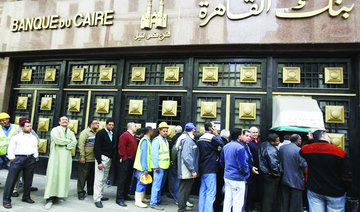
The government has said previously it plans to offer 20 percent of state-owned Banque du Caire as well as a 40 percent stake in the Arab African International Bank (AAIB), in which the central bank owns a stake.

The state owns vast swathes of Egypt’s economy, including three of its largest banks — National Bank of Egypt, Banque Du Caire, the United Bank of Egypt — along with much of its oil industry and real estate sector.

The last time state-owned companies were listed on the exchange was in 2005 when shares of Telecom Egypt, the state’s landline monopoly, and oil companies Sidi Kerir Petrochemicals and AMOC were floated.

Record $14.4bn rise in Saudi holdings of US Treasuries

Updated 19 January 2026
Follow

Record $14.4bn rise in Saudi holdings of US Treasuries

RIYADH: Saudi Arabia increased its holdings of US Treasuries by 10.71 percent in November in what was the largest increase since data tracking began in 1974, according to the latest official data,

The Kingdom’s US Treasury portfolio stood at $148.8 billion in the month, up $14.4 billion from October.

Following the increase, Saudi Arabia moved up one place to 17th place among the largest foreign holders of US Treasuries.

Countries including Saudi Arabia invest in US Treasuries for their perceived safety, liquidity, diversification benefits, and alignment with economic ties to the US. 

The Kingdom’s holdings were 17.25 percent higher in November compared with January 2025.

The allocation highlights Saudi Arabia’s preference for longer-dated US government debt as part of its foreign reserve strategy, focused on capital preservation, liquidity, and diversification amid global market volatility. 

Saudi Arabia’s holdings included $106.8 billion in long-term securities, accounting for 72 percent of the total, while short-term holdings stood at $42 billion, or 28 percent. 

Globally, Japan remained the largest foreign holder of US Treasury securities at $1.2 trillion, followed by the UK at $888.5 billion, mainland China at $682.6 billion, and Belgium at $481 billion. 

Canada ranked fifth with holdings of $472.2 billion, followed by the Cayman Islands and Luxembourg in sixth and seventh positions, with portfolios valued at $427.4 billion and $425.6 billion, respectively. 

France placed eighth with $376.1 billion, followed by Ireland at $340.3 billion and Taiwan at $312.5 billion. 

Other countries included in the top 20 list include Switzerland, Singapore, Hong Kong, and Norway, as well as India and Brazil. 

The trade relationship between Saudi Arabia and the US remains strong, with the Kingdom exporting SR5.20 billion ($1.39 billion) worth of non-oil goods in October, data from the General Authority of Statistics showed.

Speaking to Arab News in October, Nasser Saidi, founder and president of economic and financial advisory services firm Nasser Saidi & Associates and a former minister of economy and trade in Lebanon, said US Treasuries are a critical pillar of stability.

“Holding treasuries allows Saudi Arabia to meet its international payment obligations — finance imports, service external debt, portfolio, and capital flows — provide a buffer against oil revenue shocks, while also generating a steady, low-risk stream of income,” he said.