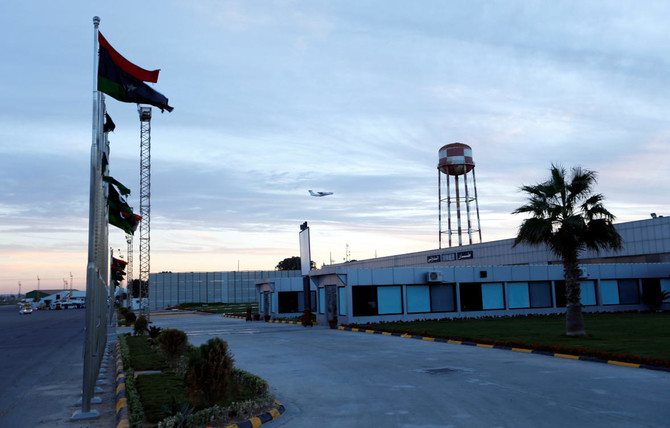
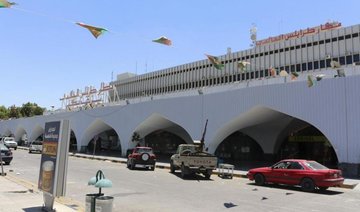
TRIPOLI: The only functioning airport in the Libyan capital reopened on Saturday after a five-day closure caused by deadly clashes that left passenger jets damaged.
Mitiga airport, located just east of Tripoli city center, appeared to be operating normally, with both departures and arrivals areas busy with passengers.
“All domestic and international flights have ...resumed,” said an airport official who asked not to be named for security reasons. “No technical problems have been reported and security is under control.”
Fighting on Monday pitted the Special Deterrence Force (SDF), which is aligned with the internationally recognized Government of National Accord (GNA), and an armed group based in the nearby Tajoura district.
At least 20 people were killed and 60 wounded. The four Libyan airlines operating out of Mitiga have been rushing to repair or replace aircraft that were hit by gunfire or artillery while parked there during the battle.
Flights to evacuate or repatriate foreign migrants from Tripoli, which are mainly operated by UN agencies, were suspended because of Mitiga’s closure.
Tripoli has frequently been shaken by clashes between armed groups since Libya slid into chaos and violence following the overthrow of Mummar Qaddafi in 2011. Under the GNA, several large groups have expanded their power and the situation remains fragile.
Tripoli’s main international airport was badly damaged by fighting in 2014 and is still out of service.

Airport in Libya’s capital reopens after closure due to clashes
In major policy shift on Syria, UN Security Council lifts sanctions on Hayat Tahrir Al-Sham
- Move reflects evolving Syrian political landscape in the post-Assad era, ending a global freeze on assets, travel ban and arms embargo
NEW YORK CITY: The UN Security Council on Friday removed Al-Nusra Front, the militant group that evolved into Hayat Tahrir Al-Sham, from its so-called Daesh and Al-Qaeda Sanctions List.
The move signals a major shift in international policy toward Syria’s evolving political landscape in the post-Assad era, and ends a global freeze on assets, travel ban and arms embargo that have been imposed on the group since 2014.
Al-Nusra Front and Hayat Tahrir Al-Sham were led by Ahmad Al-Sharaa, formerly Abu Mohammed Al-Julani, who is now Syria’s president and was a leading figure in the offensive that toppled the Assad regime.
The consensus decision by the Security Council’s sanctions committee was announced by the UK, which holds the presidency of the Security Council this month and was acting in the absence of the chair of the committee. It followed a request by the new Syrian authorities to delist “Al-Nusrah Front for the People of the Levant.”
The decision means measures that were applied to Hayat Tahrir Al-Sham under Security Council Resolution 2734, adopted in 2024, no longer apply. As a result, UN member states are notrequired to freeze the group’s funds, restrict the movement of its representatives, or block the supply or transfer of arms and related materiel.
Al-Nusra Front was added to the sanctions list for its ties to Al-Qaeda and involvement in the financing and execution of militant activities during the war in Syria. The UN initially continued to treat the group’s successor organization, Hayat Tahrir Al-Sham, as a listed alias.
Al-Sharaa has said the group severed all prior transnational jihadist links and is now solely focused on local Syrian matters.