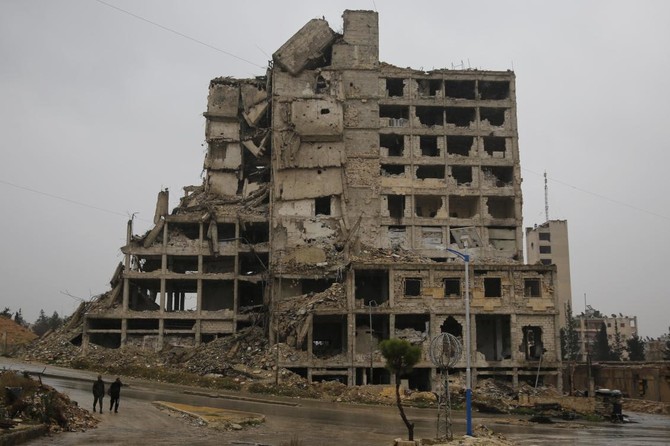
MADRID: It is over a year since Bashar Al-Assad's regime, with the help of Russian air strikes and barrel bombs, pounded the rebel-held east of Aleppo into submission.
Buildings were flattened, those who survived were left terrorised, hungry and filled with despair, and the stench of dead bodies rose up from the rubble as families searched for their loved ones.
Now, having largely destroyed the city it sought to control, the Assad regime wants the world to visit what remains: as a tourist destination.
This week the Syrian government is advertising Aleppo, along with other destinations in Syria, at the Fitur International Tourism Trade Fair in Madrid, "promoting" the country's attractions to the world.
It is the first time Syria has attended the trade fair since 2011, before the war broke out.
Along with the ruins of Aleppo, it also encourages people to visit the ancient Roman-era ruins of Palmyra, the UNESCO-listed archaeological site which was twice controlled by Daesh.
Daesh fighters blew up some of the temples and burial towers before being forced out of the city for the final time last year by Syrian government forces and their Russian backers.
"This year is the time to rebuild Syria and our economy," Bassam Barsik, director of marketing at the Syrian Ministry of Tourism, told AFP.
Barsik said 1.3 million foreign visitors travelled to Syria last year, although that figure includes those who came from neighbouring Lebanon for only one day.
"We're targeting two million visitors this year," he said.
He argued that religious destinations, such as the historic Christian town of Maaloula, one of the last places on earth where Aramaic is still spoken, are still a draw to tourists.
Damascus, Tartus, Latakia and the historic Crusader castle of Krak des Chevaliers close to the border with Lebanon, although damaged by bombing, are other possible attractions.
"In 2017, the army controlled much of the country, and that was a big help to promote Syria abroad and attract tourist groups again," said Barsik.
Most countries advise citizens against all travel to Syria.
The war has displaced millions of people and is estimated to have claimed the lives of at least 340,000 people since 2011.

Assad regime promotes Syria as a 'tourist' destination
Israel’s hostage forum releases AI-generated video of last Gaza captive
- The Gaza ceasefire, which came into effect in October, remains fragile with both sides alleging violations, and mediators fearing that Israel and Hamas alike are stalling
JERUSALEM: An Israeli group representing the families of Gaza hostages released on Tuesday an AI-generated video of Ran Gvili, the last captive whose body is still being held in the Palestinian territory.
The one-minute clip, created whole cloth using artificial intelligence, purports to depict Gvili as he sits in a Gaza tunnel and appeals to US President Donald Trump to help bring his body back to Israel.
“Mr President, I’m asking you to see this through: Please bring me home. My family deserves this. I deserve the right to be buried with honor in the land I fought for,” says the AI-generated image of Gvili.
Gvili was 24 at the time of Hamas’s October 7, 2023 attack on Israel.
He was an officer in Israel’s Yasam elite police unit and was on medical leave when he learnt of the attack.
He decided to leave his home and brought his gun to counter the Hamas militants.
He was shot in the fighting at the Alumim kibbutz before he was taken to Gaza.
Israeli authorities told Gvili’s parents in January 2024 that he had not survived his injuries.
The AI clip was released by the Hostages and Missing Families Forum, the main group representing those taken captive to Gaza.
The Forum said it was published with the approval of Gvili’s family.
“Seeing and hearing Rani speak in his own voice is both moving and heartbreaking. I would give anything to hear, see and hold him again,” Gvili’s mother Talik said, quoted by the Forum.
“But all I can do now is plead that they don’t move to the next phase of the agreement before bringing Rani home — because we don’t leave heroes behind.”
The Gaza ceasefire, which came into effect in October, remains fragile with both sides alleging violations, and mediators fearing that Israel and Hamas alike are stalling.
In the first stage, Palestinian militants were expected to return all of the remaining 48 living and dead hostages held in Gaza.
Since the ceasefire came into effect on October 10, militants have released 47 hostages.
In the next stages of the truce, Israel is supposed to withdraw from its positions in Gaza, an interim authority is to govern the Palestinian territory instead of Hamas, and an international stabilization force is to be deployed.
Israeli Prime Minister Benjamin Netanyahu is expected to meet Trump in Florida later this month to discuss the second phase of the deal.