Peak oil demand and its implications for Gulf producers

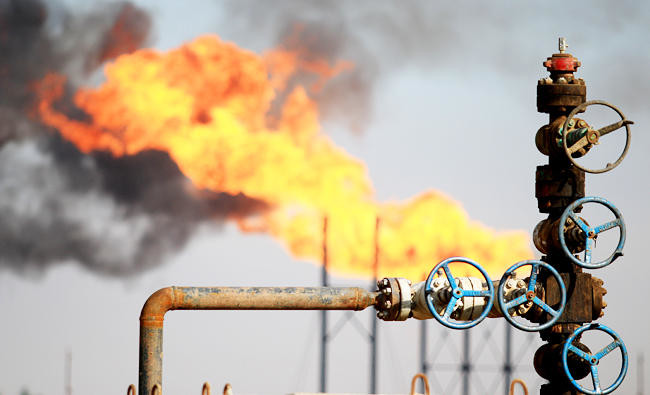
A photo taken on December 14, 2017 shows flames rising at the Bin Omar natural gas facility, part of the Basra Gas Company, north of the southern Iraqi port of Basra. (AFP)
Updated 20 January 2018
Follow

Peak oil demand and its implications for Gulf producers

LONDON: Even if oil consumption reaches a peak and then starts to fall, the world will still need large quantities of oil for many decades to come.
The prediction is contained in a thoughtful paper co-authored by Spencer Dale, chief economist of BP, and Bassam Fattouh, director of the Oxford Institute for Energy Studies.
“Global oil demand is likely to continue growing for a period, driven by rising prosperity in fast-growing developing economies,” they wrote in a paper published on Monday.
“But that pace of growth is likely to slow over time and eventually plateau, as efficiency improvements accelerate.”
The implication is that consumption is likely to reach a maximum at some point and then start to fall, though the timing and magnitude of the peak are highly uncertain and very sensitive to assumptions.
And even once demand has peaked, consumption is unlikely to drop sharply, the authors argue, given the inherent advantages of oil as an energy source, particularly its energy density.
“Peaking oil demand is not expected to trigger a significant discontinuity or sharp fall in demand,” they wrote.
Under most scenarios, the world will still be consuming tens of millions of barrels of oil per day through the middle of the century.
There are sufficient known oil resources to meet all the world’s oil demand through 2050 twice over, according to BP estimates.
But given the natural decline in output from existing fields, substantial investment will be needed to turn those resources into reserves and produce them.
The predicted peaking of consumption, coupled with vast resources, and new production made possible by hydraulic fracturing and horizontal drilling have transformed the long-term outlook for the oil industry.
The dominant narrative, which before 2008 was characterised by fears about future scarcity and oil supplies running out, has been transformed into one about future abundance.
Some now worry that many of those resources will never be needed and may become stranded assets — a welcome development for climate campaigners but a potential problem for oil producers.
Peak oil demand signals “a shift in paradigm: From an age of scarcity to an age of abundance, with potentially profound implications for oil markets,” according to Dale and Fattouh.
In an era of abundance, oil markets are likely to become increasingly competitive, as resource owners compete to secure market share and produce their reserves rather than risk them being left in the ground.
“Faced with the possibility that significant amounts of recoverable oil may never be extracted, low-cost producers have a strong incentive to use their comparative advantage to squeeze out high-cost producers and gain market share.”
Better to have money in the bank than leave oil in the ground.
As the oil market becomes more competitive, low-cost producers will find it more profitable to switch to a high-volume, lower price strategy — in contrast to the old strategy of restricting volumes and raising prices.
The argument applies especially to Saudi Arabia, Kuwait and Abu Dhabi.
The implication is that many producing countries will see revenues and formerly high resource rents decline, to the benefit of consumers.
In theory, competition for market share should drive oil prices down to the marginal cost of extraction, which the authors suggest could be lower than $10 per barrel for the major Middle East producers.
But these countries rely heavily on oil revenues to fund government operations, defense, healthcare, education and social safety nets. They need prices well above the marginal cost of extraction.
To be sustainable, oil prices must be high enough to cover these “social costs” as well as the much lower costs of physical extraction.
The authors cite fiscal breakeven prices as a proxy for social costs and say breakevens for five major Middle Eastern producers averaged $60 per barrel in 2016 compared with a physical cost of production of just $10.
Many low-cost producers recognize the need to diversify their economies away from dependence on oil but experience suggests such transitions take decades to complete.
In the meantime, the authors argue, many low-cost producers will try to resist the shift to a higher-volume, lower-price strategy while they try to make progress with the transition.
The problem with this argument is that it makes oil prices a function of social costs. In reality, it is the other way around — price drives social spending.
Dale and Fattouh argue that “it is likely that many low-cost producers will delay adopting a more competitive strategy until they have made significant progress in reforming their economies. This is likely to slow the speed at which the new competitive oil market emerges.”
“The shift to a more competitive oil market environment won’t just happen on its own accord, it requires a critical mass of low-cost producers both to recognize the need to adopt a more competitive strategy and, more importantly, to have reformed their economies sufficiently for them to be able to adopt such a strategy sustainably.”
If social costs in many low-cost producing countries remain high, according to Dale and Fattouh, that is likely to slow the pace at which a more competitive market takes hold, until they can reduce them.
Fattouh and Dale assume that Saudi Arabia and the other low-cost Middle East oil producers can successfully exercise market power, restricting production to keep prices high.
But they are probably overstating OPEC’s market power.
In the 1980s, OPEC’s market power was broken by the emergence of rival oil supplies from the North Sea as well as Russia, Alaska and China. In the 2010s, its market power was hit by the emergence of US shale, Canadian heavy oil and deepwater projects.
In practice, prices have been driven by the cost of developing and producing alternative supplies outside the major producing economies of the Middle East.
The cost of these alternative supplies is well above the $10 physical extraction cost of the major Middle East fields — but it may or may not be high enough to cover their social costs.
In future, the major oil producers will also have to reckon with increasing competition from other forms of energy.
Dale and Fattouh conclude that social costs and the pace of economic reform in the major oil-producing countries will have a decisive impact on oil prices over the next few decades.
In practice, the opposite is probably true. Oil prices and the degree of competition from other sources of supply, as well as electric vehicles, will have a decisive impact on the producers’ social spending and the rate of diversification.
• John Kemp is a Reuters market analyst. The views expressed are his own.


What MENA’s wild 2025 funding cycle really revealed  

Updated 26 December 2025
Follow

What MENA’s wild 2025 funding cycle really revealed  

RIYADH: The Middle East and North Africa startup funding story in 2025 was less a smooth arc than a sequence of sharp gears: debt-led surges, equity-led recoveries, and periodic quiet spells that revealed what investors were really underwriting.   

By November, the region had logged repeated bursts of activity — culminating in September’s $3.5 billion spike across 74 deals — yet the year’s defining feature was not just the size of the peaks, but the way capital repeatedly clustered around a handful of markets, instruments, and business models.  

Across the year’s first eleven months, funding totals swung dramatically: January opened at $863 million across 63 rounds but was overwhelmingly debt-driven; June fell to just $52 million across 37 deals; and September reset expectations entirely with a record month powered by Saudi fintech mega facilities.   

The net result was a market that looked expansive in headline value while behaving conservatively in underlying risk posture — often choosing structured financing, revenue-linked models, and geographic familiarity over broad-based, late-stage equity appetite.  

Debt becomes the ecosystem’s shock absorber  

If 2024 was about proving demand, 2025 was about choosing capital structure. Debt financing repeatedly dictated monthly outcomes and, in practice, became the mechanism that let large platforms keep scaling while equity investors stayed selective.  

Founded in 2019 by Osama Alraee and Mohamed Jawabri, Lendo is a crowdlending marketplace that connects qualified businesses seeking financing with investors looking for short-term returns. Supplied

January’s apparent boom was the clearest example: $863 million raised, but $768 million came through debt financing, making the equity picture almost similar to January 2024.   

The same pattern returned at larger scale in September, when $3.5 billion was recorded, but $2.6 billion of that total was debt financing — dominated by Tamara’s $2.4 billion debt facility alongside Lendo’s $50 million debt and Erad’s $33 million debt financing.    

October then reinforced the playbook: four debt deals accounted for 72 percent of the month’s $784.9 million, led by Property Finder’s $525 million debt round.    

By November, more than half the month’s $227.8 million total again hinged on a single debt-backed transaction from Erad.   

Tamara was founded in 2020 by Abdulmajeed Alsukhan, Turki Bin Zarah, and Abdulmohsen Albabtain, and offers buy-now-pay-later services. Supplied

This isn’t simply ‘debt replacing equity.’ It is debt acting as a stabilizer in a valuation-reset environment: late-stage businesses with predictable cash flows or asset-heavy models can keep expanding without reopening price discovery through equity rounds.  

A two-speed geography consolidates around the Gulf  

The regional map of venture capital in 2025 narrowed, widened, then narrowed again — but the center of gravity stayed stubbornly Gulf-led.    

Saudi Arabia and the UAE alternated at the top depending on where mega deals landed, while Egypt’s position fluctuated between brief rebounds and extended softness.  

In the first half alone, total investment reached $2.1 billion across 334 deals, with Saudi Arabia accounting for roughly 64 percent of capital deployed.   

Saudi Arabia’s rise was described as ‘policy-driven,’ supported by sovereign wealth fund-backed VC activity and government incentives, with domestic firms such as STV, Wa’ed Ventures, and Raed Ventures repeatedly cited as drivers.   

Erad co-founders (left to right): Faris Yaghmour, Youssef Said, Salem Abu Hammour, and Abdulmalik Almeheini. Supplied

The UAE still posted steady growth in the first half — $541 million across 114 startups, up 18 percent year-on-year — but it increasingly competed in a market where the largest single cheques were landing elsewhere unless the Emirates hosted the region’s next debt mega round.  

The concentration became stark in late-year snapshots. In November, funding was ‘tightly concentrated in just five countries,’ with Saudi Arabia taking $176.3 million across 14 deals and the UAE $49 million across 14 deals, while Egypt and Morocco each sat near $1 million and Oman had one undisclosed deal.    

Even in September’s record month, the top two markets — Saudi with $2.7 billion across 25 startups and the UAE with $704.3 million across 26 startups — absorbed the overwhelming majority of capital.  

A smaller but notable subplot was the emergence of ‘surprise’ markets when a single deal was large enough to change rank order.   

Iraq briefly climbed to third place in July on InstaBank’s $15 million deal, while Tunisia entered the top three in June entirely via Kumulus’ $3.5 million seed round.   

These moments mattered less for the totals than for what they suggested: capital can travel, but it still needs an anchor deal to justify attention.  

Events, narrative cycles, and the ‘conference effect’  

2025 also showed how regional deal flow can bunch around events that create permission structures for announcements.   

February’s surge — $494 million across 58 deals — was explicitly linked to LEAP 2025, where ‘many startups announced their closed deals,’ helping push Saudi Arabia to $250.3 million across 25 deals.  

September’s leap similarly leaned on Money20/20, where 15 deals were announced and Saudi fintechs dominated the headlines.  

This ‘conference effect’ does not mean deals are created at conferences, but it does change the timing and visibility of closes.   

Sector leadership rotates, but utility wins  

Fintech retained structural dominance even when it temporarily lost the top spot by value.   

It led January on the back of Saudi debt deals; dominated February with $274 million across 15 deals; remained first in March with $82.5 million across 10 deals; topped the second quarter by capital raised; and reclaimed leadership in November with $142.9 million across nine deals — again driven by a debt-heavy transaction.   

Even when fintech fell to ninth place by value in October with $12.5 million across seven rounds, it still remained ‘the most active sector by deal count,’ a sign of persistent baseline demand.  

Proptech was the year’s other headline sector, but its peaks were deal-specific. Nawy’s $75 million round in May helped propel Egypt to the top that month and pushed proptech up the rankings.   

Property Finder’s debt round in October made proptech the month’s top-funded sector at $526 million. In August, proptech led with $96 million across four deals, suggesting sustained investor appetite for real-estate innovation even beyond the megadeal.   

Outside fintech and proptech, the year offered signals rather than dominance. July saw deeptech top the sector charts with $250.3 million across four deals, reflecting a moment of investor appetite for IP-heavy ventures.   

AI repeatedly appeared as a strategic narrative — especially after a high-profile visit by US President Donald Trump alongside Silicon Valley investors and subsequent GCC AI initiatives — yet funding didn’t fully match the rhetoric in May, when AI secured just $25 million across two deals.   

By late year, however, expectations were already shifting toward mega rounds in AI and the industries built around it, positioning 2025 as a runway-building year rather than a breakout year for AI funding in the region.  

Stage discipline returns as valuations reset  

In 2025, MENA’s funding landscape tried to balance two priorities: sustaining early-stage momentum while selectively backing proven scale. Early-stage rounds dominated deal flow. October saw 32 early-stage deals worth $95.2 million, with just one series B at $50 million. November recorded no later-stage rounds at all, while even September’s record month relied on 55 early-stage startups raising $129.4 million.  

When investors did commit to later stages, the cheques were decisive. February featured Tabby’s $160 million series E alongside two $28 million series B rounds, while August leaned toward scale with $112 million across three series B deals. Late-stage equity was not absent — it was episodic, appearing only when scale economics were defensible. 

Hosam Arab, CEO of Tabby. File

B2B models remained the default. In the first half, B2B startups raised $1.5 billion, or 70 percent of total funding, driven by clearer monetisation and revenue visibility.  

The gender gap remained structural. Despite isolated spikes, capital allocation continued to overwhelmingly favour male-led startups.  

What 2025 actually said about 2026  

Taken together, 2025 looked like a year of capital market pragmatism. The region demonstrated capacity for outsized rounds, but much of that capacity ran through debt, a handful of megadeals, and a narrow set of markets — primarily Saudi Arabia and the UAE.   

Early-stage deal flow stayed active enough to keep the pipeline moving, even as growth-stage equity became intermittent and increasingly selective.   

By year-end, the slowdown seen in November read less like a breakdown than a deliberate pause: a market in consolidation mode preserving firepower, waiting for clearer valuation anchors and the next wave of platform-scale opportunities.   

If 2025 was about proving the region can absorb large cheques, 2026 is shaping up to test where those cheques will go — especially as expectations build around AI-led mega rounds and the industries that will form around them.