

Pence has long pushed for Trump policies on Israel

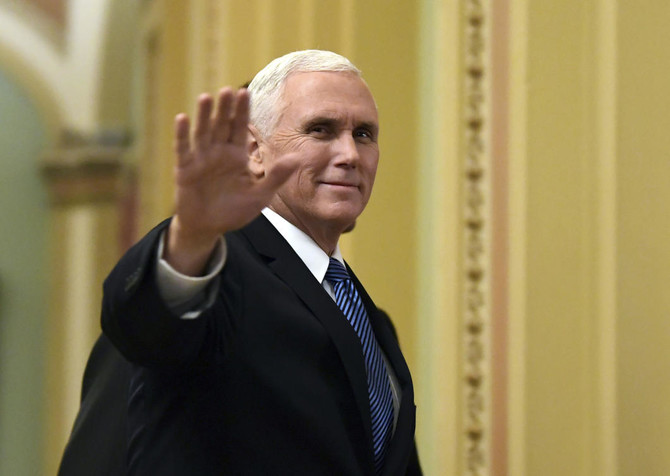
US Vice President Mike Pence will will visit the Middle East after postponing a trip to the region in December. (AP)
Updated 20 January 2018
Follow

Pence has long pushed for Trump policies on Israel

WASHINGTON: Vice President Mike Pence is making his fifth visit to Israel, returning to a region he has visited “a million times” in his heart.
An evangelical Christian with strong ties to the Holy Land, Pence this time comes packing two key policy decisions in his bags that have long been top priorities for him: Designating Jerusalem as Israel’s capital and curtailing aid for Palestinians.
Since his days in Congress a decade ago, Pence has played a role in pushing both for the shift in US policy related to the capital and for placing limits on funding for Palestinian causes long criticized by Israel.
Traveling to Israel just as Palestinians have condemned recent decisions by President Donald Trump’s administration, Pence will arrive in the region as a longtime stalwart supporter of Israel who has questioned the notion of the US serving as an “honest broker” in the stalled peace process.
“The United States certainly wants to be honest but we don’t want to be a broker,” Pence once told the Christian Broadcasting Network in 2010. “A broker doesn’t take sides. A broker negotiates between parties of equals.”
The vice president will hold four days of meetings in Egypt, Jordan and Israel during his visit, the first to the region by a senior administration official since Trump announced plans in December to designate Jerusalem as Israel’s capital and begin the process of moving the US Embassy from Tel Aviv, angering Palestinian leaders.
Pence was departing as US lawmakers sought to avert a federal government shutdown at midnight Friday. Senior White House officials said Pence planned to leave Friday evening as scheduled.
His trip will also follow Tuesday’s announcement that the US is withholding $65 million of a planned $125 million funding installment to the UN Relief and Works Agency, which provides health care, education and social services to Palestinians in the West Bank, Gaza Strip, Jordan, Syria and Lebanon.
Both decisions have come as Trump has expressed frustration over a lack of progress in restarting peace negotiations between Israel and the Palestinians, who withdrew plans to meet with Pence during his visit to the Middle East.
Senior White House officials said security issues, countering terrorism and efforts to push back against Iran would figure prominently during Pence’s trip, which concludes on Tuesday. But the vice president also is expected to face questions about Israel’s future.
On the embassy, Pence played a steady role in pushing for the shift in US policy. The decision upended past US views that Jerusalem’s status should be decided in negotiations between Israel and the Palestinians, who claim east Jerusalem as the capital of their future state.
Pence had wanted the Trump administration to convey “a clear-cut policy” on Jerusalem after the president asked him last summer to visit the Middle East, White House officials have said.
Pence discussed the issue with Jewish and evangelical leaders in the months leading up to the decision and advocated for the plan within the administration. But he noted to religious leaders late last year that the decision was the president’s alone and would fulfill a commitment from the 2016 campaign.
Pence has long aligned himself with Israel.
In Congress, he pushed for limiting US aid to the Palestinian Authority during the presidency of George W. Bush, warning the funding could be redirected to groups like the militant Hamas movement, which controls Gaza.
He was a vocal advocate for Israel’s security fence and co-sponsored the Jerusalem Embassy and Recognition Act in 2011 to recognize Jerusalem as Israel’s undivided capital. Veteran House members recall Pence’s role as a staunch ally of Israeli causes and his steadfast support for moving the embassy to Jerusalem at times when few were talking about the issue.
As Indiana’s governor, Pence signed a bill requiring the state to divest from any business that engaged in the Boycott, Divestment and Sanctions Movement — a grassroots international boycott movement against Israel.
Kenneth Weinstein, CEO of the Hudson Institute, a conservative think tank, said it has been “central to his political life from the absolute outset, from when he first ran for Congress — it’s something that’s central to who he is, to what he believes in.”
Pence traveled to Israel for the first time as an Indiana congressman in January 2004, joining a delegation from the Jewish Federation of Greater Indianapolis. He placed a wreath at the Yad Vashem Holocaust Memorial and visited the Western Wall, both of which are on Pence’s itinerary again next week, and had a private meeting with then-Israeli Prime Minister Ariel Sharon.
Doug Rose, a philanthropist in Indianapolis, flew with Pence on his 2004 trip to Israel and recalled him being deeply affected by the experience. “How could you not be moved?” Rose said of their site visits.
Pence told the Indiana Jewish Post and Opinion after his 2004 trip that he was often asked if he had been to Israel before, “and my response was, ‘Only in my dreams.’ I was raised an evangelical Christian and tried to read the Bible every day, so in my mind and in my heart I have been there a million times.”
Trump’s decision on Jerusalem has drawn protests from Middle Eastern leaders and prompted Palestinian President Mahmoud Abbas to pull out of a planned meeting with Pence in the biblical West Bank town of Bethlehem. Administration officials said Pence is not expected to meet with Palestinian leaders during the trip.
Pence remains popular with evangelical voters in the US, a large and influential constituency that helped propel Trump to victory in last year’s election. American evangelicals, especially the older generation, have a strong affinity for Israel, drawn both on spiritual grounds and a genuine love for the modern-day country and the Jewish people.

Rabbi Yechiel Eckstein, the US-born founder and president of the International Fellowship of Christians and Jews, a charity that raises tens of millions of dollars for Israeli causes from American evangelicals, said Pence’s upcoming visit should go over well with evangelicals and help shore up their support for the Trump administration.
“He’s an extension of evangelicalism and evangelical feelings for Israel, and its history,” Eckstein said. “Trump doesn’t have that history. Pence has that history of being pro-Israel.”

UN Security Council urged to put pressure on UAE to stop arming Sudanese paramilitary

Updated 8 sec ago
Follow

UN Security Council urged to put pressure on UAE to stop arming Sudanese paramilitary

  • Activist accuses Rapid Support Forces and its allies of widespread conflict-related sexual violence during war, calls for action against faction’s powerful international backers
  • Plea comes amid growing warnings of genocide in Sudan, ‘unchecked external interference’ that is allowing atrocities to continue, and the risk of further regional destabilization

NEW YORK CITY: The UN Security Council faced calls on Thursday to put pressure on the UAE to stop arming the Rapid Support Forces, one of the warring military factions in Sudan, amid warnings that atrocities bearing “the hallmarks of genocide” were spreading and the situation in the country risks causing further regional destabilization.

Sudanese activist Hala Alkarib said that “unchecked external interference” was allowing atrocities to continue. She cited the documentation by a UN panel of experts and international nongovernmental organizations of weapons and military equipment being shipped into Darfur, “including by the United Arab Emirates, in violation of this Council’s arms embargo.”

She told council members: “You can stop the violence by pressuring the RSF’s powerful backers with economic, political and criminal consequences.”

The council also heard warnings from Alkarib and senior UN officials that after more than 1,000 days of war, civilians face renewed risks of mass atrocities in Darfur and Kordofan.

Earlier on Thursday, the International Independent Fact-Finding Mission for Sudan issued a report that described atrocities committed by the RSF in and around El-Fasher in late October last year as “indicators of a genocidal path.”

Alkarib, regional director of the Strategic Initiative for Women in the Horn of Africa, told the Security Council that she had lost family members and her home in the conflict between the RSF and the Sudanese Armed Forces, which began in April 2023.

“To be here a third time, only to report that the situation is even worse, is an indictment not just of the warring parties but of this council’s inability to stop the bloodshed,” she said.

“Over 1,000 days since the start of the war, despite repeated warnings, this council has failed to act. Every red line — siege, forced displacement, man-made famine, genocide, mass rape — has been crossed.”

She warned that the kinds of atrocities seen in El-Geneina and El-Fasher now risk being repeated in Greater Kordofan and Blue Nile, where drone attacks by all sides are killing civilians and destroying hospitals, schools and markets.

“Unless you act now, you will have more blood on your hands,” Alkarib said.

Her organization has documented more than 1,294 cases of conflict-related sexual violence against women and girls since the war began, she said, “perpetrated primarily by the RSF and their allies.”

She accused RSF forces in Darfur of deliberately targeting women and girls from the Fur, Masalit, Berti, Zaghawa and Tunjur communities on the basis of ethnicity.

“As the UN Fact-Finding Mission confirmed in a report today, this is part of a strategy of genocide aimed at eradicating native African communities,” Alkarib said.

Sexual violence, arbitrary detention and enforced disappearances in RSF-controlled areas remain severely underdocumented due to access restrictions, communications blackouts and retaliation, she added.

Thousands of women and children have been detained in villages including Garny, Tura and Tabit in North Darfur, she said, and hospitals and schools have been turned into detention centers. Forced marriages, including child marriages, to RSF soldiers are frequently linked to abductions and enforced disappearances.

Alkarib called for an immediate end to hostilities, the release of civilians held by the warring parties, “particularly women held by the RSF in conditions amounting to sexual slavery,” and the deployment of a mission with a clear mandate to protect civilians across Sudan in collaboration with the African Union.

She also urged the Security Council to expand the arms embargo to the whole of Sudan; impose targeted sanctions on violators; demand safe and sustained humanitarian access; condemn attacks on aid convoys, including a recent strike on a World Food Programme convoy in North Kordofan; support Sudanese women-led organizations; and back efforts to ensure accountability, including the work of the International Criminal Court.

“None of this will stop without immediate action from you, the international community,” Alkarib added.

The UN’s political affairs chief, Rosemary DiCarlo, said: “Sudan reached a horrific milestone: 1,000 days of a brutal war that has nearly destroyed the third-largest country in Africa. 1,000 days of total impunity for the perpetrators of a long list of atrocities and war crimes.”

She warned that “the risk of regionalization of the conflict is a matter of urgent concern,” citing in particular the movement of armed groups across the border between Sudan and South Sudan “in both directions,” and reports that weapons continue to transit through neighboring states.

“The horrific events in El-Fasher in October 2025 were preventable,” DiCarlo said. During the time the city was under siege, more than a year, the UN’s Human Rights Office “repeatedly sounded the alarm about the risk of mass atrocities. But the warnings were not heeded.”

The UN high commissioner for human rights, Volker Turk, had also alerted the international community to the possibility of similar crimes in Kordofan, where civilians are once again at risk of “summary executions, sexual violence, arbitrary detention and family separation,” she added.

“During the final offensive of the RSF on El-Fasher, reports indicate that sexual violence against women and girls was widespread,” DiCarlo said. “The time to act to prevent a repeat of atrocities elsewhere in the country is now.”

She welcomed progress in an initiative to secure a humanitarian truce, led by Egypt, Saudi Arabia, the UAE and the US.

“These efforts offer a critical opportunity for immediate and much-needed deescalation and could pave the way for a sustainable cessation of hostilities,” she said. “We call on both parties to the conflict to engage with this initiative in good faith and without preconditions.”

But she stressed that unity among Sudan’s partners was essential.

“This entails ensuring that the flow of weapons to the warring parties is cut off,” DiCarlo said. “The war has gone on this long and been this deadly in large part because of the support the parties have received from abroad.”

Speaking on behalf of UN humanitarian chief Tom Fletcher, Edem Wosornu, the director of the crisis response division at the Office for the Coordination of Humanitarian Affairs, said violence continues to spread “relentlessly.”

“Nearly three years have passed since this war began — humanitarian needs have deepened and countless civilian lives have been shattered,” she added.

Since the start of this year, she said, conditions in much of Kordofan and Darfur have deteriorated and drone attacks across the three states in Kordofan have escalated, resulting in civilian casualties and displacement. More than 1 million people are now displaced in the region.

In North Kordofan, fighting around the state capital, El-Obeid, was restricting the delivery of humanitarian and commercial supplies, Wosornu said. In South Kordofan, there has been intensified fighting and aerial attacks in and around Kadugli and Dilling, where an assessment by the Integrated Food Security Phase Classification indicates famine conditions may be prevalent.

Despite recent announcements that sieges had been broken and convoys could move between El-Obeid to Kadugli and Dilling, “humanitarian access along these key supply lines remains unpredictable,” Wosornu added.

In December, rates of acute malnutrition in Um Baru and Kernoi in North Darfur exceeded the threshold for famine, she said, and more than 1,000 newly displaced people recently arrived in Tawila, joining 600,000 who were already living there “in dire conditions.”

She continued: “For over 12 million women and girls, this is a crisis within a crisis. Violence against women and girls in Sudan has reached catastrophic levels. Sexual violence against women and girls has reached horrific levels. Documented cases have nearly tripled – yet this is but a fraction of the real scale.”

Wosornu also warned that 4.2 million children and pregnant and breastfeeding women face acute malnutrition.

She urged the council to work together “in pursuit of an immediate stop to the fighting, to stem the flow of weapons into Sudan, and to press for the lasting, inclusive peace that is so desperately needed.”

The UK is chairing the Security Council this month, with British Foreign Minister Yvette Cooper serving as president of the council for February.