ATHENS: A quarter of a century after Greece saw an unprecedented million-strong march in its name row with Macedonia, nationalists are trying to whip up similar sentiment amid a new push to solve the festering issue.
Athens argues that its neighbor’s name — adopted after the Balkan country won independence in 1991 — suggests that Skopje also has territorial claims to the northern Greek region of Macedonia.
The region boasts the important port cities of Thessaloniki and Kavala and was the center of Alexander the Great’s ancient kingdom, a source of Greek pride.
Amid signs of a possible breakthrough, with new talks this week in New York between Greek and Macedonian negotiators, Greek nationalists plan to protest this weekend against any deal allowing Macedonia to use the name.
Greece’s objections have already hampered Skopje’s bid to join the European Union and NATO.
At the United Nations, Macedonia is known as the Former Yugoslav Republic of Macedonia (FYROM). But the Security Council acknowledged that this was a provisional name when it agreed to membership.
In 1992, at a time of nationalist fervor across the Balkans, over a million Greeks — one in 10 of the population — joined a rally in Thessaloniki, northern Greece’s biggest city to proclaim that “Macedonia is Greek.”
The weekend rallies in Thessaloniki and the southern Peloponnese peninsula will likely be much smaller.
UN negotiator Matthew Nimetz — a 24-year veteran on the issue — said he was “very hopeful” that a solution is within reach.
“The climate has changed,” says Christina Koulouri, a professor of political science and history at Athens’ Panteio University, even though the issue “remains sensitive for all of Greek society.”
“A generation has passed and society has matured,” adds Nikos Maratzidis, professor of Balkan studies at the University of Thessaloniki.
For the time being, the backlash in Greece seems to be dominated by hard-line clerics, the far-right and Greek diaspora groups.
Maratzidis admits that decision-makers will closely scrutinize the turnout this weekend.
The Church of Greece has officially discouraged participation in marches, even though it strongly rejects Skoje’s claim.
Its leader Archbishop Ieronymos on Thursday reportedly told Prime Minister Alexis Tsipras that “national unity is needed...(not) protests and shouts.”
A separate protest will be held in the Peloponnese on Saturday, called by a local hard-line bishop.
Ironically, the Macedonia issue threatens to damage the opposition New Democracy conservatives more than Greece’s leftist-led government.
Prominent party cadres, from lawmakers to local mayors, have ignored a tacit order by their liberal-minded leader Kyriakos Mitsotakis to boycott the protests.
It was Mitsotakis’ sister, Dora Bakoyannis, who as foreign minister a decade ago helped to set Greece’s current position on the issue — a composite name, including the word Macedonia, for external and internal use.
If a deal is reached, the compromise name will be put before Greek parliament for approval.
According to media in Macedonia, Nimetz this week proposed five alternatives all containing the name.
Tsipras’ coalition partner Panos Kammenos, who heads the small nationalist ANEL party and holds the defense portfolio, has suggested the name Vardarska, the former Yugoslav province’s name between 1929 and 1941.
Kammenos has ruled out voting for any name containing the word Macedonia — but the government is confident that even if New Democracy is split on the issue, other pro-EU parties in parliament can carry the day.
Koulouri says that the Tsipras administration, which seeks to pull the country out of eight years of economic crisis and dependence on the EU and the International Monetary Fund, “stands only to gain” from a compromise that helps to stabilize the area.
Nicholas Tzifakis, who teaches international relations at the University of the Peloponnese, says that Greece must tread carefully as its EU and NATO partners are losing patience on the issue.
Failure to reach a deal “could work against Greece,” he says.


![]()
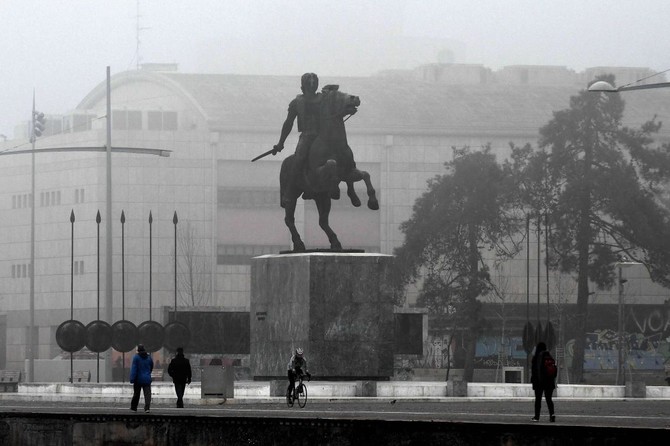
Greek nationalists seek momentum amid Macedonia talks
Greek nationalists seek momentum amid Macedonia talks
Latest updates


© 2026 SAUDI RESEARCH & PUBLISHING COMPANY, All Rights Reserved And subject to Terms of Use Agreement.