

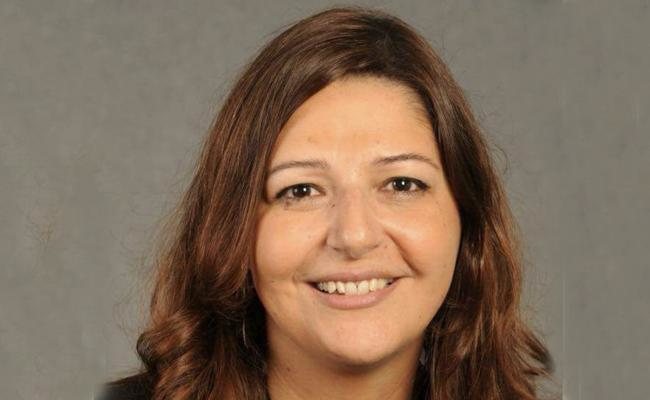
Lebanese journalist sentenced to 6 months in prison for ‘attacking army’

Hanin Ghaddar
Updated 18 January 2018
Follow

Lebanese journalist sentenced to 6 months in prison for ‘attacking army’

BEIRUT: A Lebanese military court sentenced Hanin Ghaddar, a Lebanese fellow at the Washington Institute for Near East Policy, to six months in prison in absentia on charges of “attacking the Lebanese Army.”

She wrote on her Facebook page: “I am going to prison because I voiced my opinion while criminals and terrorists freely roam the country.”

Ghaddar’s defense attorney, Marwan Sakr, said: “Sentencing my client in absentia was prompted by a declaration she made in 2014 during a seminar at the Washington Institute for Near East Policy, when she said the Lebanese Army discriminated between Sunni and Shiite terrorism while tolerating the latter.”

He added: “In similar cases we normally object to the sentences, but in this particular case we cannot raise any objection because Hanin lives outside Lebanon.”

The SKeyes Center for Media and Cultural Freedom said the sentence “constitutes a dangerous precedent in Lebanon, in which the military judiciary intervenes in a civil case. It also constitutes lack of justice, muffling of voices, and deliberate bullying in which one party plays the role of a referee in a manner that contradicts the principles of fair trial.”

The sentence is “a new step toward turning the Lebanese government into an authoritarian regime, similar to other regimes in the region, where military judiciary is used for oppressing the public under vague terms and false arguments,” SKeyes added.

“How can an authority that claims to be concerned about freedom and human rights carry out a military sentence against journalists participating in political seminars?”

The sentence came 24 hours after Lebanon reversed a ban on Steven Spielberg’s new film “The Post.”

The ban was recommended by the country’s censorship board, but the Interior Ministry rejected the recommendation and the film was allowed in cinemas from Wednesday.

The ministry’s decision “was based on the fact that more than 20 Spielberg movies were allowed in Lebanese theaters, so there was no reason to ban his latest, and this is a good precedent,” Gino Raidy, vice president of the MARCH Center for Freedom of Speech, told Arab News.

When asked if he is worried about riots erupting in cinemas, he replied: “These kinds of activists aren’t violent; they’re peaceful even when they have different views.”



Foreign media group slams Israel for refusing to lift Gaza press ban

Updated 58 min 58 sec ago
Follow

Foreign media group slams Israel for refusing to lift Gaza press ban

  • Foreign Press Association expresses 'profound disappointment' with Israeli government’s response to a Supreme Court appeal
  • Israel has barred foreign journalists from independently entering the devastated territory since the war started

JERUSALEM: An international media association on Tuesday criticized the Israeli government for maintaining its ban on unrestricted media access to Gaza, calling the move disappointing.
The government had told the Supreme Court in a submission late Sunday that the ban should remain in place, citing security risks in the Gaza Strip.
The submission was in response to a petition filed by the Foreign Press Association (FPA) — which represents hundreds of journalists in Israel and Palestinian territories — seeking immediate and unrestricted access for foreign journalists to the Gaza Strip.
“The Foreign Press Association expresses its profound disappointment with the Israeli government’s latest response to our appeal for full and free access to the Gaza Strip,” the association said on Tuesday.
“Instead of presenting a plan for allowing journalists into Gaza independently and letting us work alongside our brave Palestinian colleagues, the government has decided once again to lock us out” despite the ceasefire in the territory, it added.
Since the outbreak of the Gaza war in October 2023, triggered by an attack on Israel by the Palestinian militant group Hamas, the government has barred foreign journalists from independently entering the devastated territory.
Instead, Israel has allowed only a limited number of reporters to enter Gaza on a case-by-case basis, embedded with its military inside the blockaded Palestinian territory.
The FPA filed its petition in 2024, after which the court granted the government several extensions to submit its response.
Last month, however, the court set January 4 as a final deadline for the government to present a plan for allowing media access to Gaza.
In its submission, the government maintained that the ban should remain in place.
“This is for security reasons, based on the position of the defense establishment, which maintains that a security risk associated with such entry still exists,” the government submission said.
The government also said that the search for the remains of the last hostage held in Gaza was ongoing, suggesting that allowing journalists in at this stage could hinder the operation.
The remains of Ran Gvili, whose body was taken to Gaza after he was killed during Hamas’s 2023 attack, have still not been recovered despite the ceasefire.
The FPA said it planned to submit a “robust response” to the court, and expressed hope the “judges will put an end to this charade.”
“The FPA is confident that the court will provide justice in light of the continuous infringement of the fundamental principles of freedom of speech, the public’s right to know and free press,” the association added.
The Supreme Court is expected to issue a ruling on the matter, though it is unclear when a decision will be handed down.
An AFP journalist sits on the board of the FPA.