Lebanon court orders six-month jail term for journalist

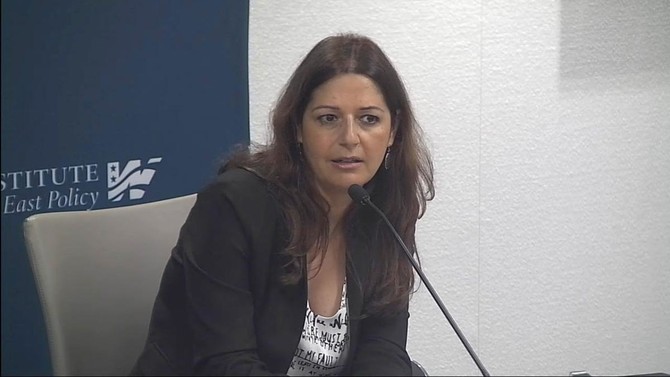
Hanin Ghaddar, a researcher known for her criticism of the powerful Hezbollah movement, was sentenced in absentia. (YouTube/Washington Institute)
Updated 18 January 2018
Follow

Lebanon court orders six-month jail term for journalist

BEIRUT: A Lebanese military court handed down a six-month prison sentence to a journalist for presenting views critical of the army, a court official told AFP said Thursday.
Hanin Ghaddar, also a researcher known for her criticism of the powerful Hezbollah movement, was sentenced in absentia on Jan. 10 over an expose at a conference in the US, the source said.
Her sentence sparked outrage among fellow journalists and academics in Lebanon, where they said free speech and freedom of the press were once again being challenged.
The court official said the ruling found Ghaddar, a US resident, guilty of “defaming the Lebanese army, harming its reputation and accusing it of distinguishing between Lebanese citizens.”
During a conference session in Washington in 2014, a recording of which is available online, she described the situation in Lebanon as “Sunnis being clamped down by Hezbollah and the Lebanese army versus Hezbollah militia being the untouchables.”
Hezbollah is a Shiite organization backed by Iran which is represented in the Lebanese government and has a militia often considered more powerful than the national army itself.
The military courts in Lebanon have a very broad jurisdiction over civilians and rights groups have voiced concern that could be used as a tool for intimidation against free speech and activism.
— AFP


Fragrance artisans weave heritage into Jazan Festival experience

Updated 8 sec ago
Follow

Fragrance artisans weave heritage into Jazan Festival experience

Riyadh: Perfumes are emerging as living connections to ancestral memory at the Jazan Festival 2026, which opened on Friday, the Saudi Press Agency reported.

A narrative rooted in botanical origins is unfolding as veteran craftswomen showcase decades of accumulated wisdom, transforming the contents of native plants into small vessels that distill the human bond with terrain.

Aromas wafting through the space suggest imagery of regional ecosystems — fragrant vegetation cultivated across highland and lowland zones, harvested during optimal periods, then subjected to extended drying and distillation processes before materializing as perfumes and essences embodying geographical character, the Saudi Press Agency reported.

Arranged fragrance containers resemble nature’s output, composed by skilled practitioners versed in harvest timing, plant dormancy requirements and scent extraction methods, yielding products preserving organic integrity and territorial identity.

Craftswoman Fatima bint Mohammed Al-Faifi has dedicated two decades to perfume production, characterizing regional practice as social custom interwoven throughout daily existence — deployed in guest reception, featured at celebrations, accompanying community gathering — elevating scent to cultural signature, the Saudi Press Agency reported.

Festival attendees are discovering aromatic botanicals, absorbing production methodology explanations and discerning nuanced olfactory distinctions, demonstrating how craftsmanship blends persistence with expertise, tradition with innovation.

Perfume artisan involvement aligns with Jazan Festival’s initiative repositioning traditional crafts as dynamic, evolving culture while spotlighting women’s contributions safeguarding regional inheritance and expressing this through modern methods, the Saudi Press Agency reported.