LONDON: British and French leaders aim to deepen cooperation in tackling terrorism and the migration crisis at a bilteral summit near London Thursday, as Britain tries to strengthen ties before leaving the EU next year.
Prime Minister Theresa May will meet President Emmanuel Macron — on his first official trip across the Channel — at an army base close to the capital, with an agenda intended to “reflect the broadness of the UK-France relationship,” British officials said.
Either side of the summit, attended by both countries’ Cabinet ministers, the leaders are expected to have a private lunch and attend a reception at the Victoria and Albert Museum.
In a piece of diplomatic theater, Macron is expected to confirm that France will agree in principle to loan London the Bayeux Tapestry, the famed 941-year-old embroidery that recounts the 1066 Norman conquest of Britain.
“Today’s summit will underline that we remain committed to defending our people and upholding our values as liberal democracies in the face of any threat, whether at home or abroad,” May said in a statement ahead of the talks.
“Our friendship has always gone far beyond defense and security and the scope of today’s discussions represents its broad and unique nature,” she added.
The leaders will address the sensitive issue of immigration, with Britain’s arrangement with France over policing the border in Calais likely to be scrutinized.
Hundreds of people continue to camp out in the northern French town, hoping to stow away on trucks heading to Britain, a destination seen as an El Dorado by some migrants from Afghanistan and East Africa.
The two countries currently abide by the 15-year-old Treaty of Le Touquet, which permits immigration checks within each other’s borders.
A new treaty will be signed at Thursday’s summit to complement the 2003 deal, according to French officials.
May is set to agree to welcome more young refugees stuck in Calais and increase financial aid, a British government spokesman said.
Media reports Thursday suggest she is willing to offer an extra £45 million to improve border security, but Macron will demand extra funds for Calais.
“We have in the past contributed to security and if there are requests for further help we would look at those,” said a May government spokesman.
“We’ve given clear commitment to child refugees.”
May and Macron are also due to announce enhanced police cooperation to control the border.
The British prime minister is also set to commit to sending Royal Air Force (RAF) helicopters to a key French counter-terrorism operation in Mali.
The deployment of three RAF Chinook helicopters to provide logistic support to French troops tackling jihadis across Africa’s Sahel region is part of broader counter-terrorism and military efforts there by the UN, EU and African Union.
“Recent terrorist attacks across Europe underline the scale of the cross-border challenge we face in keeping our citizens safe,” the UK government spokesman said.
France, in turn, has agreed to commit troops to the British-led NATO battlegroup in Estonia in 2019.
Officials said it would build on the joint deployment of soldiers to the Baltic country whom the two leaders visited together last year.
At the summit, the pair will also discuss their joint crackdown on online extremism “to ensure that the Internet cannot be used as a safe space for terrorists and criminals,” according to the spokesman.
Britain is also expected to allocate £50 million of additional aid for those affected by epidemics, natural disasters and conflict across Mali, Niger, Chad, North Cameroon, Burkina Faso and Mauritania.
The government hopes the cash will help provide 320,000 people with emergency food and provide protection for 255,000 refugees.
Thursday’s gathering at Sandhurst military academy — the 35th UK-France summit — comes as Britain is eager to develop stronger bilateral ties with its continental partners ahead of leaving the EU in March 2019.
The issue of Brexit is not scheduled for formal discussion but will likely be touched upon in talks on other topics, the British official said.
Summits in previous years have focused on defense and security, foreign policy and nuclear energy, but the 2018 agenda was broadened to cover “the full spectrum of the UK-France bilateral relationship including prosperity, innovation, science and education” he added.


![]()
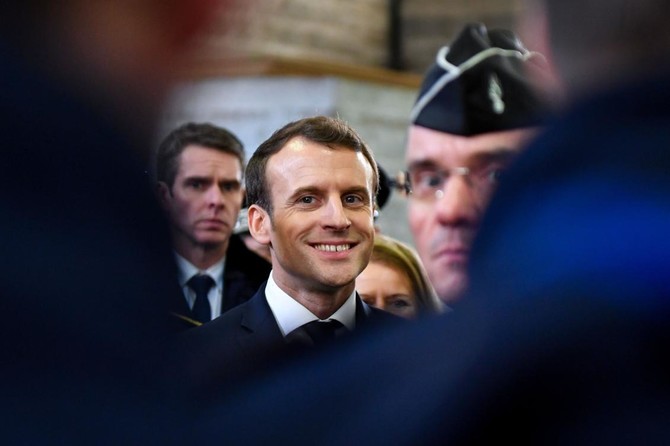
British PM May, French President Macron to hold bilateral summit amid migrant crisis, Brexit
British PM May, French President Macron to hold bilateral summit amid migrant crisis, Brexit
Latest updates


© 2026 SAUDI RESEARCH & PUBLISHING COMPANY, All Rights Reserved And subject to Terms of Use Agreement.