Toshiba reaches deal to sell claims in bankrupt Westinghouse

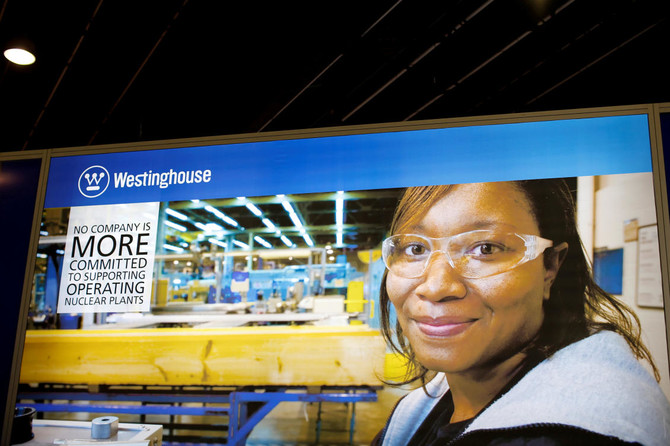
Pittsburgh-based Westinghouse, which traces its roots to the 19th century, was acquired by Toshiba in 2006 for $5.4 billion at a time of increased interest in cleaner fuel sources. (Reuters)
Updated 18 January 2018
Follow

Toshiba reaches deal to sell claims in bankrupt Westinghouse

TOKYO/WASHINGTON: Toshiba said on Thursday it had clinched an agreement to sell its claims in bankrupt US nuclear plant maker Westinghouse Electric in a deal that would add $3.7 billion (SR13.87 billion) to the Japanese owner’s depleted capital base.
The Japanese conglomerate has also agreed to transfer its Westinghouse-related shares to Canada’s Brookfield Business Partners, which earlier this month agreed to buy the unit for $4.6 billion — money that will be used to repay the nuclear plant maker’s creditors.
These deals could help clear Westinghouse’s path out of bankruptcy before Toshiba’s financial year ends in March, while also allowing the Japanese firm to resolve its negative net worth and stay listed on the Tokyo Stock Exchange.
Toshiba said in a statement that it would sell its claims against Westinghouse to a group of hedge funds led by the Baupost Group, and that the deal that would contribute about ¥410 billion to its capital base.
The deal, first reported by Reuters earlier in the day, will make the group of hedge funds Westinghouse’s biggest creditor, helping cut down the fights among several creditors that had threatened to slow down the resolution of the bankruptcy.
The group led by Baupost has already bought claims worth more than $2.2 billion from Scana Corp, a South Carolina utility that contracted Westinghouse to build two reactors.
The South Carolina project, and another in Georgia, went billions of dollars over the fixed-price contract, forcing Westinghouse into bankruptcy in March.
Westinghouse’s bankruptcy pushed Toshiba into a crisis and prompted Toshiba to sell its memory chip business for $18 billion to shore up its balance sheet. The Japanese firm also forecast a negative net worth of ¥750 billion at end-March.
But finances are set to be shored up by the Baupost deal, which includes an after-tax profit of about ¥170 billion from the sale of claims and tax benefits of about ¥240 billion, Toshiba said. It added the company would promptly announce any revised forecasts as appropriate.
Pittsburgh-based Westinghouse, which traces its roots to the 19th century, was acquired by Toshiba in 2006 for $5.4 billion at a time of increased interest in cleaner fuel sources.
In recent weeks, Citibank on behalf of the Baupost group of hedge funds has claimed it is owed as much as $7.5 billion by Westinghouse, alleging among other things gross negligence. The allegations are based on the South Carolina claims that the Baupost group has acquired.
Westinghouse disputed the new claims and said it threatened to delay the resolution of the case.


Saudi Arabia’s cultural sector is a new economic engine between Riyadh and Paris, says ambassador

Updated 25 January 2026
Follow

Saudi Arabia’s cultural sector is a new economic engine between Riyadh and Paris, says ambassador

RIYADH: Culture has become a fundamental pillar in bilateral relations between France and Saudi Arabia, according to the French Ambassador to the Kingdom, Patrick Maisonnave.

Maisonnave noted its connection to the entertainment and tourism sectors, which makes it a new engine for economic cooperation between Riyadh and Paris.

He told Al-Eqtisadiah during the opening ceremony of La Fabrique in the Jax district of Diriyah that cultural cooperation with Saudi Arabia is an important element for its attractiveness in the coming decades.

La Fabrique is a space dedicated to artistic creativity and cultural exchange, launched as part of a partnership between the Riyadh Art program and the French Institute in Riyadh. 

Running from Jan. 22 until Feb 14, the initiative will provide an open workspace that allows artists to develop and work on their ideas within a collaborative framework.

Launching La Fabrique as a space dedicated to artistic creativity

The ambassador highlighted that the transformation journey in the Kingdom under Vision 2030 has contributed to the emergence of a new generation of young artists and creators, alongside a growing desire in Saudi society to connect with culture and to embrace what is happening globally. 

He affirmed that the relationship between the two countries is “profound, even cultural par excellence,” with interest from the Saudi side in French culture, matched by increasing interest from the French public and cultural institutions unfolding in the Kingdom.

Latest estimates indicate that the culture-based economy represents about 2.3 percent of France’s gross domestic product, equivalent to more than 90 billion euros ($106.4 billion) in annual revenues, according to government data. The sector directly employs more than 600,000 people, making it one of the largest job-creating sectors in the fields of creativity, publishing, cinema, and visual arts.

Saudi Arabia benefiting from French experience in the cultural field

Maisonnave explained that France possesses established cultural institutions, while Saudi Arabia is building a strong cultural sector, which opens the door for cooperation opportunities.

This comes as an extension of the signing of 10 major cultural agreements a year ago between French and Saudi institutions, aiming to enhance cooperation and transfer French expertise and knowledge to contribute to the development of the cultural system in the Kingdom.

He added that experiences like La Fabrique provide an opportunity to meet the new generation of Saudi creators, who have expressed interest in connecting with French institutions and artists in Paris and France.

La Fabrique encompasses a space for multiple contemporary artistic practices, including performance arts, digital and interactive arts, photography, music, and cinema, while providing the public with an opportunity to witness the stages of producing artistic works and interact with the creative process.