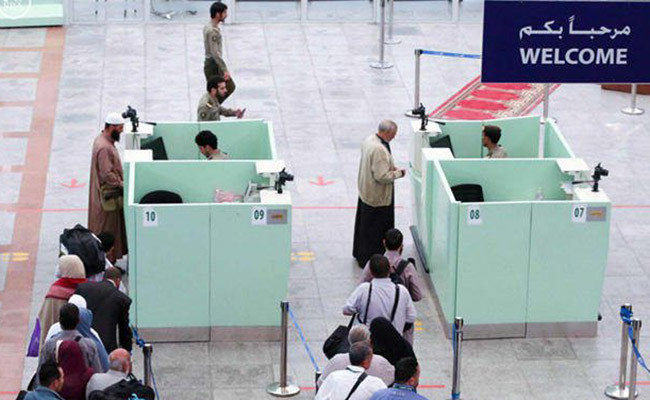
RIYADH: Saudi females will be recruited at the rank of private to work in airports and land border-crossing points, the General Directorate of Passports has announced.
Registration and admission applications will be received from Jan. 21 to 25.
The directorate has set some conditions for the recruitment.
Female applicants must be born and raised in Saudi Arabia and between 25 and 35 years old (according to the identity card upon presenting the applications).
They should have a good reputation and be free of any breach of trust and integrity. They cannot be government employees, nor have served in the military field.
Applicants cannot be married to non-Saudis. The directorate will only accept candidates who fall into a specific height range (a minimum of 155cm) and whose weight is proportionate to their height.
They must be holders of a high-school diploma or equivalent, must agree to be interviewed according to the specified conditions, must be medically qualified for the military service and must commit to the specified shifts in any region, province or border-crossing in the Kingdom, under any circumstances.
Any applicant who presents information that turns out to be false will be excluded. The registration process does not mean a final approval. Applicants must attend training even if it is outside the city they work in.

Immigration department starts recruiting Saudi women
SR 4.5bn raised from 135m donations through the Saudi Ehsan charity platform in 2025
- More than 330m donations made on the platform over past 5 years worth a total of SR14bn, officials reveal in run-up to 6th National Campaign for Charitable Work
- In addition, the Jood Eskan platform that helps low-income families secure housing has raised SR5bn from 4.5m donors since its launch in 2019
RIYADH: Ahead of the launch on March 3 of the sixth National Campaign for Charitable Work on the Ehsan platform, officials on Monday revealed that more than SR4.5 billion ($1.2 billion) was donated through the platform in 2025 alone.
Abdullah Alghamdi, president of the Saudi Data and Artificial Intelligence Authority, said there were 135 million donations last year worth a total daily average of SR12.45 million, compared with about SR2.8 million during the platform’s first campaign in 2021.
Over the past five years, he added, more than 330 million donations have been made through Ehsan, worth a total of SR14 billion.
The platform was built on three main pillars, Alghamdi said: reliability, transparency and ease of use. It uses advanced data analytics and artificial intelligence to verify beneficiary eligibility and prevent duplication of support, he added, and a donation can be completed in less than five seconds.
It was built to “humanize the donation journey,” he said, by ensuring donors can see the direct effects of their contributions, and operates under a framework of governance that includes 13 supervisory entities and five subcommittees.
The Ehsan Waqf Fund, which was introduced to ensure long-term sustainability, so far has collected SR2.2 billion of a SR5 billion target, Alghamdi said.
Majed Al-Hogail, the minister of municipalities and housing, highlighted the expanding role of nonprofit organizations in the housing sector in particular. More than 313 nonprofits now operate within the system, he said, supported by more than 345,000 volunteers working alongside public and private organizations.
Housing initiatives have helped support more than 106,000 families eligible for assistance, he added, and prevented more than 200,000 households from losing their homes. In addition, a rent-support program is assisting about 6,600 families this year, “expanding the reach of support to more households.”
The Jood Eskan housing platform, which enables donors to help people on low incomes secure housing, began by supporting 100 families and now serves more than 50,000 across the Kingdom, Al-Hogail said. Since its launch in 2019, more than 4.5 million donors have contributed more than SR5 billion to housing initiatives, he added.
“This transformation is the result of cumulative efforts built on clear governance, precise eligibility criteria, and electronic integration with relevant entities,” Al-Hogail said.
He also highlighted digital-transformation efforts designed to accelerate the provision of assistance, including the linking of a debt defaulters support platform to the Ministry of Justice, which has reduced processing times for cases from a month to 19 days. Meanwhile an electronic signature service cut the processing time for property-ownership procedures from 14 days to just two.
“In 2025, more than 150,000 digital operations were implemented and the needs of over 400,000 beneficiary families were studied through the integration of national databases,” Al-Hogail said.