

Lahore protesters urge top politicians to step down over deadly 2014 clashes

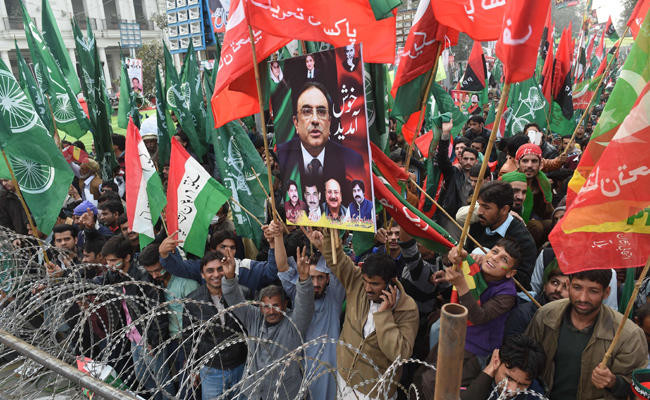
Supporters of Pakistan Awami Tehreek (PAT), Pakistan Peoples Party (PPP) and Pakistan Tehreek-i-Insaf (PTI) carry their party flags during an anti-government protest rally in Lahore on January 17, 2018. (AFP / ARIF ALI)
Updated 17 January 2018
Follow

Lahore protesters urge top politicians to step down over deadly 2014 clashes

ISLAMABAD: Thousands of protesters took part in a mass rally in Lahore on Wednesday to demand the resignation of Punjab’s Chief Minister Shahbaz Sharif and Law Minister Rana Sanaullah.

The demonstrators and opposition politicians hold the two men responsible for the deaths of 14 people in clashes with police outside the home of Pakistan Awami Tehrik (PAT) leader Muhammed Tahir-ul-Qadri in the Model Town suburb of the city in June 2014.

Tahir-ul-Qadri led Wednesday’s protest, supported by Imran Khan of Pakistan Tehrik-e-Insaf (PTI), former President Asif Ali Zardari of the Pakistan People’s Party (PPP), and leaders from the Pakistan Muslim League-Qaid-e-Azam, Majlis Wahdat-ul-Muslimeen and Awami Muslim League.

Protesters began gathering at noon in the city’s busy Mall Road, and 6,000 police were on duty to maintain security.

Addressing the crowd from a temporary stage on top of a container near the Punjab Assembly building, Tahir-ul-Qadri said: “The entire political leadership is here to honor humanity, to empower the weak, to give voice to the voiceless. We have gathered to wake up the nation against the suppression of human rights.”

Chief Minister Shahbaz Sharif is the brother of Nawaz Sharif, the former prime minister who was ordered to step down and disqualified from office by the Supreme Court last June. The Sharif family cared only about their own dynasty, the former president told the rally.

“We can oust them from power anytime and they are forcing us to do so,” Zardari said, while urging the continuity of the democratic process.

National Assembly opposition leader Khursheed Shah of the PPP told the crowd: “We are here to seek justice. We are all one to show solidarity with those killed in 2014 in Model Town.”

Although Imran Khan and Zardari both took part in the rally, they did not appear on the stage together because of political differences. PTI spokesman Fawad Chaudhry said to do so would damage the PTI’s movement against corruption.

Wednesday’s rally was expected to conclude by midnight at the request of the High Court in Lahore, but further protests are expected.

Minister of State for Information Maryam Aurangzeb said: “We should keep in mind why they are protesting. Just months before general elections, Nawaz Sharif’s popularity pushed these parties together against the government.”


Bangladesh halts controversial relocation of Rohingya refugees to remote island

Updated 29 December 2025
Follow

Bangladesh halts controversial relocation of Rohingya refugees to remote island

  • Administration of ousted PM Sheikh Hasina spent about $350m on the project
  • Rohingya refuse to move to island and 10,000 have fled, top refugee official says

DHAKA: When Bangladesh launched a multi-million-dollar project to relocate Rohingya refugees to a remote island, it promised a better life. Five years on, the controversial plan has stalled, as authorities find it is unsustainable and refugees flee back to overcrowded mainland camps.

The Bhasan Char island emerged naturally from river sediments some 20 years ago. It lies in the Bay of Bengal, over 60 km from Bangladesh’s mainland.

Never inhabited, the 40 sq. km area was developed to accommodate 100,000 Rohingya refugees from the cramped camps of the coastal Cox’s Bazar district.

Relocation to the island started in early December 2020, despite protests from the UN and humanitarian organizations, which warned that it was vulnerable to cyclones and flooding, and that its isolation restricted access to emergency services.

Over 1,600 people were then moved to Bhasan Char by the Bangladesh Navy, followed by another 1,800 the same month. During 25 such transfers, more than 38,000 refugees were resettled on the island by October 2024.

The relocation project was spearheaded by the government of former Prime Minister Sheikh Hasina, who was ousted last year. The new administration has since suspended it indefinitely.

“The Bangladesh government will not conduct any further relocation of the Rohingya to Bhasan Char island. The main reason is that the country’s present government considers the project not viable,” Mizanur Rahman, refugee relief and repatriation commissioner in Cox’s Bazar, told Arab News on Sunday.

The government’s decision was prompted by data from UN agencies, which showed that operations on Bhasan Char involved 30 percent higher costs compared with the mainland camps in Cox’s Bazar, Rahman said.

“On the other hand, the Rohingya are not voluntarily coming forward for relocation to the island. Many of those previously relocated have fled ... Around 29,000 are currently living on the island, while about 10,000 have returned to Cox’s Bazar on their own.”

A mostly Muslim ethnic minority, the Rohingya have lived for centuries in Myanmar’s western Rakhine state but were stripped of their citizenship in the 1980s and have faced systemic persecution ever since.

In 2017 alone, some 750,000 of them crossed to neighboring Bangladesh, fleeing a deadly crackdown by Myanmar’s military. Today, about 1.3 million of them shelter in 33 camps in the coastal Cox’s Bazar district, making it the world’s largest refugee settlement.

Bhasan Char, where the Bangladeshi government spent an estimated $350 million to construct concrete residential buildings, cyclone shelters, roads, freshwater systems, and other infrastructure, offered better living conditions than the squalid camps.

But there was no regular transport service to the island, its inhabitants were not allowed to travel freely, and livelihood opportunities were few and dependent on aid coming from the mainland.

Rahman said: “Considering all aspects, we can say that Rohingya relocation to Bhasan Char is currently halted. Following the fall of Sheikh Hasina’s regime, only one batch of Rohingya was relocated to the island.

“The relocation was conducted with government funding, but the government is no longer allowing any funds for this purpose.”

“The Bangladeshi government has spent around $350 million on it from its own funds ... It seems the project has not turned out to be successful.”