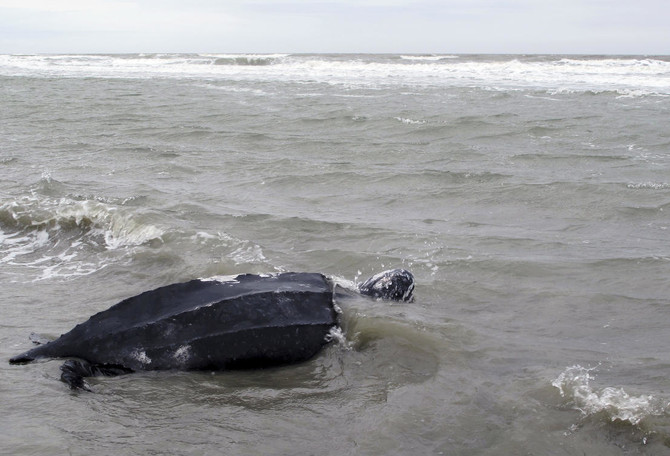
Federal ocean managers say it might be time to move the East Coast population of the world’s largest turtle from the United States’ list of endangered animals.
An arm of the National Oceanic and Atmospheric Administration has received a petition from a fishing group asking that the Northwest Atlantic Ocean’s leatherback sea turtles be listed as “threatened,” but not endangered, under the Endangered Species Act. The giant reptiles, which can weigh 2,000 pounds, would remain protected under federal law, but their status would be moved down a notch.
NOAA officials have said the agency has reviewed the petition from New Jersey-based Blue Water Fishermen’s Association and found “substantial scientific and commercial information” that the move might be warranted. The agency now has about eight months to make a decision about the status of the turtles.
Leatherbacks live all over the world’s oceans and have been listed as endangered by the US since 1970. Deciding whether the listing should be changed will require determining the stability of the population, said Jennifer Schultz, a fisheries biologist with NOAA Fisheries.
“We’ll look at scientific papers, we look at the best available scientific and commercial data,” she said. “And then we’ll say, ‘What does the status look like? How are they doing?’“
The fishing group that requested the change wants the Northwestern Atlantic’s leatherback population to be considered a distinct segment of the population. That segment would include all of the leatherbacks that nest on beaches in the eastern US states. But NOAA Fisheries is going to look at the status of the turtles worldwide, said Angela Somma, chief of endangered species division with NOAA Fisheries.
Blue Water Fishermen’s Association requested the change of listing in part to spur new research into the status of the leatherback population, said Ernie Panacek, a past president of the organization. Data about species such as sea turtles and marine mammals play a role in crafting fishing regulations, and fishermen fear the government is using outdated data about leatherbacks, he said.
“I get a little frustrated in the fact that they are making regulations without scientific data in front of them,” he said. “The more turtles there are, the more interactions you are bound to have with them.”
The leatherback sea turtle has been the subject of intense interest from conservation groups over the years. It’s listing as endangered by the US predates the modern Endangered Species Act that was enacted in 1973. The Costa Rica-based Leatherback Trust, an international nonprofit group, describes them as “ancient creatures celebrated in creation myths belonging to diverse cultures around the world.”
International Union for Conservation of Nature lists the leatherback sea turtle as “vulnerable,” which is one notch above “endangered” on the IUCN’s scale. It’s one of the largest reptiles on Earth, feeding mostly on jellyfish, which has left them at risk to plastic in the ocean, which can kill them if they ingest it. They are also notable for being the deepest diving and most migratory of all sea turtles, and for their lack of a bony shell.
NOAA is collecting information and comments on the subject until Feb. 5.


![]()
World’s largest sea turtle could come off ‘endangered’ list
World’s largest sea turtle could come off ‘endangered’ list


Latest updates


© 2026 SAUDI RESEARCH & PUBLISHING COMPANY, All Rights Reserved And subject to Terms of Use Agreement.