STRASBOURG: The European Union unveiled plans Tuesday for all plastic packaging in Europe to be recyclable by 2030 and phase out single-use plastic like coffee cups to fight pollution.
The strategy announced by the European Commission, the EU-executive, follows China’s decision to ban imports of foreign products to be recycled, including huge quantities from Europe.
“The commission aims to increase plastic recycling and for all plastic packaging to be reusable or recyclable by 2030,” the executive body said.
The Commission said its proposals also aim to create business opportunities by transforming the way plastic products are designed, produced and recycled in Europe.
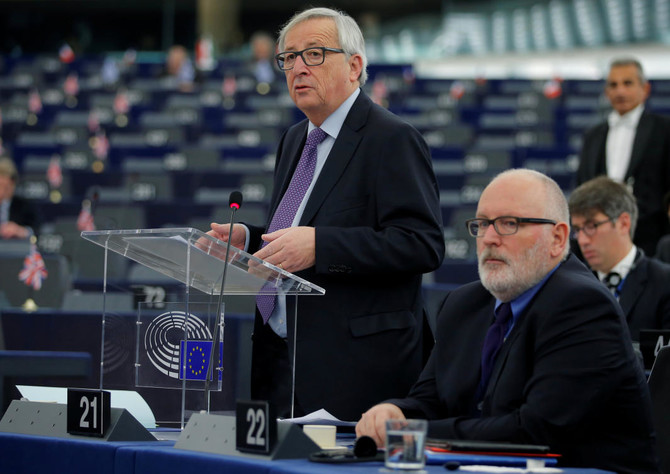
Commission First Vice President Frans Timmermans said: “We must stop plastics getting into our water, our food, and even our bodies. The only long-term solution is to reduce plastic waste by recycling and reusing more.”
“The Chinese decision is undoubtedly a big challenge but let’s turn that challenge into an opportunity,” he added.
The proposals did not contain plans for a tax on plastic packaging, which budget commissioner Guenther Oettinger proposed last week to fight pollution and to help plug a hole of around 13 billion euros in the bloc’s budget caused by Brexit.
“We have not found a way to introduce a European-wide plastic tax yet,” Vice President Jyrki Katainen, who is responsible for jobs and investment, told reporters. “It is too early to promise anything.”
Britain’s Prince Charles and others held an EU-backed conference last year for drastic action to stop eight million tons of plastic waste polluting the world’s oceans annually.
The commission said Europeans generate 25 million tons of plastic waste annually, but less than 30 percent is collected for recycling.
Timmermans called for promoting awareness, urging parents to tell their children that a plastic straw takes only a second to produce but 500 years to degrade.
He said the commission has launched a process to ultimately ban microplastics, which are found in cosmetics and other products but slip into the body through food.
Katainen said the strategy is “a great opportunity for European industry to develop global leadership in new technology and materials.”
He added Europe does not yet have a functioning single recycling market for plastic as there are no set standards.
According to Plastics Europe, the Brussels-based association of European plastics manufacturers, the industry is worth 340 billion euros (2015 figures) in the EU, and employs more than 1.5 million people.


EU sets 2030 target for recyclable plastic packaging
EU sets 2030 target for recyclable plastic packaging

GCC economy to grow by 4.4% in 2026: Oxford Economics
RIYADH: Gulf Cooperation Council regional economies are expected to stay resilient in 2026, driven by strong domestic demand and a broadly steady global economy, according to an analysis.
In its latest report, Oxford Economics highlighted that the real gross domestic product of the GCC region is expected to expand by 4.4 percent in 2026, up from the projected 4 percent this year.
The projection is broadly aligned with the World Bank’s December outlook, which expects growth in the GCC region to hit 3.2 percent in 2025 and 4.5 percent in 2026.
Earlier this month, the International Monetary Fund said that GCC economic output is forecast to accelerate to an average of 3.3 percent in 2025, up from 1.7 percent in 2024.
“Growth in the GCC will likely beat our expectations this year following two years of disappointment. US trade policy under President Donald Trump has had no notable impact on regional growth, and non-energy sectors have sustained their robust momentum,” said Oxford Economics.
It added: “Meanwhile, oil production has gradually increased, providing a boost to the region’s economies. We expect GCC growth will rise to 4.4 percent in 2026, from 4 percent this year.”
In November, the GCC Statistical Center said that economic growth in the region is set to accelerate to 4.3 percent by 2027, driven by expanding non-oil sectors.
The GCC Statistical Center revealed that economies in the region expanded by 3 percent in the first half of this year, with combined GDP reaching $588.1 billion, up from $570.9 billion in the same period last year.
Non-oil activities accounted for 73.2 percent of total GDP, up from 70.6 percent at the end of 2024, highlighting the region’s continued progress toward diversification.
Boost in consumer spending
According to Oxford Economics, GCC consumers will be standout performers in 2026 and are expected to outperform their international peers.
Oxford Economics said that low inflation has helped protect growth in real disposable income, which has also been supported by strong demand and very low unemployment rates.
“We do not envision any let-up, as governments continue to push for greater foreign direct investment in their push to diversify their economies away from oil and gas,” the report added.
In October, the IMF said that inflation in the GCC region is expected to average 1.7 percent in 2025 and 2 percent in 2026 — underscoring the bloc’s resilience to global price pressures.
In December, the IMF further said that headline inflation is expected to stay below 2 percent in Bahrain, Oman, and Qatar, close to 2 percent in the Kingdom and the UAE, and slightly above 2 percent in Kuwait in 2025–2026.
According to Oxford Economics, credit growth is expected to remain elevated in the GCC region during 2026, as access to financial services is expected to grow and lending is projected to be supported by further cuts in interest rates.
“Owing to their currency pegs to the US dollar, GCC central banks are expected to follow the US Federal Reserve by easing monetary policy further, which in turn will lower debt servicing costs and boost disposable income and demand,” said the report.
OPEC+ production cuts
The report further highlighted that the OPEC+ pause on oil output will likely be extended to the second quarter of next year, marginally impacting growth momentum among countries in the region.
“The announcement from OPEC+ of a pause in the recent re-expansion of oil production came as no surprise, as excess inventories surpassed two million barrels per day,” said Oxford Economics.
It added: “Our forecast has the price of Brent crude oil falling below $60 pb in early 2026, which should prompt OPEC+ to extend its pause to the second quarter. This is likely to stall the contribution from oil extraction to GDP.”
The report projected that GCC countries are expected to resume raising oil supplies again in the second half of next year, and a full unwinding of remaining caps on production is likely to happen in mid-2027.
Qatar’s economy is likely to be the best-performing in the region, as the country is expected to substantially increase its gas production and exports in 2026.
The rising importance of AI
Oxford Economics further said that GCC countries are increasingly recognizing the importance of diversifying their economies, with these nations considering AI-related sectors as strategically important opportunities for the region.
“Governments aim to provide a complete ecosystem for AI leaders, so that they choose to locate and grow in the GCC region. With abundant energy, they are aiming not only to service the AI industry, but also to have it serve as an export industry in the future,” said the report.
Affirming the growth of AI in the region, a report released by PwC earlier this month said that the usage of AI among the workforce in the Middle East continues to rise, with 75 percent of employees in the region using it in their jobs over the past 12 months.
Earlier this month, data from the Global AI Index revealed that the Kingdom has secured fifth place globally and first in the Arab region for growth in the AI sector.
In November, a report released by KPMG highlighted Saudi Arabia’s progress in the technology sector and said that 84 percent of CEOs in the nation are ready to deploy AI responsibly, well above the 76 percent global benchmark, supported by the Kingdom’s data governance ecosystem, including national initiatives led by the Saudi Data and Artificial Intelligence Authority.
According to Oxford Economics, 2026 will be a pivotal year for the AI sector, as plans move into execution and the region sees increased capital investment and deeper integration.
“This includes further investment in the required infrastructure, such as energy, hardware, data centers, and skilled staff. Policymakers are thinking holistically about how to make the region attractive, including having more pragmatic laws to allow for experimentation and growth,” said the report.


