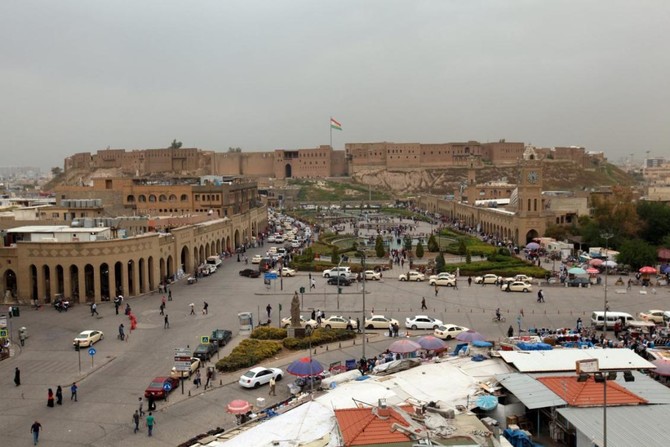
Baghdad reports ‘atmosphere of trust’ in talks with Kurdistan region

Envoys of the two sides met in the Kurdish regional capital Irbil in northern Iraq and discussed major issues including security, control over the Kurdistan Regional Government’s (KRG) land borders, airports, the oil industry, customs revenue and river dams. (Reuters)
Updated 15 January 2018
Follow

Baghdad reports ‘atmosphere of trust’ in talks with Kurdistan region

BAGHDAD: Iraq’s central government said “an atmosphere of trust” marked talks held on Monday with the semi-autonomous Kurdistan region to resolve a conflict that triggered armed clashes in October.
Envoys of the two sides met in the Kurdish regional capital Irbil in northern Iraq and discussed major issues including security, control over the Kurdistan Regional Government’s (KRG) land borders, airports, the oil industry, customs revenue and river dams, a statement from the Iraqi cabinet said.
“The meetings were held in an atmosphere of trust and understanding and concluded...by formulating a number recommendations” to help resolve the issues, the statement added, giving no further details.
Conflict broke out after the KRG held a referendum on independence at the end of September, angering neighboring states including Turkey and Iran, with their own restive Kurdish minorities, and drawing rebukes from the Iraqi Kurds’ key Western supporters, the United States and European Union.
Under Iraqi Prime Minister Haider Al-Abadi’s orders, government forces responded to the referendum by dislodging Kurdish militia from disputed regions including the oil city of Kirkuk.
Abadi also retaliated with a series of measures curtailing the KRG’s autonomy, including a ban on direct international travel to the two main Kurdish airports.


Trump to host Colombia’s Petro just weeks after insulting him as a ‘sick man’ fueling drug trade

Updated 1 sec ago
Follow

Trump to host Colombia’s Petro just weeks after insulting him as a ‘sick man’ fueling drug trade

WASHINGTON: President Donald Trump is set to welcome Colombian President Gustavo Petro to the White House on Tuesday for talks only weeks after threatening military action against the South American country and accusing the leader of pumping cocaine into the United States.
US administration officials say the meeting will focus on regional security cooperation and counternarcotics efforts. And Trump on Monday suggested that Petro — who has continued to criticize Trump and the US operation to capture Venezuela’s Nicolás Maduro — seems more willing to work with his administration to stem the flow of illegal drugs from Colombia.
“Somehow after the Venezuelan raid, he became very nice,” Trump told reporters. “He changed his attitude very much.”
Yet, bad blood between the leaders overshadows the sit-down, even as Trump sought to downplay any friction on the eve of the visit.
The conservative Trump and leftist Petro are ideologically far apart, but both leaders share a tendency for verbal bombast and unpredictability. That sets the stage for a White House visit with an anything-could-happen vibe.
In recent days, Petro has continued poking at the US president, calling Trump an “accomplice to genocide” in the Gaza Strip, while asserting that the capture of Maduro was a kidnapping.
And ahead of his departure for Washington, Petro called on Colombians to take to the streets of Bogotá during the White House meeting.
There’s been a shift in US-Colombia relations
Historically, Colombia has been a US ally. For the past 30 years, the US has worked closely with Colombia, the world’s largest producer of cocaine, to arrest drug traffickers, fend off rebel groups and boost economic development in rural areas.
But relations between the leaders have been strained by Trump’s massing US forces in the region for unprecedented deadly military strikes targeting suspected drug smuggling boats in the Caribbean Sea and eastern Pacific. At least 126 people have been killed in 36 known strikes.
In October, the Trump administration announced it was imposing sanctions on Petro, his family and a member of his government over accusations of involvement in the global drug trade.
The Treasury Department leveled the penalties against Petro; his wife, Veronica del Socorro Alcocer Garcia; his son, Nicolas Fernando Petro Burgos; and Colombian Interior Minister Armando Alberto Benedetti.
The sanctions, which had to be waived to allow Petro to travel to Washington this week, came after the US administration in September announced it was adding Colombia to a list of nations failing to cooperate in the drug war for the first time in three decades.
Then came the audacious military operation last month to capture Maduro and his wife to face federal drug conspiracy charges, a move that Petro has forcefully denounced. Following Maduro’s ouster, Trump put Colombia on notice, and ominously warned Petro he could be next.
Colombia is “run by a sick man who likes making cocaine and selling it to the United States,” Trump said of Petro last month. “And he’s not gonna be doing it very long, let me tell you.”
But a few days later, tensions eased somewhat after a call between the leaders. Trump said Petro in their hourlong conversation explained “the drug situation and other disagreements.” And Trump extended an invitation to Petro for the White House visit.
Trump on a couple of occasions has used the typically scripted leaders’ meetings to deliver stern rebukes to counterparts in front of the press.
Trump and Vice President JD Vance lashed out at Ukrainian President Volodymyr Zelensky in February for showing insufficient gratitude for US support of Ukraine. Trump also used a White House meeting in May to forcefully confront South African President Cyril Ramaphosa,accusing the country, with reporters present, of failing to address Trump’s baseless claim of the systematic killing of white farmers.
It was not clear that the meeting between Trump and Petro would include a portion in front of cameras.