Iraqi PM loses electoral allies

Iraqi security forces cordon off the area where a double suicide bombing killed 38 people in central Baghdad on Monday. (AFP)
Updated 16 January 2018
Follow

Iraqi PM loses electoral allies

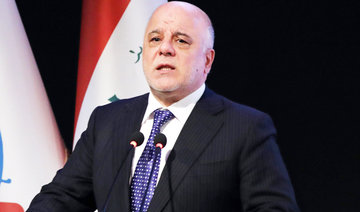
BAGHDAD: Iraq’s Prime Minister Haider Abadi on Monday lost the backing of most of the commanders of the Shiite-dominated Popular Mobilization Units (PMU) who had allied with him for parliamentary and provincial elections due in May, leaders involved in the talks between the two sides told Arab News.
The new developments came as Abadi called for the elimination of Daesh “sleeper cells” after a twin suicide bombing killed 38 people in Baghdad on Monday in the second such attack in three days.
The bombers targeted the bustling Tayran Square, in the heart of Baghdad, setting off their explosive vests among laborers and street vendors during the morning rush hour. More than 100 people were wounded, The Associated Press quoted police and hospital officials as saying.
Abadi is hoping to secure another term in the parliamentary elections after declaring victory over Daesh and thwarting an Iraqi Kurdish bid for independence.
The “Victory of Iraq” alliance had until Monday been the strongest to announce its participation in the upcoming elections.
But PMU commanders who had allied themselves with Abadi abandoned the prime minister because they could not persuade him to give up certain conditions as the basis for forming the alliance, leaders familiar with the talks told Arab News.
Abadi “had asked them to give up their political and armed affiliations, and to join the alliance as individuals,” a senior Shiite leader familiar with the talks told Arab News on condition of anonymity.
“That was his essential condition from the beginning. They (PMU commanders) believed they could pressure him to change his mind, but he insisted on his stance.”
Abadi “told them clearly to forget any demands related to posts that they’re looking to get after the elections,” the Shiite leader added.
A PMU commander involved in the talks confirmed to Arab News on condition of anonymity that Abadi had refused to discuss the issue of desired posts.
“The electoral alliance has been broken, but the doors will stay open for parliamentary alliances after the election,” Ahmad Assadi, a PMU commander, told Arab News.
With their wide electoral base, PMU commanders’ backing is crucial for Abadi to get a comfortable parliamentary majority to form the next government.
The most powerful Shiite political and armed factions — including the Badr Organization, Asaib Ahl Al-Haq, Kataib Hezbollah and the Islamic Supreme Council — have left Abadi’s alliance.
But all the Sunni, Christian, Shabak, Yazidi and Turkmen armed factions that fought Daesh under the PMU umbrella have stayed with him.
“All possibilities still exist. Abadi may ally with (Shiite cleric Moqtada) Sadr or a number of PMU armed factions,” a senior Shiite leader familiar with the talks told Arab News.
“Nothing is clear so far, but the certain thing is that Badr and Asaib Ahl Al-Haq won’t come back to ally with Abadi.”
Meanwhile, Iraqi Parliament Speaker Salim Al-Jabouri denounced Monday’s attack as a “cowardly act against innocent people” and called on the government to take all necessary security measures.
Einas Khalil, a Baghdad housewife, blamed the security breakdown on the country’s feuding politicians, many of whom are connected to different state-sanctioned militias or branches of the security forces.
“We were expecting this because of the upcoming elections,” she told The Associated Press. “Every four years we have to live through this suffering because of political differences and disagreements.”



Egyptian woman faces death threats for filming alleged harasser

Updated 6 sec ago
Follow

Egyptian woman faces death threats for filming alleged harasser

  • Case revives longstanding national debate in Egypt over harassment and violence against women
  • A 2013 UN study found that 99.3 percent of Egyptian women reported experiencing harassment
CAIRO: A young Egyptian woman is facing death threats after posting a video showing the face of a man she says repeatedly harassed her, reviving debate over how victims are treated in the country.
Mariam Shawky, an actress in her twenties, filmed the man aboard a crowded Cairo bus earlier this week, accusing him of stalking and harassing her near her workplace on multiple occasions.
“This time, he followed me on the bus,” Shawky, who has been dubbed “the bus girl” by local media, said in a clip posted on TikTok.
“He kept harassing me,” added the woman, who did not respond to an AFP request for comment.
Hoping other passengers would intervene, Shawky instead found herself isolated. The video shows several men at the back of the bus staring at her coldly as she confronts her alleged harasser.
The man mocks her appearance, calls her “trash,” questions her clothing and moves toward her in what appears to be a threatening manner.
No one steps in to help. One male passenger, holding prayer beads, orders her to sit down and be quiet, while another gently restrains the man but does not defend Shawky.
Death threats
As the video spread across social media, the woman received a brief flurry of support, but it was quickly overwhelmed by a torrent of abuse.
Some high-profile public figures fueled the backlash.
Singer Hassan Shakosh suggested she had provoked the situation by wearing a piercing, saying it was “obvious what she was looking for.”
Online, the comments were more extreme. “I’ll be the first to kill you,” one user wrote. “If you were killed, no one would mourn you,” said another.
The case has revived a longstanding national debate in Egypt over harassment and violence against women.
A 2013 UN study found that 99.3 percent of Egyptian women reported experiencing harassment, with more than 80 percent saying they faced it regularly on public transport.
That same year, widespread protests against sexual violence rocked the Egyptian capital.
In 2014, a law criminalizing street harassment was passed. However, progress since then has been limited. Enforcement remains inconsistent and authorities have never released figures on the number of convictions.
Public concern spiked after previous high-profile incidents, including the 2022 killing of university student Nayera Ashraf, stabbed to death by a man whose advances she had rejected.
The perpetrator was executed, yet at the time “some asked for his release,” said prominent Egyptian feminist activist Nadeen Ashraf, whose social-media campaigning helped spark Egypt’s MeToo movement in 2020.
Denials
In the latest case, the authorities moved to act even though the bus company denied any incident had taken place in a statement later reissued by the Ministry of Transport.
The Interior Ministry said that the man seen in the video had been “identified and arrested” the day after the clip went viral.
Confronted with the footage, he denied both the harassment and ever having met the woman before, according to the ministry.
Local media reported he was later released on bail of 1,000 Egyptian pounds (around $20), before being detained again over a pre-existing loan case.
His lawyer has called for a psychiatric evaluation of Shawky, accusing her of damaging Egypt’s reputation.
These images tell “the whole world that there are harassers in Egypt and that Egyptian men encourage harassment, defend it and remain silent,” said lawyer Ali Fayez on Facebook.
Ashraf told AFP that the case revealed above all “a systemic and structural problem.”
She said such incidents were “never taken seriously” and that blame was almost always shifted onto women’s appearance.
“If the woman is veiled, they’ll say her clothes are tight. And if her hair is uncovered, they’ll look at her hair. And even if she wears a niqab, they’ll say she’s wearing makeup.”
“There will always be something.”