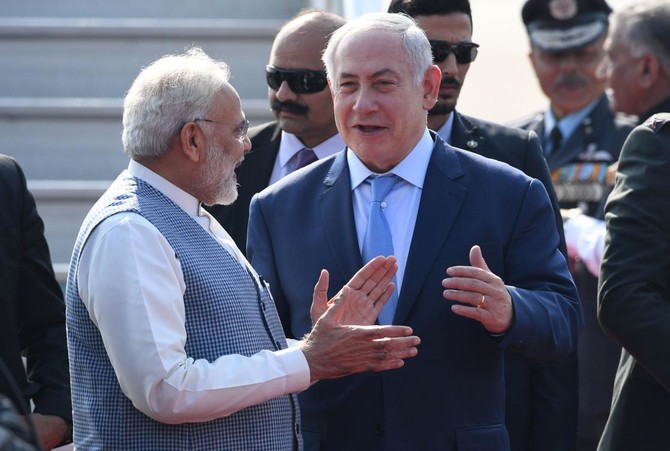
NEW DELHI: Israeli Prime Minister Benjamin Netanyahu said Monday he was “disappointed” by India’s refusal to back recognition of Jerusalem as his country’s capital but would not let it spoil his landmark visit to the Asian giant.
Netanyahu also vowed that Israel would “catch up” with the killers of a Jewish couple murdered in 2008 attacks in Mumbai whose son is accompanying him on a six-day trip to India.
The Israeli leader arrived Sunday at the head of the biggest business delegation he has taken on a foreign visit.
Netanyahu told the India Today media group, in an interview released Monday, that he has a “special relationship” with his counterpart Narendra Modi.
But the run-up was clouded by India joining more than 100 countries at the United Nations in voting last month to condemn Washington’s recognition of Jerusalem as Israel’s capital.
“Naturally I am disappointed but I think this visit is a testament to the fact that our relationship is moving forward on so many fronts,” Netanyahu said in the interview.
Ahead of the visit, India also canceled a $500 million deal for Israeli Spike anti-tank missiles.
Israel exports an average of $1 billion of military equipment each year to India, but Modi wants to end India’s status as the world’s top defense importer.
But Netanyahu was again optimistic on the missile deal.
“I hope that this visit can help resolve this issue because I think there is a reasonable chance we can reach an equitable solution,” he said.
Declaring that no details could be given until the end of his tour, Netanyahu added: “Our defense relationship is quite significant and it encompasses many things.
“I think the keyword is defense. We want to defend ourselves. We are not aggressive nations, but very committed to making sure that noone can commit aggression against us.”
Netanyahu is the first Israeli leader to visit India in 15 years.
The prime minister and his wife Sara were welcomed at New Delhi airport by Modi, who made history in July when he became the first Indian leader to visit Israel.
Modi also stressed how the “historic” visit would “further cement the close friendship between our nations.”
Netanyahu expects to sign new agreements in energy, aviation and cinema production. He is to visit the Taj Mahal and Modi’s home state of Gujarat as well as hold meetings with Bollywood stars in Mumbai.
But he will also make an emotional visit to a Jewish center targeted in the 2008 Mumbai attacks, a symbolic gesture to India’s tiny Jewish community.
Netanyahu is accompanied by 11-year-old Moshe Holtzberg whose parents were among 166 people killed by Pakistani militants in co-ordinated attacks on the city.
“Ultimately we will catch up with the killers but the objective is also to prevent future killers,” Netanyahu said in the interview.

Netanyahu disappointed by ally Modi’s Jerusalem rejection

Israel’s ‘deliberate intention of preventing births among Palestinians’ meets ‘legal criteria of Genocide Convention’: Reports
- Births in Gaza fell by 41% during conflict as maternal deaths, miscarriages surged
- ‘The destruction of maternal care in Gaza reflects the deliberate infliction of conditions of life calculated to bring about the destruction of the Palestinian people, in whole or in part’
LONDON: Births in Gaza fell by 41 percent due to Israel’s war on the territory, with the conflict resulting in catastrophic numbers of maternal deaths, miscarriages and birth complications, two reports have found.
The data on pregnant women, babies and maternity care in the war-torn Palestinian enclave also revealed a surge in newborn mortality and premature births, The Guardian reported on Wednesday.
Dangerous wartime conditions and Israel’s systematic destruction of Gaza’s health systems were blamed for the alarming statistics.
The two reports were conducted by Physicians for Human Rights, in collaboration with the University of Chicago Law School’s Global Human Rights Clinic and Physicians for Human Rights — Israel.
Researchers highlighted Israel’s “deliberate intention of preventing births among Palestinians, meeting the legal criteria of the Genocide Convention.”
The reports build on earlier findings by PHR’s Israel branch. They place the testimonies of pregnant women and new mothers within the context of health data and field reports, which recorded “2,600 miscarriages, 220 pregnancy-related deaths, 1,460 premature births, over 1,700 underweight newborns, and over 2,500 infants requiring neonatal intensive care” between January and June 2025.
PHRI’s Lama Bakri, a psychologist and project manager, said: “These figures represent a shocking deterioration from pre-war ‘normalcy,’ and are the direct result of war trauma, starvation, displacement and the collapse of maternal healthcare.
“These conditions endanger both mothers and their unborn babies, newborns, and breastfed infants, and will have consequences for generations, permanently altering families.”
She added: “Beyond the numbers, what emerges in this report are the women themselves, their voices, choices and lived realities, confronting impossible dilemmas that statistics alone cannot fully capture.”
Maternal and newborn care in Gaza has been damaged by Israel’s destruction of health infrastructure, as well as fuel shortages, blocked medical supplies, mass displacement and relentless bombardment.
As a result, survival in Gaza’s overcrowded tent encampments has become the sole option for pregnant women and new mothers.
During the first six months of Israel’s war on the territory, more than 6,000 mothers were killed, at an average of two every hour, according to UN Women estimates.
It is also believed that about 150,000 pregnant women and new mothers have been forcibly displaced by the conflict.
In the first months of last year, just 17,000 births were recorded in Gaza, a 41 percent fall compared to the same period in 2022.
The researchers examined Israel’s apparent strategy to undermine Palestinian births, highlighting a targeted strike in December 2023 on the Al-Basma IVF clinic.
The attack on Gaza’s largest fertility center destroyed about 5,000 reproductive specimens and ended a pattern of 70-100 IVF procedures each month.
The strike was deliberately designed to target the reproductive potential of Palestinians, the Independent International Commission of Inquiry later found.
“Reproductive violence constitutes a violation under international law; when carried out systematically and with them intent to destroy, it falls within the definition of genocide of the Genocide Convention,” the reports said.
“The destruction of maternal care in Gaza reflects the deliberate infliction of conditions of life calculated to bring about the destruction of the Palestinian people, in whole or in part.”