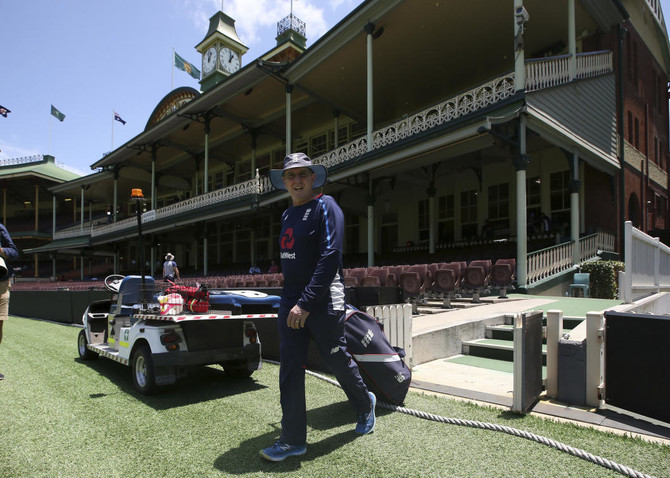
CENTURION: By the time Trevor Bayliss took over as England’s cricket coach, after a World Cup in which the team were the tournament’s laughing stock, the winds of change had already cleared some of the dressing-room gloom. Paul Farbrace, who had been Bayliss’s deputy when Sri Lanka reached the final of the World Twenty20 in 2009, was the man managing transition, and he had already loosened the straitjackets that had doomed the Peter Moores regime.
Bayliss came with a stellar resume. Less than two years after reaching that World T20 final at Lord’s, he took Sri Lanka to a World Cup final in Mumbai, where only an unprecedented run chase from India denied them the trophy. After that, and a successful stint with the Sydney Sixers in the Big Bash League, he took over a side that was even more of a joke than England’s World Cup team.
The Kolkata Knight Riders started off with a movie star owner, Shah Rukh Khan, and a local hero, Sourav Ganguly, as captain. John Buchanan, whose coaching reputation plummeted like the global stock markets in 2008 once he left Australia, then experimented with the idea of multiple captains during the IPL’s second season. That was as effective as a lead balloon.
Under Bayliss, and with the side now led by the combative Gautam Gambhir, Kolkata won the IPL twice in three seasons. Bayliss was not prone to the eccentricities of his predecessor. Instead, he empowered his stars to take responsibility. Freed from quixotic ideas and playing without fear, they went from being a team others mocked to one that they wanted to emulate.
When he was appointed to the England post, the mandate was clearly to win the biggest prize in the white-ball game, the World Cup. Since reaching the final for the third time in 1992, England have not even made the last four, with each outing more embarrassing than the last.
The numbers have certainly vindicated the appointment. Despite the Champions Trophy disappointment, where they were undone by an inspired Pakistan in the semifinal, England’s win-loss record under Bayliss, 32-13, is the best of any team, better than India (30-16) and South Africa (27-13). Australia, the world champions, who England crushed at the Melbourne Cricket Ground on Sunday on the back of Jason Roy’s dazzling 180, are way behind (25-22).
“Trevor’s been fantastic for us, he creates a brilliant atmosphere around the team which allows people to go out and play in that free fashion,” Jos Buttler told the BBC recently. “He doesn’t miss a beat, he sees everything that goes on and his great strength is he’s a great man manager. He really looks after people and gives them confidence. Any coach who can make the player feel 10 feet tall when they go out is fantastic.”
Why then is there so much unease over Bayliss recently announcing that he would leave the job after the 2019 World Cup and home Ashes? That’s easily explained. The hardcore of English cricket support, who follow the team around the world at considerable expense, enjoy the one-day jinks, but it is Test cricket that really matters to them.
And in that arena, Bayliss’s England have been poor. The 4-0 Ashes drubbing followed a 4-0 hammering in India the previous winter. But for an Ashes win immediately after he took over and home and away successes against a South Africa side managing some tricky transformation issues, England just haven’t been good enough. The win-loss ratio (15-18) leaves them trailing way behind the leading trio of India, South Africa and Australia.
Worse still, the one player to have improved as a Test cricketer under Bayliss, Ben Stokes, is now in limbo. And the selection of the Test squad to New Zealand suggests that the authorities aren’t really bothered by the downturn in red-ball form. After an Ashes series where all the leading lights apart from Jimmy Anderson failed — Alastair Cook’s double-hundred with the series already lost should not get too many brownie points — it is the fringe players that have paid the price.
Gary Ballance is gone without even playing a game, Jake Ball after just one in Brisbane. Tom Curran, who had the misfortune to bowl on the two most sluggish surfaces while showing plenty of gumption with the bat, is also omitted.
Time was when an Ashes debacle resulted in the kind of purge that accompanies revolutions. By burying their head in the sand after this latest disaster, English cricket’s decision-makers have clearly shown that it is the white ball that is uppermost in their thoughts.


![]()
ODI-focussed England bury their head in the sand over Ashes debacle
ODI-focussed England bury their head in the sand over Ashes debacle


Latest updates


© 2026 SAUDI RESEARCH & PUBLISHING COMPANY, All Rights Reserved And subject to Terms of Use Agreement.