Egypt approves Cabinet reshuffle ahead of elections

1 / 2
Rania Al-Mashat
2 / 2
Enas Abdeldayem
Updated 14 January 2018
Follow

Egypt approves Cabinet reshuffle ahead of elections

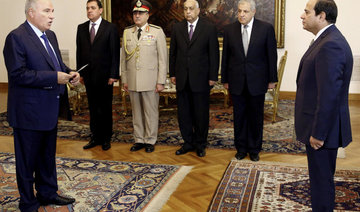
CAIRO: Egypt’s Parliament approved on Sunday a Cabinet reshuffle including four new ministers, government sources said, two months ahead of a scheduled presidential election.
The reshuffle included the appointment of Abu Bakr Al-Gendi as minister for local development, Rania Al-Mashat as tourism minister, Enas Abdeldayem as culture minister and Khaled Badawy as public enterprise minister.
Two new ministry deputies were also appointed in the reshuffle.
Housing Minister Mustafa Madbuly will continue to serve as interim prime minister while Prime Minister Sherif Ismail recovers from surgery, government sources said.
Egypt is set to hold a presidential vote on March 26-28, with a run-off on April 24-26. Candidates must register between Jan. 20 and 29.
Egypt’s last Cabinet reshuffle was in February last year and included new investment and agriculture ministers.
The new minister of culture, Enas Abdeldayem, is the first female to be the minister of culture since the ministry was officially founded in 1958. Abdeldayem was the head of the Opera House and a prominent flute player. She further concluded her MA and Ph.D. degrees in the flute in Paris. She held multiple solo performances and joined the joined the International Orchestra of the UNESCO.
The other female minister Rania Al-Mashat was deputy governor of the Central Bank of Egypt for monetizing policy for 11 years.
Besides the new two female ministers who have recently joined the Cabinet, this is the first time in the history of Egypt’s Cabinets to have six female ministers at once, making the representation of female ministers accounts for about 17.6 percent.


Battered by Gaza war, Israel’s tech sector in recovery mode

Updated 21 February 2026
Follow

Battered by Gaza war, Israel’s tech sector in recovery mode

  • “High-tech companies had to overcome massive staffing cuts, because 15 to 20 percent of employees, and sometimes more, were called up” to the front as reservists, IIA director Dror Bin told

JERUSALEM: Israel’s vital tech sector, dragged down by the war in Gaza, is showing early signs of recovery, buoyed by a surge in defense innovation and fresh investment momentum.
Cutting-edge technologies represent 17 percent of the country’s GDP, 11.5 percent of jobs and 57 percent of exports, according to the latest available data from the Israel Innovation Authority (IIA), published in September 2025.
But like the rest of the economy, the sector was not spared the knock-on effects of the war, which began in October 2023 and led to staffing shortages and skittishness from would-be backers.
Now, with a ceasefire largely holding in Gaza since October, Israel’s appeal is gradually returning, as illustrated in mid-December, when US chip giant Nvidia announced it would create a massive research and development center in the north that could host up to 10,000 employees.
“Investors are coming to Israel nonstop,” Prime Minister Benjamin Netanyahu said at the time.
After the war, the recovery can’t come soon enough.
“High-tech companies had to overcome massive staffing cuts, because 15 to 20 percent of employees, and sometimes more, were called up” to the front as reservists, IIA director Dror Bin told AFP.
To make matters worse, in late 2023 and 2024, “air traffic, a crucial element of this globalized sector, was suspended, and foreign investors froze everything while waiting to see what would happen,” he added.
The war also sparked a brain drain in Israel.
Between October 2023 and July 2024, about 8,300 employees in advanced technologies left the country for a year or more, according to an IIA report published in April 2025.
The figure represents around 2.1 percent of the sector’s workforce.
The report did not specify how many employees left Israel to work for foreign companies versus Israeli firms based abroad, or how many have since returned to Israel.

- Rise in defense startups -

In 2023, the tech sector far outpaced GDP growth, increasing by 13.7 percent compared to 1.8 percent for GDP.
But the sector’s output stagnated in 2024 and 2025, according to IIA figures.
Industry professionals now believe the industry is turning a corner.
Israeli high-tech companies raised $15.6 billion in private funding in 2025, up from $12.2 billion in 2024, according to preliminary figures published in December by Startup Nation Central (SNC), a non-profit organization that promotes Israeli innovation.
Deep tech — innovation based on major scientific or engineering advances such as artificial intelligence, biotech and quantum computing — returned in 2025 to its pre-2021 levels, according to the IIA.
The year 2021 is considered a historic peak for Israeli tech.
The past two years have also seen a surge in Israeli defense technologies, with the military engaged on several fronts from Lebanon and Syria to Iran, Yemen, Gaza and the occupied West Bank.
Between July 2024 and April 2025, the number of startups in the defense sector nearly doubled, from 160 to 312, according to SNC.
Of the more than 300 emerging companies collaborating with the research and development department of Israel’s defense ministry, “over 130 joined our operations during the war,” Director General Amir Baram said in December.
Until then, the ministry had primarily sourced from Israel’s large defense firms, said Menahem Landau, head of Caveret Ventures, a defense tech investment company.
But he said the war pushed the ministry “to accept products that were not necessarily fully finished and tested, coming from startups.”
“Defense-related technologies have replaced cybersecurity as the most in-demand high-tech sector,” the reserve lieutenant colonel explained.
“Not only in Israel but worldwide, due to the war between Russia and Ukraine and tensions with China.”