Pope Francis and Latin American winds of change

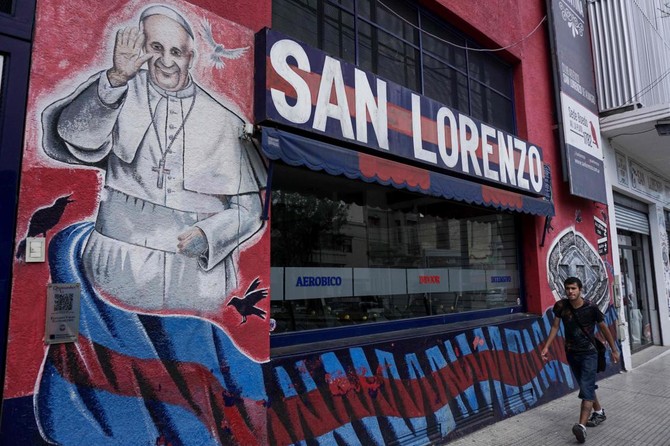
A man walks past a store of Argentine San Lorenzo de Almagro sports club decorated with a graffiti depicting Pope Francis in Buenos Aires on Jan. 03, 2017. Pope Francis returns to Latin America for the sixth time in his pontificate on January 15, 2018 avoiding again his native Argentina, a significant gesture that brings up many questions. (AFP/Eitan Abramovich)
Updated 14 January 2018
Follow

Pope Francis and Latin American winds of change

Vatican City: A squall of fresh air with a distinct Latin American feel tore through the Vatican on the election of Pope Francis, a passionate Argentine whose defense of the downtrodden has stirred hearts across the world.
On his return to the continent this week with a trip to Catholic majority Chile and Peru, Francis will not only speak his native Spanish but also a vibrant spiritual and cultural language common to all.
“I feel free, nothing scares me,” the pontiff once said, despite shouldering the burden of leading the world’s 1.3 billion Catholics, nearly half of whom live in the Americas.
It was a typically American expression according to fellow Argentine, Bishop Marcelo Sanchez Sorondo, who has known Francis for decades.
“North and South America are both societies with European origins that have realized they need independence. The idea of freedom is the cornerstone of the Americas,” the philosophy professor told AFP.
The first pope to address the United States congress has “a strong sense of human dignity and freedom,” he says.
But while one of the Americas has prospered, the other has become increasingly impoverished.
“The pope is very sensitive to the issue of social justice — a more Latin than North American theme, hence the interest he has for the ‘peripheries’ in difficulty,” Sorondo said, referring to Francis’s support for those on the margins.

The Archbishop of Buenos Aires was virtually an unknown when he was elected on March 13, 2013, becoming the first pope to choose the name Francis — a homage to St. Francis of Assisi, who dedicated his life to the poor.
The Argentine hails from a family of Italian immigrants and became “a sort of link between the Old World and the New World,” says Giovanni Maria Vian, editor of the Vatican’s L’Osservatore Romano newspaper.
However, “the dramatic history of Argentina at the end of the 20th century is what shapes his personal trajectory,” he says in the preface to a book called “Francis, the American pope.”
In 2007, Jorge Bergoglio was elected by his fellow bishops in Aparecida in Brazil to draw up the final document of the Latin American Episcopal Council, which can be read as a guide to many of the themes dearest to him.
Bergoglio stressed the ills of a “scandalous inequality which wounds personal dignity,” a theme which “clearly guides his actions at the head of the church today,” Vatican specialist Nicolas Seneze writes in “The Words of the Pope.”
The Aparecida conference “prioritized the poor,” Sarondo said.
“The pope is very critical of capitalism which sacrifices human rights — a typical stance of the Latin American episcopate,” he added.

While Polish pope John Paul II had denounced “wild capitalism,” Francis has taken more concrete steps, such as calling for “a poor church for the poor” and turning down a luxurious papal apartment for a humble hotel room, he said.
Bergoglio was an active pastor, taking the bus around Buenos Aires and heading without a second thought into slums in Latin America to comfort the poor.
His experience of the Argentine economic crisis has also shaped his idea of “the misery of big cities,” which fatally attract poor farmers from the countryside in search of a better life, stripping them of their culture.
His vision was strongly influenced by the “theology of the people,” the Argentine, non-violent version of the South American Liberation theology — a strain without the focus on the Marxist class struggle.
And since his arrival in Rome, the pope has created new Latin American cardinals, saying “they bring with them the air of new churches and of a history of faith and of blood.”
In doing so, he is also reshaping in his image the conclave of cardinals that will elect his successor.

Southeast Asian countries repatriate nationals from Cambodia as thousands flee scam centers

Updated 5 sec ago
Follow

Southeast Asian countries repatriate nationals from Cambodia as thousands flee scam centers

  • Almost 2,800 Indonesians have sought consular support to return home since mid-January
  • Malaysia, Philippines also repatriate citizens after Cambodian PM orders crackdown on crime networks

Southeast Asian countries are repatriating their nationals from Cambodia, as thousands are estimated to have fled scam compounds over recent weeks following Phnom Penh’s pledge for a fresh crackdown on the multibillion-dollar industry.

Scam centers have flourished in parts of Southeast Asia in recent years, with hundreds of thousands of people lured to work in illicit operations in countries like Cambodia and Myanmar, according to a 2023 report by the UN Office of the High Commissioner for Human Rights.

A wave of foreign nationals who were either released or have escaped from scam compounds across Cambodia since mid-January have returned to their home countries in the past week after seeking consular support from their respective embassies, officials said.

“The number of Indonesians formerly involved with online scam syndicates who are reporting to the Indonesian Embassy in Phnom Penh continues to increase. Since Jan. 16 to Jan. 30, we have recorded 2,795 Indonesian nationals,” the Indonesian Embassy in Phnom Penh said in a statement on Saturday.

At least 36 Indonesian nationals were repatriated on Friday, while another 30 are scheduled to return to Indonesia over the weekend.

Malaysia has also “rescued and repatriated” 29 Malaysians from Cambodia who were “victims of an online syndicate,” its embassy in Phnom Penh said earlier this week, while the Philippines repatriated 13 Filipinos identified as human trafficking victims last Sunday, the Department of Migrant Workers in Manila said in a statement.

Human rights organization Amnesty International estimated that thousands of people have been released or escaped from at least 17 scamming compounds across Cambodia in recent weeks, with interviews indicating that some were “subjected to grave abuses including rape and torture.”

The survivors are also from countries beyond the region, including Brazil, Nigeria, and Bangladesh, Amnesty said, as it called out the Cambodian government for ignoring the growing humanitarian crisis.

“This mass exodus from scamming compounds has created a humanitarian crisis on the streets that is being ignored by the Cambodian government. Amid scenes of chaos and suffering, thousands of traumatized survivors are being left to fend for themselves with no state support,” said Montse Ferrer, Amnesty International’s regional research director.

“This is an international crisis on Cambodian soil. Our researchers have met people from Asia, Africa, Europe, and the Americas. They are in urgent need of consular assistance in order to help get them home and out of harm’s way.”

The latest development comes after Cambodian Prime Minister Hun Manet ordered authorities to step up efforts to eradicate online scam networks in the country, a directive that was followed with the arrest of several key figures.

Among those arrested was Chen Zhi, a Chinese-born Cambodian tycoon, who was extradited to China earlier this month.

Chen was sanctioned by the UK and the US in October last year, with the US Department of Treasury accusing him of running “a transnational criminal empire through online investment scams targeting Americans and others worldwide.”

The Global Anti-Scam Alliance estimates that $442 billion was lost to scammers in 2025.