WASHINGTON: President Donald Trump offered a partial denial in public but privately defended his extraordinary remarks disparaging Haitians and African countries.
Trump said he was only expressing what many people think but won’t say about immigrants from economically depressed countries, according to a person who spoke to the president as criticism of his comments ricocheted around the globe.
Trump spent Thursday evening making a flurry of calls to friends and outside advisers to judge their reaction to the tempest, said the confidant, who spoke on condition of anonymity because he wasn’t authorized to disclose a private conversation. Trump wasn’t apologetic about his inflammatory remarks and denied he was racist, instead, blaming the media for distorting his meaning, the confidant said.
Critics of the president, including some in his own Republican Party, took time Friday blasting the vulgar comments he made behind closed doors. In his meeting with a group of senators, he had questioned why the US would accept more immigrants from Haiti and “shithole countries” in Africa as he rejected a bipartisan immigration deal, according to one participant and people briefed on the remarkable Oval Office conversation.
The comments revived charges that the president is racist and roiled immigration talks that were already on tenuous footing.
“The language used by me at the DACA meeting was tough, but this was not the language used,” Trump insisted in a series of Friday morning tweets, pushing back on some depictions of the meeting.
But Trump and his advisers notably did not dispute the most controversial of his remarks: using the word “shithole” to describe African nations and saying he would prefer immigrants from countries like Norway instead.
Sen. Dick Durbin of Illinois, the only Democrat in the room, said Trump had indeed said what he was reported to have said. The remarks, Durbin said, were “vile, hate-filled and clearly racial in their content.”
He said Trump used the most vulgar term “more than once.”
“If that’s not racism, I don’t know how you can define it,” Florida GOP Rep. Ileana Ros-Lehtinen told WPLG-TV in Miami.
Tweeted Republican Sen. Jeff Flake of Arizona: “The words used by the president, as related to me directly following the meeting by those in attendance, were not ‘tough,’ they were abhorrent and repulsive.”
Sen. Dianne Feinstein, D-Calif., called the comments “beneath the dignity of the presidency” and said Trump’s desire to see more immigrants from countries like Norway was “an effort to set this country back generations by promoting a homogenous, white society.”
Republican leaders were largely silent, though House Speaker Paul Ryan said the vulgar language was “very unfortunate, unhelpful.”
Trump’s insults — along with his rejection of the bipartisan immigration deal that six senators had drafted — also threatened to further complicate efforts to extend protections for hundreds of thousands of young immigrants, many of whom were brought to this country as children and now are here illegally.
Trump last year ended the Deferred Action for Childhood Arrivals program, which provided protection from deportation along with the ability to work legally in the US He gave Congress until March to come up with a legislative fix.
The three Democratic and three GOP senators who’d struck their proposed deal had been working for months on how to balance those protections with Trump’s demands for border security, an end to a visa lottery aimed at increasing immigrant diversity, and limits to immigrants’ ability to sponsor family members to join them in America.
It’s unclear now how a deal might emerge, and failure could lead to a government shutdown.
“The rhetoric just makes it more difficult, and that’s unfortunate,” said Rep. Mike Simpson, R-Idaho, a senior House lawmaker. “I don’t think it makes it impossible, but I suspect the Democrats are sitting there going, ‘Why would we want to compromise with him on anything?’“
There were also questions about which lawmakers were in position to conduct meaningful talks. John Cornyn of Texas, the No. 2 GOP senator, and other Republicans have derided the group of six senators as having little clout. Initial bargaining has also occurred among a separate group of four leaders — the second-ranking Republican and Democrat from both the House and Senate, a group to which both Cornyn and Durbin belong.
At a forum Friday at the University of Wisconsin-Milwaukee, Ryan, R-Wisconsin, said, “We just have to get it done.”
Durbin said, “We have seven days and the clock is ticking. Our bipartisan group continues to build support for the only deal in town.” He said he wants to call the bill to the floor of the Senate early next week.
Lawmakers have until Jan. 19 to approve a government-wide stopgap spending bill, and Republicans will need Democratic votes to push the measure through. But some Democrats have threatened to withhold support unless an immigration pact is forged.
Trump’s comments came as Durbin was presenting details of the compromise plan that included providing $1.6 billion for a first installment of the president’s long-sought border wall.
Trump took particular issue with the idea that people who’d fled to the US after disasters hit their homes in places such as El Salvador, Guatemala and Haiti would be allowed to stay as part of the deal, according to the people, who spoke on condition of anonymity because they weren’t authorized to publicly describe the discussion.
When it came to talk of extending protections for Haitians, Durbin said Trump replied: “We don’t need more Haitians.’“
“He said ‘Put me down for wanting more Europeans to come to this country. Why don’t we get more people from Norway?” Durbin told reporters in Chicago.
The administration announced last year that it would end a temporary residency permit program that allowed nearly 60,000 Haitians to live and work in the US in the wake of a devastating 2010 earthquake.
Trump insisted Friday that he “never said anything derogatory about Haitians other than Haiti is, obviously, a very poor and troubled country. Never said ‘take them out.’ Made up by Dems.” Trump wrote, “I have a wonderful relationship with Haitians. Probably should record future meetings — unfortunately, no trust!“
Trump did not respond to shouted questions about his comments as he signed a proclamation Friday honoring Martin Luther King Jr. Day, which is Monday.
Sens. David Perdue, R-Ga., and Tom Cotton, R-Arkansas, who both attended the Thursday meeting, said in a statement that they “do not recall the president saying these comments specifically.” What Trump did do, they said, was “call out the imbalance in our current immigration system, which does not protect American workers and our national interest.”
But Sen. Lindsey Graham, R-S.C., said by Durbin to have voiced objection to Trump’s comments during the meeting, issued a statement that did not dispute the remarks.
“Following comments by the president, I said my piece directly to him yesterday. The president and all those attending the meeting know what I said and how I feel,” Graham said, adding: “I’ve always believed that America is an idea, not defined by its people but by its ideals.”


![]()
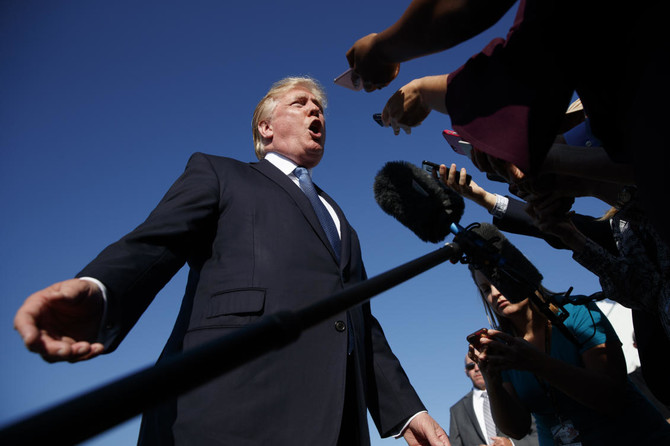
Trump defends vulgar immigrant comments, partly denies them
Trump defends vulgar immigrant comments, partly denies them

Latest updates


© 2026 SAUDI RESEARCH & PUBLISHING COMPANY, All Rights Reserved And subject to Terms of Use Agreement.