BAGHDAD: Negotiations between Iraqi Prime Minister Haider Abadi and leaders of Shiite-dominated paramilitary troops to form an electoral alliance in the parliamentary and provincial election scheduled for May had not produced a final agreement on Friday, leaders involved in the talks told Arab News.
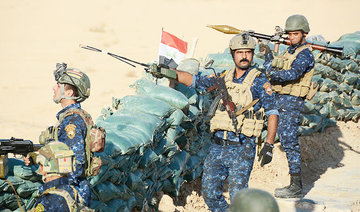
Gaining the support of the armed factions who fought Daesh alongside the government during the past three years is crucial for Abadi to gain a comfortable parliamentary majority to form the next government.
The negotiations, which started on Thursday, have been taking place in Baghdad between representatives of Abadi and leaders of the “Al-Fattah Alliance,” which includes the most powerful Shiite armed factions such as Badr Organization, Asaib Ahl Al-Haq, Kataib Huzballah and Jund Al-Imam in addition to the leaders of the Islamic Supreme Council of Iraq and the independents.
Abadi has been seeking to form the biggest electoral alliance along with “Al-Fattah,” which is headed by Hadi Al-Amiri, the commander of Badr Organization, while the leaders of the Popular Mobilization Units (PMU) have been looking for protection.
“An alliance with Abadi is in the interest of both parties (Abadi and the PMU),” a senior PMU commander said on condition of anonymity to Arab News.
“The prime minister is the only one who can threaten the existence of us (the PMU). Legally he (the prime minister) is authorized to go after any of us and represents a source of concern.
“If he will be with us, this means we will be protected,” the commander said.
The negotiation teams of both sides on Friday had agreed on several issues, but who will head the final coalition and who will lead the electoral list in Baghdad are topics “still under negotiation,” leaders involved in the talks told Arab News.
“We are looking to form the biggest bloc in the next parliament, so Abadi is the best choice to achieve this,” Yazin Al-Joubori, one of the PMU commanders, told Arab News.
“The problem is that Abadi insists on being the head of the (final) coalition and the leader of the electoral list in Baghdad while (Hadi) Al-Amiri insists on giving him just one of them,” Al-Joubori said.
The guarantees which Abadi has to present to the PMU leaders also was one of the biggest obstacles as his negotiation team insists on “not giving any promises or concessions.” By the end of Friday’s meetings, no final agreement was made, leaders involved in the talks said.
“Abadi is well aware that he has a very strong card now and knows that the PMU factions need him, so he is negotiating from a position of strength,” a Shiite politician involved in the talks told Arab News on condition of anonymity.
“In all cases, this alliance will be made, but (looks like) it will be according to Abadi’s conditions.
“We have presented so many concessions, while he has refused to give us anything (in return).
“There is no other strong alternative (than Abadi). We need him so we have to go with him,” the leader said.


![]()

Abadi seeks alliance with Popular Mobilization Units based on his terms
Abadi seeks alliance with Popular Mobilization Units based on his terms
Latest updates


© 2026 SAUDI RESEARCH & PUBLISHING COMPANY, All Rights Reserved And subject to Terms of Use Agreement.