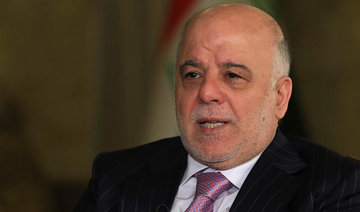
BAGHDAD: Negotiations between Iraqi Prime Minister Haider Abadi and leaders of Shiite-dominated paramilitary troops to form an electoral alliance in the parliamentary and provincial election scheduled for May had not produced a final agreement on Friday, leaders involved in the talks told Arab News.
Gaining the support of the armed factions who fought Daesh alongside the government during the past three years is crucial for Abadi to gain a comfortable parliamentary majority to form the next government.
The negotiations, which started on Thursday, have been taking place in Baghdad between representatives of Abadi and leaders of the “Al-Fattah Alliance,” which includes the most powerful Shiite armed factions such as Badr Organization, Asaib Ahl Al-Haq, Kataib Huzballah and Jund Al-Imam in addition to the leaders of the Islamic Supreme Council of Iraq and the independents.
Abadi has been seeking to form the biggest electoral alliance along with “Al-Fattah,” which is headed by Hadi Al-Amiri, the commander of Badr Organization, while the leaders of the Popular Mobilization Units (PMU) have been looking for protection.
“An alliance with Abadi is in the interest of both parties (Abadi and the PMU),” a senior PMU commander said on condition of anonymity to Arab News.
“The prime minister is the only one who can threaten the existence of us (the PMU). Legally he (the prime minister) is authorized to go after any of us and represents a source of concern.
“If he will be with us, this means we will be protected,” the commander said.
The negotiation teams of both sides on Friday had agreed on several issues, but who will head the final coalition and who will lead the electoral list in Baghdad are topics “still under negotiation,” leaders involved in the talks told Arab News.
“We are looking to form the biggest bloc in the next parliament, so Abadi is the best choice to achieve this,” Yazin Al-Joubori, one of the PMU commanders, told Arab News.
“The problem is that Abadi insists on being the head of the (final) coalition and the leader of the electoral list in Baghdad while (Hadi) Al-Amiri insists on giving him just one of them,” Al-Joubori said.
The guarantees which Abadi has to present to the PMU leaders also was one of the biggest obstacles as his negotiation team insists on “not giving any promises or concessions.” By the end of Friday’s meetings, no final agreement was made, leaders involved in the talks said.
“Abadi is well aware that he has a very strong card now and knows that the PMU factions need him, so he is negotiating from a position of strength,” a Shiite politician involved in the talks told Arab News on condition of anonymity.
“In all cases, this alliance will be made, but (looks like) it will be according to Abadi’s conditions.
“We have presented so many concessions, while he has refused to give us anything (in return).
“There is no other strong alternative (than Abadi). We need him so we have to go with him,” the leader said.

Abadi seeks alliance with Popular Mobilization Units based on his terms
Pakistan opposition continues sit-in outside parliament over ex-PM Khan’s eye treatment
- Opposition leader says the protest will continue until Imran Khan, currently at Adiala prison, is admitted to Shifa Hospital
- The government says Khan’s medical report will be compiled again, promising no negligence in the matter under judicial oversight
ISLAMABAD: Pakistan’s opposition alliance is continuing its sit-in outside the Parliament House in Islamabad for the second day on Saturday, seeking shifting of jailed former prime minister Imran Khan to a private hospital for treatment of his worsening eye condition.
The protest follows a rare prison visit earlier this week by Barrister Salman Safdar, appointed as amicus curiae by the Supreme Court to assess Khan’s health and living conditions at Rawalpindi’s Adiala jail. In his report, Safdar highlighted “seriousness” of Khan’s ocular condition and recommended an independent examination.
On Friday evening, opposition members gathered outside the parliament building in Islamabad to stage a sit-in, with the police locking its gates and cordoning off surrounding roads to prevent protesters from gathering in front of the building, witnesses and opposition leaders said.
Mehmood Khan Achakzai, the head of the Tehreek-e-Tahafuz-e-Ayeen-e-Pakistan opposition alliance, criticized the authorities for the measures to prevent opposition members from reaching the sit-in venue in Islamabad.
“We are not the ones who make threats, but if you continue with this attitude, after two or three days every roundabout in Pakistan will be closed,” Achakzai said on X late Friday. “Then we will not even be able to handle the people.”
In an earlier post on X, the alliance said its leadership would continue the sit-in “until Imran Khan is admitted to Al-Shifa Hospital.”
“We have staged a sit-in for the earliest medical check-up of Imran Khan, which would take just ten minutes,” Achakzai told reporters on Friday evening. “If it is conducted, we will end our protest.”
According to a Feb. 6 medical report from the Pakistan Institute of Medical Sciences (PIMS) cited in Safdar’s filing, Khan was diagnosed with “right central retinal vein occlusion” after reporting reduced vision in his right eye. He underwent an intravitreal injection at PIMS and was discharged with follow-up advice.
In his interaction with Safdar, Khan said he had suffered “rapid and substantial loss of vision over the preceding three months” and claimed his complaints had not been addressed promptly in custody. He further said he had been left with “only 15 percent vision in his right eye.”
Safdar’s report noted that the 73-year-old former premier appeared “visibly perturbed and deeply distressed” over the loss of vision, though it also recorded that he expressed satisfaction with his safety, basic amenities and food provisions in prison.
Responding to the controversy, Parliamentary Affairs Minister Tariq Fazal Chaudhry rejected PTI’s claims that Khan had been suffering from an eye issue since October last year, noting that the ex-premier was visited by his sister on Dec. 2 but she did not mention the medical issue.
“Medical report will be compiled again, the chief justice of the Supreme Court is himself monitoring this case,” he said. “Wherever it will be requested, Imran Khan’s eye will be examined at.”
Chaudhry vowed there would be no negligence.
Khan has been in custody since August 2023 in connection with multiple cases that he and his party describe as politically motivated. The government denies the allegation.
Concerns over his health resurfaced after authorities confirmed he had briefly been taken from prison to a hospital in Islamabad for an eye procedure. While the government said his condition was stable, Khan’s family and PTI leaders alleged they were not informed in advance and that he was being denied timely and independent medical access.