LONDON: The FA Cup will not offer redemption for Arsene Wenger this time. No manager has been more successful in the competition and winning it in three of the past four seasons has helped deflate at least some of the pressure mounting on him.
But last Sunday’s defeat at Nottingham Forest, as Wenger, banned from the touchline, fretted toward the back of the stand was another low. It was a first defeat for him in the third round but it also laid bare the poverty of options Arsenal now have.
That they responded to that defeat by drawing 0-0 at Chelsea in the League Cup was typical. Inconsistency has become a familiar mode. The players, of course were largely different, but you would expect some measure of continuity of organization, discipline and attitude to run through the club. But what’s more worrying from an Arsenal point of view is that there was a time when we waited to watch his second string with a sense of anticipation.
In 2007, for instance, Arsenal blazed by Newcastle, Sheffield United and Blackburn with a team that included Justin Hoyte, Armand Traore, Denilson, Theo Walcott, Fran Merida, Henri Lansbury, Kieran Gibbs and Mark Randall, all of whom were in their teens at the time. They played fast, fluent, exciting football and they were regarded with a sense of awe. This, it seemed, was the future: Wenger was building a young army
of players brought up in his philosophy and they would dominate for years to come.
Only Walcott remains, body wearied by injury, his face oddly youthful despite his experiments with a beard, the oldest teenager in the world, and even he is likely to be gone by the end of the transfer window. These are the lost boys, the kids whose potential was never quite realized, and in whose stories is written the failure of late-period Wenger.
But worst of all is that the hope the new generation once offered isn’t there any more. That is not to say that the players are not talented. Ainsley Maitland-Niles, for instance, has slotted impressively into the first team (so long as he is played at wing-back rather than full-back, where his lack of heading ability can be exposed). But it is to say that the sense of stagnation has crept down from the top. The vivacity the young back-ups used to exude was gone. They did not lose at the
City Ground because of naivety or a lack of composure; they lost because of a basic lack of organization and drive.
That in turn raises ominous questions. Wenger has been an enormous positive both for Arsenal and for English football. He has helped revolutionize thinking on nutrition and recruitment. As well as his seven FA Cups, he has won three league titles, one of them passing through the season unbeaten, and reached two European finals. He has overseen the move to the Emirates. He stands alongside Herbert Chapman in the pantheon of great Arsenal managers.
And yet the stasis has been going on so long that, almost unthinkably, there’s a serious risk he leaves the club in a worse position than they were when he took over.
Wenger arrived in October 1996, replacing Bruce Rioch, who had quit following a dispute over transfers. The previous season they had finished fifth, 19 points off the top. The comparison is not entirely fair given how astonishingly good Manchester City have been this season, but at the moment Arsenal lie sixth, 23 points off the top. But last season, they finished fifth, 18 points off the top.
The side Rioch left included not merely David Seaman and the great back four constructed by George Graham but also Dennis Bergkamp and Ian Wright. Wenger quickly added Patrick Vieira and Nicolas Anelka, and then, before the double-winning season of 1997-98, Emmanuel Petit and Marc Overmars. But the nucleus of a good squad was there.
If Wenger left this summer (and he almost certainly will not), what would he leave behind? Alexis Sanchez and Mesut Ozil will be gone. Hector Bellerin has been persistently linked with moves away. Laurent Koscielny and Jack Wilshere have long-term struggles with injuries.
After 22 years, half of them glorious, Shkodran Mustafi, Granit Xhaka and Alexandre Lacazette doesn’t seem like much of a legacy.


![]()
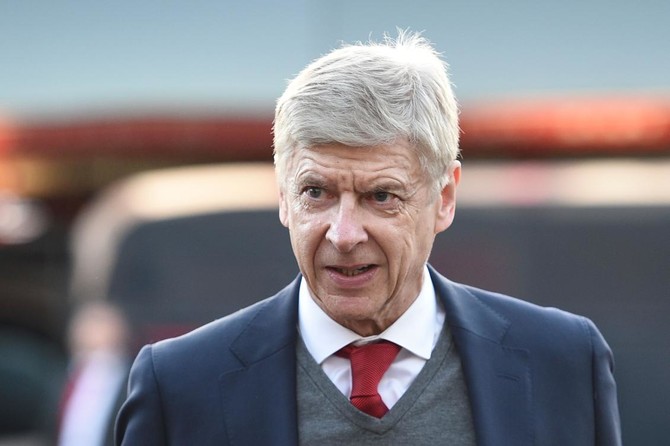
Arsene Wenger in danger of tarnishing great Arsenal legacy
Arsene Wenger in danger of tarnishing great Arsenal legacy


Latest updates


Recommended


© 2026 SAUDI RESEARCH & PUBLISHING COMPANY, All Rights Reserved And subject to Terms of Use Agreement.