

Syrian war will drag into next decade, says senior Kurdish leader

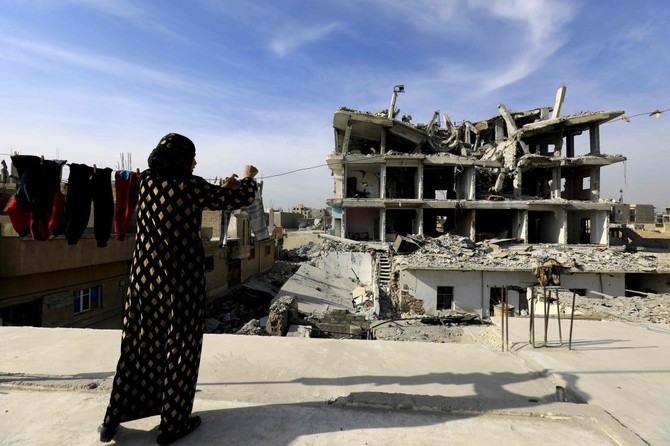
A Russian-led effort to end the war in Syria will fail and drag on into the next decade, according to a senior Kurdish leader. (AFP)
Updated 12 January 2018
Follow

Syrian war will drag into next decade, says senior Kurdish leader

BEIRUT: A Russian-led effort to end the war in Syria will fail and the conflict looks set to extend into the next decade, a top Syrian Kurdish politician has said.
In an interview with Reuters, Aldar Khalil, an architect of Kurdish-led plans for autonomous rule in northern Syria, also said the US appears in “no hurry” to leave areas where it has helped Kurdish-led forces fight Daesh, and that he expects ties with Washington to develop as US recovery efforts proceed.
The Syrian Kurds are among the few winners in the almost seven-year-old war, having established control over large parts of the north with a powerful militia that has partnered with the US-led coalition against Daesh.
Russia, President Bashar Assad’s ally, has asked them to take part in an international peace conference on Syria for the first time — a peace congress scheduled in the Russian city of Sochi on Jan. 29-30.
“Yes we are invited and we might take part in the show but it will not succeed,” Khalil, co-chair of the Movement for a Democratic Society, a coalition of Syrian Kurdish parties, said by telephone.
He questioned what the hundreds of anticipated attendees could accomplish in two days and said more preparation was required.
UN-led diplomacy in Geneva was also set for more failure, he said, adding that the war would “ebb and flow” until at least 2021, the end of Assad’s current seven-year presidential term.
“I don’t expect any breakthrough in the Syrian situation before 2021 ... it might even go on until ‘25,” he said.
“Daesh might expand in other areas, and of course the Turks might try to stir up problems in some areas.”
The Syrian Kurds’ ascendancy in Syria has alarmed neighboring Turkey. Ankara views the dominant Syrian Kurdish groups as an extension of Kurdish parties in Turkey that have been fighting Ankara for more than three decades.
US. support for Syrian Kurdish fighters has also strained ties between the NATO allies: Turkey on Wednesday summoned a top U. diplomat in Ankara to protest over US support of Kurdish fighters in Syria.
Khalil is seen as a key figure in plans to establish a federal region in northern Syria — a plan Washington has opposed despite backing the Syrian Kurdish YPG in the war with Daesh.
The Syrian Kurds say independence is not their goal. But Khalil said the Kurdish-led authorities would press ahead with unilateral autonomy plans, though elections to a new regional parliament have been postponed to allow more time to prepare.

WARNING TO ASSAD
With the fight against Daesh winding down, US Defense Secretary Jim Mattis said last month he expected to see a larger US civilian presence in Syria, including contractors and diplomats to focus on stabilization and ensuring Daesh does not return.
Khalil declined to say how long the United States might maintain a foothold in northern Syria, but said that achieving US goals of helping cities such as Raqqa to recover implied a commitment of at least 18 months to two years.
“These matters will not be completed in less time than this,” he said.
“I can’t confirm to you a long-term relationship, but at least for the foreseeable time, it seems they are not in a hurry to leave,” he said. Pointing to the Mattis remarks, he said he expected US ties to northern Syria to develop further.
The Kurdish-led authorities have held two local elections since September, part of their plan to build new governing structures. Discussions are underway to decide when a third vote — aimed at electing a regional parliament — will happen.
Khalil said the delay was aimed partly at giving a chance for areas recently captured from Daesh to decide whether to participate.
Though Assad recently condemned the US-backed Kurdish forces and their allies as “traitors,” Khalil said the Syrian government was incapable of attacking areas they control and warned that if it tried to “all its forces will be killed.”
He warned that Daesh sleeper cells posed a big threat. “The Daesh campaign is not over, now the more difficult phase has started,” he said.

Trump says ‘someone from within’ Iranian regime might be best choice to lead once war ends

Updated 8 sec ago
Follow

Trump says ‘someone from within’ Iranian regime might be best choice to lead once war ends

  • Trump had earlier called on Iranians to “take over your government” once the war US-Israel strikes end
  • He now appears to drift away from the idea of putting an end Iran's theocratic rule
WASHINGTON: President Donald Trump on Tuesday said that “someone from within” the Iranian regime might be the best choice to take power once the US-Israel military campaign is completed — but said “most of the people we had in mind are dead.”
The president, who four days ago had emphatically called on Iranians to “take over your government” once the US-Israel bombardment ends, appeared to drift further away from the idea that the war presents an opportunity to end the theocratic rule that has been in place since the country’s 1979 Islamic revolution.
Trump said that many Iranian officials his administration had viewed as potential new leaders for the country had been killed in the US-Israeli campaign that killed Iranian Supreme Leader Ali Khamenei and many other top officials.
Trump has not publicly identified anyone whom he views as a credible future leader for Iran. And it’s unclear what, if any, outreach the White House had with Iranian officials since the war started.
“Most of the people we had in mind are dead,” he said in an exchange with reporters in the Oval Office. “Now we have another group, they may be dead also, based on reports. So you have a third wave coming. Pretty soon we’re not going to know anybody.”
Trump said Reza Pahlavi, the exiled crown prince of Iran’s last shah who is trying to position himself for a return should Iran’s Shiite theocracy fall, is not someone that his administration has considered in depth to take over leadership in Iran.
“It would seem to me that somebody from within maybe would be more appropriate,” Trump said, adding that it may make sense for “somebody that’s there, that’s currently popular, if there is such a person” to emerge from the power vacuum.
Trump’s comments came as he hosted German Chancellor Friedrich Merz for his first in-person engagement with a foreign leader since the US and Israel launched the war against Iran.
Trump said he wanted to avoid a “worst case” scenario where “somebody takes over who’s as bad as the previous person.”
“That could happen. We don’t want that to happen,” Trump added. “You go through this, and then in five years you realize you put somebody in who was no better.”
The White House is trying to counter criticism
The White House has stepped up its push to counter criticism that it moved unnecessarily quickly to launch a war of choice against Iran.
Trump’s decision to strike last week followed lengthy negotiations by the president’s envoy Steve Witkoff and son-in-law Jared Kushner with the Iranians — talks the US increasingly viewed as an effort to stall any progress.
After the most recent round of discussions in Geneva, Switzerland, last week, Witkoff and Kushner told Trump that reaching a nuclear agreement similar to one that former President Barack Obama struck in 2015 was possible, according to a senior administration official.
The official, who briefed journalists on condition of anonymity, described it as a potential “Obama-plus deal” and Witkoff and Kushner believed such an agreement would take months, but was possible.
Still, even as they expressed their willingness to pursue diplomacy and “fight for every point that we can” if that’s what Trump wanted, the negotiators stressed to the president that the Iranians were not willing to make a deal that would be satisfactory to the US
Trump snaps at the UK, Spain over lack of support
Meanwhile, Trump sharply criticized Britain and Spain for their reluctance to aid the US-Israeli strikes on Iran.
“This is not Winston Churchill that we’re dealing with,” Trump fumed about British Prime Minister Keir Starmer.
Starmer had initially blocked American planes from using British bases for the attacks on Iran that started on Saturday. He later agreed to let the United States use bases in England and on Diego Garcia in the Indian Ocean to strike Iran’s ballistic missiles and their storage sites, but not to hit other targets.
Trump also said he was going to “cut off all trade with Spain,” the day after Foreign Minister José Manuel Albares said his country would not allow the US to use jointly operated bases in southern Spain in any strikes not covered by the United Nations’ charter.
Trump disputes that Israel forced his hand
The president also sought to push back on criticism from some of his staunchest allies over the decision to go to war — questions that grew louder after Secretary of State Marco Rubio said on Monday that the US had decided to strike because “we knew that there was going to be an Israeli action.”
“And we knew that if we didn’t preemptively go after them before they launched those attacks, we would suffer higher casualties,” Rubio said.
But Trump rejected the notion that the White House had been dragged into the conflict by Israel. “We were having negotiations with these lunatics, and it was my opinion that they were going to attack,” Trump said. “If anything, I might have forced Israel’s hand.”
Rubio on Tuesday echoed Trump’s insistence that the decision to attack Iran was made independent of Israel.
Merz said during his visit with Trump at the Oval Office that Germany is “looking forward to the day after” the Iran war is over.
He said Berlin wants to work with the US on a strategy for when the current Iranian government no longer exists.
“We are having a high interest in common approach and common work and what we can do,” Merz said. “And this is this is important not just for the Americans,” he said. “This is extremely important for Europe and extremely important for Israel and their security.”
Merz also noted surging oil prices were damaging the world economy, laying down an argument for finding a quick endgame to the conflict.
The president acknowledged that oil and gas prices were going to rise as the US remains engaged in the strikes — yet argued it would be fleeting.
“We have a little high oil prices for a little while, but as soon as this ends, those prices are going to drop, I believe, lower than even before,” Trump said.
The average price for a gallon of gasoline in the US jumped 11 cents overnight Tuesday to about $3.11 in the United States, according to the AAA.