WASHINGTON: President Donald Trump is open to the US holding talks with North Korea “under the right circumstances,” the White House said Wednesday after South Korean President Moon Jae-In signalled a willingness to sit down with Kim Jong-Un.
Signs of a potential cooling following months of red-hot tensions on the Korean peninsula came the day after Pyongyang reached a landmark agreement to send athletes to the Winter Olympics in the South, a move the international community broadly welcomed.
In a phone call with Moon, Trump expressed his openness to talks with Pyongyang “at the appropriate time, under the right circumstances,” the White House said.
The two leaders also “underscored the importance of continuing the maximum pressure campaign against North Korea,” White House Press Secretary Sarah Sanders added in a statement confirming a South Korea account of the call.
The Olympics in Pyeongchang next month have long been overshadowed by geopolitical tensions, with the North repeatedly test-firing missiles it says are capable of reaching the US mainland, and detonating its most powerful nuclear device to date.
But Pyongyang — which boycotted the 1988 Summer Olympics in Seoul — agreed Tuesday to send athletes and officials to the Games as the North and South held their first formal talks in two years at Panmunjom in the Demilitarized Zone.
“It is only the beginning,” Moon told a press conference. “Yesterday was the first step and I think we had a good start.”
“Bringing North Korea to talks for denuclearization is the next step we must take.”
He was willing to hold a summit “at any time,” he said, “but it cannot be a meeting for meeting’s sake. To hold a summit, the right conditions must be created and certain outcomes must be guaranteed.”
Moon has long supported engagement with the North to bring it to the negotiating table over banned weapons programs that have alarmed the US and the global community, and seen Pyongyang subjected to multiple sets of UN sanctions.
But the US has said the regime must stop nuclear tests if negotiations with Washington are to take place.
“We have no difference in opinion with the US,” Moon insisted, saying they shared an understanding about security and were working together.
But he stressed the aim was to bring Pyongyang to talks, and “stronger sanctions and pressures could further heighten tensions and lead to accidental armed conflicts.”
Seoul had no plans to ease its unilateral sanctions at present, Moon said.
Trump, who has a much closer relationship with Japanese Prime Minister Shinzo Abe than with Moon, has claimed credit for the North-South talks.
“If I weren’t involved, they wouldn’t be talking about the Olympics right now, they’d be doing no talking,” Trump said at the weekend.
Moon acknowledged his efforts Wednesday.
“I think President Trump’s role in the realization of inter-Korean talks was very big,” he said. “I would like to express my gratitude.”
The US has warned the North’s attendance at the Games should not undermine international efforts to isolate the Kim regime.
China — the North’s major diplomatic backer and trade partner — and Russia, which also has strong ties with Pyongyang, both welcomed the inter-Korean talks.
And Japan’s top government spokesman Yoshihide Suga said that while Tokyo “highly valued” Pyongyang’s decision to participate in the Olympics, there would be “no change in our policy of exerting the maximum level of pressure on North Korea until they change their policy.”
International Olympic Committee president Thomas Bach held talks with North Korea’s IOC member Chang Ung on Wednesday on the practicalities of Pyongyang’s participation in the Games, including the question of whether the North Korean athletes would be housed in the Olympic village.
“It’s an issue up for debate, but their presence in the Olympic village is not certain,” a source close to the talks told AFP.
Officials from North and South Korea will meet at the IOC’s headquarters Jan. 20 to hammer out details of Pyongyang’s participation, the IOC said.
South Korean Prime Minister Lee Nak-Yon said Wednesday the North was expected to send “a massive delegation of between 400-500 people” to Pyeongchang.
The UN Security Council welcomed Tuesday’s inter-Korean talks, said its current president Kairat Umarov, the ambassador from Kazakhstan.
“Members of the Council noted that an initial dialogue between the two Korean states can open possibilities for confidence and trust building on the Korean peninsula to reduce tensions and drive toward denuclearization,” Umarov said after talks among the 15 council members on Korea affairs.


![]()
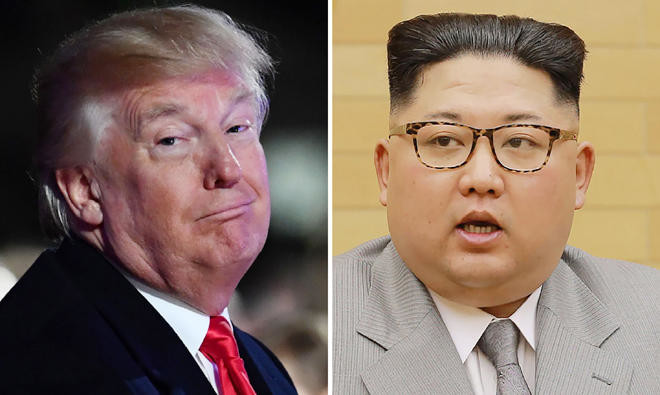
Trump, Moon signal openness for talks with North Korea
Trump, Moon signal openness for talks with North Korea

Latest updates


© 2026 SAUDI RESEARCH & PUBLISHING COMPANY, All Rights Reserved And subject to Terms of Use Agreement.