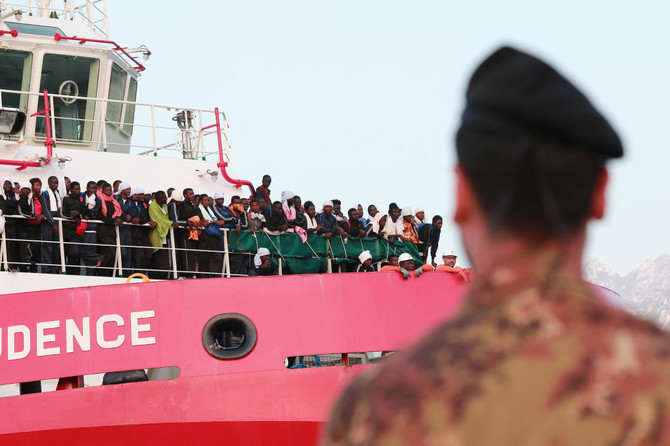
LONDON: The flow of migrants into Europe shows no signs of abating, say experts with the number of asylum seekers increasing in some countries and many living in dire conditions as they wait for their applications to be processed.
While Germany saw a decline in the number of refugee applications in 2017, France witnessed the highest number of asylum applications in 40 years during 2017 and anticipates a further rise this year.
Pascal Brice, director general of the French Office for the Protection of Refugees and Stateless Persons (Ofpra) told French broadcaster CNEWS that the number of asylum applicants in the country had increased by 17 percent, with more than 100,000 requests registered last year.
“France is one of the top countries for seeking asylum in Europe” after Germany, which expects to receive just under 200,000 requests for asylum in 2018,” Brice said.
Brice noted a sharp rise in the number of requests from Albanian and West African nationals with 7,630 applications from Albania and 5,987 from Afghanistan — the second most common country of origin.
Speaking to Arab News, professor Christian Dustmann, director of the Center for Research and Analysis on Migration (CReaM) said: “The political fallout has been quite tremendous in Europe so clearly European countries have tried to make sure that the influx of asylum seekers will be reduced.”
“That has seen some success so things have calmed down a little bit but in the longer run this will not totally abate.”
Neil Grungas, executive director of the organization for Refuge, Asylum & Migration (Oram) pointed to “signs of instability” elsewhere in the region, including the recent uprising in Iran and the possibility of further crackdown on protesters by the regime. “We don’t yet know what will be the impact in terms of outflow from Iran.”
“Also, the fact that ISIL (Daesh) has been apparently quelled in some sections of Syria and in Iraq doesn’t mean they are gone. We can expect the kind of radicalism and the kind of political pressures that we’ve seen to carry on further and further.”
“People will need to leave…some because they are living in war zones and others because they are tired of living in situations of perpetual displacement,” he added.
“There is a lot of political instability in the Middle East so I don’t see that this will now disappear completely, I think we will live with this challenge for a very long time to come,” Dustmann said.
A series of regime air strikes in rebel-held Idlib in Syria on Sunday, which killed at least 40 people, sent thousands fleeing north toward the Syrian border.
Kerem Kinik, president of the Turkish Red Crescent Society, told Arab News earlier this week that in the past fortnight around 64,000 Syrians have traveled from the south of Idlib toward the north.
“We are doing our best to accommodate them in our camp between Idlib and our southern border,” he said.
A report released by The UN Refugee Agency (UNHCR) in March 2017 found that counties bordering Syria hosted the vast majority of refugees, with more than 5 million people seeking refuge in Turkey, Lebanon and Jordan, as well as Egypt and Iraq.
The controversial deal struck between the EU and Turkey last year, which left many refugees stranded on Greek islands, was designed to stem the flow of migrants crossing into Europe but relations between the signatories have since deteriorated.
The EU’s deal with Turkey is “beginning to fray around the edges” said Jonathan Portes, professor of economics and public policy at King’s College London, and a senior fellow of the UK in a Changing Europe program.
“It’s quite possible that you will continue to have very large numbers of people displaced from Syria to Jordan, Turkey, Lebanon and that many of those will continue to try and make their way to Europe if they see that as being a potentially feasible thing to do.”
For those trying to cross into Europe, the journey has grown increasingly difficult and perilous since more countries closed off migration routes.
“Even if applications are going up in France, there’s still quite a strong cohort of people in Calais who are in the dire conditions because there is no official camp and there are more and more restrictions on what services can be provided for them,” said Fizza Qureshi, Director of the Migrants’ Rights Network.
“For us the concern is there are no easy routes for protection, so a lot of people are having to put themselves into the hands of traffickers.”
“Its incredibly difficult for people who end up in places like Hungary and some of the other Eastern European countries that are very unwelcoming at the moment to refugees.”
“There needs to be a much more rights-based approach to refugee protection.”

Europe refugees flows set to continue amid sharp rise in asylum applications

Trump urges Iranian Kurds to attack Iran as war widens
- Azerbaijan preparing unspecified retaliatory measures on Thursday
- The seven-day war has now seen Iran target Israel, the Gulf states, Cyprus, Turkiye and Azerbaijan, and spread to the Indian Ocean off Sri Lanka
DUBAI/WASHINGTON: US President Donald Trump encouraged Iranian Kurdish forces in Iraq to launch attacks against Iran as the Middle East conflict widened, with Azerbaijan warning it would retaliate for being targeted by Iranian missiles.
Israel on Friday said it had started a “broad-scale” wave of attacks against infrastructure targets in Tehran, as Gulf cities came under renewed bombardment by Iran.
The seven-day war has now seen Iran target Israel, the Gulf states, Cyprus, Turkiye and Azerbaijan, and spread to the Indian Ocean off Sri Lanka where a US submarine sank an Iranian naval ship.
On the possibility of the Iranian Kurdish forces entering Iran, Trump told Reuters on Thursday: “I think it’s wonderful that they want to do that, I’d be all for it.”
Two Iranian drone attacks targeted an Iranian opposition camp in Iraqi Kurdistan on Thursday, security sources said.
Iranian Kurdish militias have consulted with the United States in recent days about whether, and how, to attack Iran’s security forces in the western part of the country, according to three sources with knowledge of the matter.
The Iranian Kurdish coalition of groups based on the Iran-Iraq border in the semi-autonomous region of Iraqi Kurdistan has been training to mount such an attack in hopes of weakening the country’s military, as the United States and Israel pound Iranian targets with bombs and missiles. Trump, speaking with Reuters in a telephone interview, also said the United States must have a role in deciding who will be the next leader of Iran after airstrikes killed Supreme Leader Ayatollah Ali Khamenei last week.
“We’re going to have to choose that person along with Iran. We’re going to have to choose that person,” he said.
US Defense Secretary Pete Hegseth said on Thursday that the US was not expanding its military objectives in Iran, despite what Trump said about choosing the country’s next leader.
“There’s no expansion in our objectives. We know exactly what we’re trying to achieve,” he said. The attack on Iran is a major political gamble for the Republican president, with opinion polls showing little support and Americans concerned about the rise in gasoline prices caused by disruption to energy supplies. Trump dismissed that concern. Shares on Wall Street fell on Thursday, weighed by surging oil prices, as the economic impact of the campaign intensified, with countries around the world cut off from a fifth of global supplies of oil and liquefied natural gas and air transport still facing chaos and global logistics increasingly snarled.
Azerbaijan prepares to retaliate
Azerbaijan was preparing unspecified retaliatory measures on Thursday after it said four Iranian drones crossed its border and injured four people in the Nakhchivan exclave.
“We will not tolerate this unprovoked act of terror and aggression against Azerbaijan,” President Ilham Aliyev told a meeting of his Security Council.
Iran, which has a significant Azeri minority, denied it targeted its neighbor.
Lebanon’s Iran-backed Hezbollah militia warned Israeli residents to evacuate towns within 5 km (3 miles) of the border between the countries in a message posted on its Telegram channel in Hebrew early on Friday.
“Your military’s aggression against Lebanese sovereignty and safe citizens, the destruction of civilian infrastructure and the expulsion campaign it is carrying out will not go unchallenged,” Hezbollah said.
Us munitions full
Hegseth and Admiral Brad Cooper, who leads US forces in the Middle East, said during a briefing about operations that the US has enough munitions to continue its bombardment indefinitely.
“Iran is hoping that we cannot sustain this, which is a really bad miscalculation,” Hegseth told reporters at Central Command headquarters in Florida. “Our munitions are full up and our will is ironclad.”
The Pentagon earlier this week said the military campaign, known as Operation Epic Fury, is focused on destroying Iran’s offensive missiles, missile production and navy, while not allowing Tehran to have a nuclear weapon.
Cooper said the US had now hit at least 30 Iranian ships, including a large drone carrier that he said was the size of a World War Two aircraft carrier.
He added that B-2 bombers had in the past few hours dropped dozens of 2,000 penetrator bombs targeting deeply buried ballistic missile launchers, and that bombings were also targeting Iran’s missile production facilities.
Iran’s ballistic missile attacks had decreased by 90 percent since the first day of the war, while drone attacks had decreased by 83 percent in that time frame, he said. In Iran, at least 1,230 people have been killed, according to the Iranian Red Crescent Society, including 175 schoolgirls and staff killed at a primary school in Minab in the country’s south on the first day of the war. Another 77 have been killed in Lebanon, its Health Ministry says. Thousands fled southern Beirut on Thursday after Israel warned residents to leave.