SEOUL: North Korea offered to send athletes and a high-level delegation to the forthcoming Winter Olympics in the South on Tuesday as the rivals held their first official talks in more than two years after months of tensions over Pyongyang’s nuclear weapons program.
Seoul urged that reunions of families divided by the 1950-53 Korean War — one of the most emotive legacies of the conflict — be held at the same time as the Games.
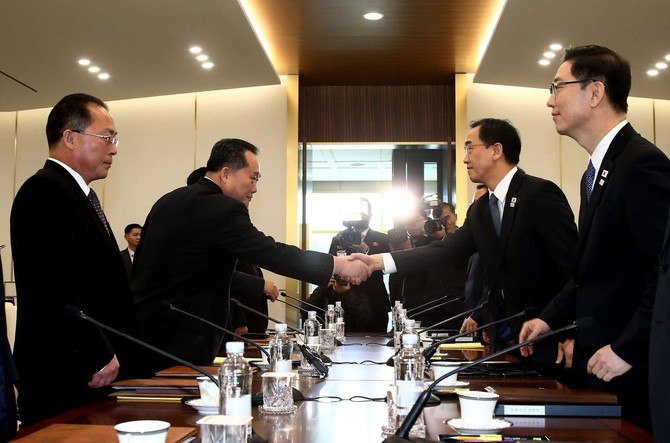
The talks were held in Panmunjom, the truce village in the Demilitarized Zone that splits the peninsula, with the North’s group walking over the Military Demarcation Line to the Peace House venue on the southern side — just yards from where a defector ran across in a hail of bullets two months ago.
Looking businesslike, the South’s Unification minister Cho Myoung-Gyon and the North’s chief delegate Ri Son-Gwon shook hands at the entrance to the building, and again across the table.
In accordance with standard practice in the North, Ri wore a badge on his left lapel bearing an image of the country’s founding father Kim Il-Sung and his son and successor Kim Jong-Il. Cho also wore a lapel badge, depicting the South Korean flag.
As well as its athletes, the North proposed sending a high-level delegation, supporters, art performers and a taekwondo demonstration team to the Games, the South’s vice unification minster Chun Hae-Sung told journalists.
Seoul suggested the two sides march together at the opening ceremony, he added, and called for the resumption of family reunions, as well as Red Cross talks and military discussions to prevent “accidental clashes.”
“Let’s present the people with a precious new year’s gift,” said the North’s Ri. “There is a saying that a journey taken by two lasts longer than the one traveled alone.”
The atmosphere was friendlier than at past meetings, and Cho told him that Seoul believed “guests from the North are going to join many others from all around the world” at the Olympics.
“The people have a strong desire to see the North and South move toward peace and reconciliation,” he added.
It was a radically different tone from the rhetoric of recent months, which have seen the North’s leader Kim Jong-Un and US President Donald Trump trade personal insults and threats of war, while Pyongyang has launched missiles capable of reaching the US mainland and carried out its sixth and most powerful nuclear test to date.
Seoul has been keen to proclaim the Games in Pyeongchang, just 80 kilometers (50 miles) south of the DMZ, a “peace Olympics” but it needs Pyongyang to attend to make the description meaningful.
Kim indicated in his New Year’s speech that the North could take part in the Games and Seoul responded with an offer of high-level dialogue. Last week the hotline between the neighbors was restored after being suspended for almost two years.
Issues still to be settled include the question of joint entrances to the opening and closing ceremonies, the size of the delegation and their accommodation — widely expected to be paid for by Seoul — as well as any linked discussions.
The North so far has only two winter sports athletes qualified for the Games, but hundreds of young, female North Korean cheerleaders have created a buzz at three previous international sporting events in the South.
The group may stay on a cruise ship in Sokcho, about an hour’s drive from the Olympic venue, which would enable their movements to be closely monitored and controlled.
A high-level delegation accompanying the team could include Kim’s younger sister Yo-Jong, who is a senior member of the ruling Workers’ Party, according to South Korean reports.
Both sides expressed desires to address issues beyond the Olympics. But Pyongyang has snubbed previous attempts by Seoul to set up further family reunions, saying it will not do so unless several of its citizens are returned by the South.
It was not clear whether the North had sought to discuss a permanent end to large-scale annual military drills between Seoul and Washington.
The North’s Rodong Sinmun newspaper made no mention of the talks Tuesday but said that US policies aimed at sanctions and pressure against the North had failed and Pyongyang had become “an international nuclear power.”
The US and South Korea agreed last week to delay the Foal Eagle and Key Resolve exercises until after the Games, apparently to help ease nerves.
Trump said at the weekend he hoped the rare talks between the two Koreas would go “beyond the Olympics” and that Washington could join the process at a later stage.
But US ambassador to the UN Nikki Haley said that there was “no turnaround” in the US stance, reiterating that the North must stop nuclear tests for talks with Washington.


![]()
North Korea offers to attend Winter Olympics in talks with Seoul
North Korea offers to attend Winter Olympics in talks with Seoul

Latest updates






© 2026 SAUDI RESEARCH & PUBLISHING COMPANY, All Rights Reserved And subject to Terms of Use Agreement.