ROME: Italy’s main political forces began in earnest to plot strategies for the upcoming general election Sunday, as the country’s finance minister raised a reg flag over political uncertainty in the eurozone’s third largest economy.
The March 4 vote, which will pit a strong center-right coalition against populists and a divided left, is widely expected to produce a hung parliament — a prediction already spooking international markets.
A coalition between the outgoing center-left Democratic Party (PD) and billionaire Silvio Berlusconi’s Go Italy (FI) could be on the cards, Finance Minister Pier Carlo Padoan said in an interview with the Corriere della Sera daily.
“In a context of high uncertainty nothing can be ruled out. Such uncertainty is already being perceived. Financial markets are rather nervous: when parliament was dissolved (in December), the spread widened,” he said.
The spread between Italian and German 10-Year sovereign bonds was scrutinized daily during the 2011 debt crisis, and the fear that the heavily-indebted country could topple over the financial cliff and drag Europe with it has been hard to shift.
The anti-establishment Five Star Movement (M5S), which supports a hotchpotch of policies from across the ideological spectrum, is the leading single party in opinion polls, with some 28 percent of the vote, ahead of the PD’s 25 percent.
But sailing comfortably ahead is a center-right coalition made up of Berlusconi’s Go Italy, the anti-immigrant Northern League and smaller right-wing Brothers of Italy, currently forecast to take home over 35 percent of the vote.
Under a new electoral law, roughly 40 percent of the vote is needed to govern.
Parties across the spectrum are pledging to cut taxes and challenge the European Union over its strict budget rules, but efforts to woo voters with cures for a shy economy may be overshadowed by concerns over immigration.
Outgoing PM Paolo Gentiloni appealed to voters Sunday “not to shut yourselves away in the small world of daily fears” in a reference to the wave of voter anger over the number of asylum seekers in Italy — anger that has boosted the right.
The center-right coalition leaders met for a working lunch Sunday at Berlusconi’s luxury Milan villa, the main course served with a side-helping of debate over how they will split seats in parliament.
Berlusconi, 81, is not able to run for office owing to a tax fraud conviction, but wants his party to get the lion’s share.
League head Matteo Salvini, 44, has ambitions of his own, tweeting Sunday: “Salvini for Prime Minister.”
“It’s a bit soon to be counting chickens,” retorted the M5S’s candidate for prime minister, Luigi Di Maio.
The movement is determined to go it alone and has refused to counter alliances with traditional parties — which did not stop the new Free and Equal party, a breakaway wing of the PD, suggesting a deal could be done with the populists.
“We’ll speak with everyone — apart from the right, but that’s a question of mental hygiene,” leftist stalwart Pier Luigi Bersani said at the party’s conference in Rome.


![]()
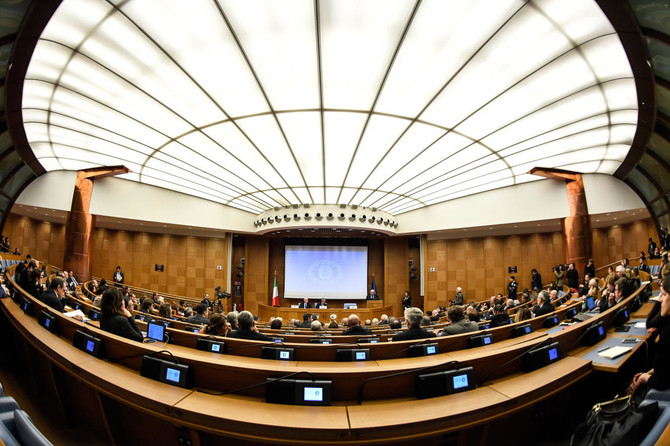
Italy political forces begin election wheeling and dealing
Italy political forces begin election wheeling and dealing
Latest updates


© 2026 SAUDI RESEARCH & PUBLISHING COMPANY, All Rights Reserved And subject to Terms of Use Agreement.