Iraq evicting refugees to ‘unsafe’ areas

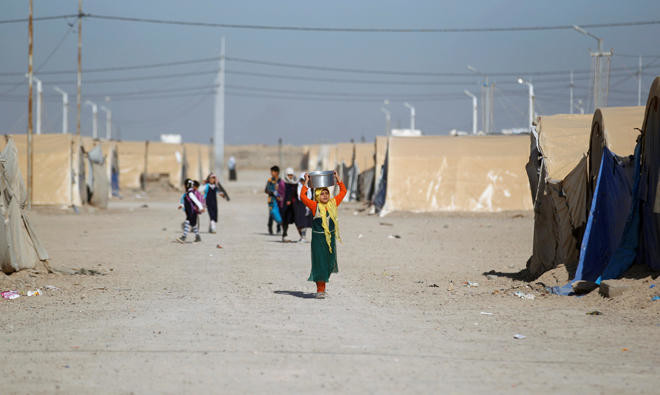
Displaced Iraqi people are seen at the Amriyat Al-Fallujah camp in Anbar Province, on Wednesday. (Reuters)
Updated 07 January 2018
Follow

Iraq evicting refugees to ‘unsafe’ areas

AMRIYAT AL-FALLUJA: Iraqi security forces are forcibly returning civilians from refugee camps to unsafe areas in the Anbar province, exposing them to death from booby-traps or acts of vigilantism, refugees and aid workers say.
Managing more than 2 million Iraqis displaced by the war against Daesh is one of Prime Minister Haider Al-Abadi’s most daunting tasks. But critics say he is more interested in winning elections in May than alleviating the suffering of displaced Iraqis and returning them safely home.
Authorities are sending back people against their will, refugees and aid workers say, to ensure that the election takes place on time. People must be in their area of origin to vote and if they do not get home, this could delay the election.
Abadi is riding a wave of popularity after defeating Daesh in Iraq and is anxious the election should not be held up.
His strategy is not without its hazards. Abadi risks alienating Sunni voters if displaced Sunnis are seen to be suffering from being sent home to dangerous areas.
Abadi is seeking a second term in which he plans to fight corruption and maintain national unity in the face of Kurdish separatism. He will need all the votes he can muster to face down a challenge from candidates linked to Iranian-backed militias.
Military trucks
Interviews with aid workers and dozens of displaced people at camps in the town of Amriyat Al-Falluja, located in the Anbar province, 40km from Baghdad, as well as with several families who were returned to other areas in the province, reveal that many were forced to go home and several suffered death or injury.
Aid workers said military trucks arrive at camps unannounced and commanders read out lists of people, who have one hour to pack their belongings and go.
The aid workers, who all spoke on condition of anonymity, estimated that between 2,400 and 5,000 people were forcibly returned between Nov. 21 and Jan. 2.
“These returns are not safe,” said one aid worker. “Even those who don’t openly resist really have no other choice. They cannot really say no to a bunch of people with guns.”
‘They gave him a tent’
An Iraqi military spokesman said the claim that the military forced displaced civilians to return against their will was an exaggeration.
“Our primary concern is the safety of our citizens, our job is to protect people,” Iraqi Joint Operations Command Spokesman Brig. Gen. Yahya Rasool told Reuters.
However, “citizens have to go home” now that had been defeated, he said.
Some aid workers said local military commanders told them the orders came from Abadi’s office. The prime minister’s spokesman did not respond to requests for comment.
On Nov. 25, security forces arrived at a camp in Amriyat Al-Falluja and told Saleh Ahmed, 37, and his family to return to their home town of Betaya, his father, Mahdi Ahmed, said.
They refused because contacts at home told them the area was filled with booby-traps left by retreating Daesh fighters and their houses had been destroyed.
A local commander assured them the area was safe, saying it was “better to go live in a tent in your home town than live in a tent in the camp.”
Saleh reluctantly took his wife and some of his children and got on the truck. Mahdi Ahmed, 72, remained at the camp with his sick wife, another son, and some of Saleh’s children as their names were not on the list.
“They gave him a tent. He went back to our destroyed house and tried to pitch it in our yard,” Mahdi Ahmed told Reuters at the camp in Amriyat Al-Falluja.
An explosive went off. Saleh’s wife was killed instantly and his daughter sustained full body burns. Saleh lost one eye and was seriously injured in the other, according to one of his sons, who witnessed the incident.
Cannot afford to return
The Ahmeds’ case is not unique. Abdallah, 17, told Reuters his family was forced to return to the town of Jweibeh on Nov. 26
A week later masked men arrived at the family home at 2 a.m. demanding to speak to the father. When he refused to open the door, they burst in and started shooting. Abdallah’s father suffered leg injuries and his mother lost a finger.
The family do not know what the men wanted.
“It’s not that we don’t want to return but it has to be safe,” said Abdallah, who is now the family breadwinner, working at a shop in the city of Falluja.
For many it is not economically viable to leave the camps, where they can set up barber shops or fruit stands at makeshift markets, making about $50 a month.
That sum would not be possible back home where jobs, basic services, and schools are nonexistent.
“I can’t afford to return,” said camp resident Alaa Hussein.
One man whose father suffers from kidney failure said leaving means losing access to the camp’s dialysis machine. His village, 450km from the camp, does not have one.
“I will return once there are adequate health services there, but why should I go before then?” said Jassem Ali, 37.
Five camp residents told Reuters separately they were forced to leave, but had to turn back because checkpoints manned by Iranian-backed militias were demanding bribes of up to $400 to let people through, a sum none could afford.
They spoke on condition of anonymity for fear of reprisal. Reuters was unable to independently verify the claim.
Life ruined
A US diplomat in Baghdad said she had heard reports of forced returns, which the embassy had brought to the attention of the Iraqi government.
She said the government had stressed its commitment to safe and voluntary returns but also said that “there is a real desire to get people home as quickly as possible.”
The UN says more than half of displaced Iraqis have already returned. More than 3.2 million people were back home at the end of December, with 2.6 million still displaced, according to the International Organization for Migration.
For Mahdi Ahmed, the government has achieved the reverse of what it intended.
“They are doing this because of the election, but if I go back and see my house destroyed, my money gone, and my life ruined, why would I vote for them?” he asked.


Iraq’s political future in limbo as factions vie for power

Updated 21 December 2025
Follow

Iraq’s political future in limbo as factions vie for power

  • The government that eventually emerges will be inheriting a security situation that has stabilized in recent years

BAGHDAD: Political factions in Iraq have been maneuvering since the parliamentary election more than a month ago to form alliances that will shape the next government.
The November election didn’t produce a bloc with a decisive majority, opening the door to a prolonged period of negotiations.
The government that eventually emerges will be inheriting a security situation that has stabilized in recent years, but it will also face a fragmented parliament, growing political influence by armed factions, a fragile economy, and often conflicting international and regional pressures, including the future of Iran-backed armed groups.
Uncertain prospects
Prime Minister Mohammed Shia Al-Sudani’s party took the largest number of seats in the election. Al-Sudani positioned himself in his first term as a pragmatist focused on improving public services and managed to keep Iraq on the sidelines of regional conflicts.
While his party is nominally part of the Coordination Framework, a coalition of Iran-backed Shiite parties that became the largest parliamentary bloc, observers say it’s unlikely that the Coordination Framework will support Al-Sudani’s reelection bid.
“The choice for prime minister has to be someone the Framework believes they can control and doesn’t have his own political ambitions,” said Sajad Jiyad, an Iraqi political analyst and fellow at The Century Foundation think tank.
Al-Sudani came to power in 2022 with the backing of the Framework, but Jiyad said that he believes now the coalition “will not give Al-Sudani a second term as he has become a powerful competitor.”
The only Iraqi prime minister to serve a second term since 2003 was Nouri Al-Maliki, first elected in 2006. His bid for a third term failed after being criticized for monopolizing power and alienating Sunnis and Kurds.
Jiyad said that the Coordination Framework drew a lesson from Al-Maliki “that an ambitious prime minister will seek to consolidate power at the expense of others.”
He said that the figure selected as Iraq’s prime minister must generally be seen as acceptable to Iran and the United States — two countries with huge influence over Iraq — and to Iraq’s top Shiite cleric, Grand Ayatollah Ali Al-Sistani.
Al-Sudani in a bind
In the election, Shiite alliances and lists — dominated by the Coordination Framework parties — secured 187 seats, Sunni groups 77 seats, Kurdish groups 56 seats, in addition to nine seats reserved for members of minority groups.
The Reconstruction and Development Coalition, led by Al-Sudani, dominated in Baghdad, and in several other provinces, winning 46 seats.
Al-Sudani’s results, while strong, don’t allow him to form a government without the support of a coalition, forcing him to align the Coordination Framework to preserve his political prospects.
Some saw this dynamic at play earlier this month when Al-Sudani’s government retracted a terror designation that Iraq had imposed on the Lebanese Hezbollah militant group and Yemen’s Houthi rebels — Iran-aligned groups that are allied with Iraqi armed factions — just weeks after imposing the measure, saying it was a mistake.
The Coalition Framework saw its hand strengthened by the absence from the election of the powerful Sadrist movement led by Shiite cleric Muqtada Sadr, which has been boycotting the political system since being unable to form a government after winning the most seats in the 2021 election.
Hamed Al-Sayed, a political activist and official with the National Line Movement, an independent party that boycotted the election, said that Sadr’s absence had a “central impact.”
“It reduced participation in areas that were traditionally within his sphere of influence, such as Baghdad and the southern governorates, leaving an electoral vacuum that was exploited by rival militia groups,” he said, referring to several parties within the Coordination Framework that also have armed wings.
Groups with affiliated armed wings won more than 100 parliamentary seats, the largest showing since 2003.
Other political actors
Sunni forces, meanwhile, sought to reorganize under a new coalition called the National Political Council, aiming to regain influence lost since the 2018 and 2021 elections.
The Kurdish political scene remained dominated by the traditional split between the Kurdistan Democratic Party and Patriotic Union of Kurdistan parties, with ongoing negotiations between the two over the presidency.
By convention, Iraq’s president is always a Kurd, while the more powerful prime minister is Shiite and the parliamentary speaker Sunni.
Parliament is required to elect a speaker within 15 days of the Federal Supreme Court’s ratification of the election result, which occurred on Dec. 14.
The parliament should elect a president within 30 days of its first session, and the prime minister should be appointed within 15 days of the president’s election, with 30 days allotted to form the new government.
Washington steps in
The incoming government will face major economic and political challenges.
They include a high level of public debt — more than 90 trillion Iraqi dinars ($69 billion) — and a state budget that remains reliant on oil for about 90 percent of revenues, despite attempts to diversify, as well as entrenched corruption.
But perhaps the most delicate question will be the future of the Popular Mobilization Forces, a coalition of militias that formed to fight the Daesh group as it rampaged across Iraq more than a decade ago.
It was formally placed under the control of the Iraqi military in 2016 but in practice still operates with significant autonomy. After the Hamas-led attack in southern Israel on Oct. 7, 2023 sparked the devastating war in Gaza, some armed groups within the PMF launched attacks on US bases in the region in retaliation for Washington’s backing of Israel.
The US has been pushing for Iraq to disarm Iran-backed groups — a difficult proposition, given the political power that many of them hold and Iran’s likely opposition to such a step.
Two senior Iraqi political officials, who spoke on condition of anonymity because they weren’t authorized to comment publicly, said that the United States had warned against selecting any candidate for prime minister who controls an armed faction and also cautioned against letting figures associated with militias control key ministries or hold significant security posts.
“The biggest issue will be how to deal with the pro-Iran parties with armed wings, particularly those... which have been designated by the United States as terrorist entities,” Jiyad said.