Syria rebel enclave is Assad regime’s weak spot/node/1220511/middle-east
Syria rebel enclave is Assad regime’s weak spot
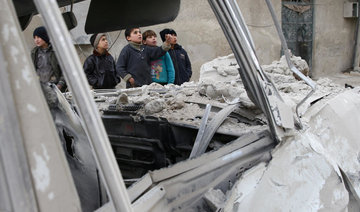
A Syrian man carries an injured woman following reported bombardment by Syrian and Russian forces in the rebel-held town of Hamouria, in the Eastern Ghouta. (AFP)
BEIRUT: Syria’s rebel-held enclave of Eastern Ghouta near the capital is the regime’s Achilles heel, and because of this it faces an almost inevitable military offensive, experts say.
The battle-scarred region east of Damascus, which has been under near-daily bombardment and a crippling government siege since 2013, is strategically vital to President Bashar Assad.
Despite residents facing a humanitarian crisis, rebels controlling the region have been able to use it as a launch pad for rocket and mortar attacks on the capital.
Joshua Landis, director of the Center for Middle East Studies at the University of Oklahoma, said the ongoing rebellion in Eastern Ghouta contrasted with the regime “presenting itself as the winner” of Syria’s war elsewhere.
“The persistence of the East Ghouta resistance has become a major embarrassment and liability for the Assad regime,” he said.
The Assad regime, militarily backed by its ally Russia, has retaken control of more than half of the country with a string of victories against rebel and jihadist forces.
“It hopes to convince the international community that it faces little opposition any more save for the enclaves on the margins of Syria,” Landis said.
But rebel and jihadist groups managed this week to surround a regime base on the edge of Eastern Ghouta, prompting intensified regime air strikes there.
Rami Abdel Rahman, head of the Syrian Observatory for Human Rights, said the enclave is the regime’s “weak spot.”
“The factions there are strong and directly threaten Damascus,” he told AFP.
Even though Eastern Ghouta was one of four “de-escalation zones” agreed under a deal between rebel and regime backers, fighting has continued there.
The area is the target of near-daily regime air strikes and artillery fire that has killed thousands of people since 2011.
Rebels have killed hundreds of civilians with mortar rounds and rockets fired at Damascus, although such attacks have waned since the regime seized several areas close to the capital.
The beleaguered 100-square-kilometer (40-square-mile) enclave’s estimated 400,000 inhabitants are suffering severe shortages of food and medicine.
Children there are particularly vulnerable to malnutrition.
Despite the civilian suffering caused by the blockade, rebel groups in Ghouta “still have a popular base, because thousands of their fighters are from the region,” Abdel Rahman said.
Jaish Al-Islam, a powerful Islamist rebel group that has recognized the de-escalation deal and takes part in United Nations-backed peace talks, is among the most powerful groups in Eastern Ghouta.
It controls Douma, the largest city in the region, but shares power with Faylaq Al-Rahman, another Islamist rebel group that controls the localities of Erbin and Hammuriyeh.
But the offensive against the regime military base was the work of Ahrar Al-Sham and an alliance dominated by the jihadists of Fateh Al-Sham, a former Al-Qaeda affiliate.
Syria analyst Sam Heller of the Century Foundation think tank said the regime had responded by intensifying its operations, “whatever the cost in terms of troops and reinforcements.”
Additional forces have been deployed to the area, according to pro-regime Syrian media.
Heller said things were moving “toward a militarily settlement in the regime’s favor” in areas held by Faylaq Al-Rahman, Ahrar Al-Sham and the Fateh-al Sham-dominated alliance.
But the situation is different in areas controlled by Jaish Al-Islam, he said.
The group “is an armed force that is not to be underestimated, and it controls large residential areas that the regime would struggle to absorb,” he said.
He said talks between the group and Russia could lead to “a negotiated solution that would leave it in place once it has made some concessions.”
Landis said the de-escalation deal over the area would be “nibbled away at” in the coming weeks.
“Assad has preferred until now to starve and bomb the Ghouta enclave rather than launch an expensive frontal attack,” he said.
Rights groups and the UN have criticized “reconciliation” agreements that see civilians evacuated following sieges and bombardment apparently aimed at forcing civilians to leave their homes.
Such deals have seen rebels transferred to Idlib in the north, the only province in Syria fully outside regime control.
“We should also expect that increased pressure will be applied to the Ghouta militias to surrender or agree to reconciliation or deportation to Idlib,” Landis said.
Great expectations: Yemenis look forward to outcomes of Riyadh dialogue
Southern factions look to Saudi-hosted talks to defuse tensions after December’s violent escalation
Analysts say Riyadh dialogue could help reset the southern cause — but only if militias are excluded
Updated 07 January 2026
Mohammed Al-Sulami
RIYADH: Last December marked a troubled end to the year in Yemen, particularly in its southern and eastern governorates. While much of the world marked the season with hopes for peace and stability, developments on the ground took a sharply different turn.
The Southern Transitional Council (STC), led by Aidarous Al-Zubaidi, moved to seize control of state institutions and military camps, defying expectations in Hadramout and Al-Mahra and mounting a direct challenge to the internationally recognized government.
These actions, carried out through armed force and supported by external actors, led to casualties and an escalation of tensions in both governorates.
In response, Yemen’s political leadership appealed to the Saudi-led coalition to contain the situation, called for the withdrawal of Emirati forces, and initiated operations to reassert control over military headquarters in Hadramout and Al-Mahra.
Subsequently, Rashad Mohammed Al-Alimi, chairman of the Presidential Leadership Council, asked Saudi Arabia to host a conference in Riyadh, bringing together all southern factions to discuss solutions — a request accepted by the Saudi leadership.
Supporters of the UAE-backed separatist Southern Transitional Council (STC) wave flags of the STC, during a rally in Aden, Yemen, January 1, 2026. (Reuters)
The initiative comes amid the Kingdom’s affirmation of the legitimacy of the southern cause, coupled with its clear rejection of any solution imposed by force.
Arab News surveyed the views of several Yemeni politicians and analysts on their expectations for the conference, convened at a critical and highly sensitive juncture, and on the key issues anticipated to dominate the dialogue.
Among them was Salah Batis, a member of the Yemeni Shura Council, a member of the Preparatory Committee for the Unified Council of the Eastern Governorates, and a prominent figure in Hadramout.
“We extend our sincere gratitude to our brothers in the Kingdom of Saudi Arabia — both leadership and people — for their steadfast support, assistance, and courageous stand alongside the people of Hadramout and the eastern governorates in particular, and Yemen as a whole,” Batis told Arab News.
“Without this support, and without the role of the Saudi Air Force, this victory would not have been achieved, security would not have been restored, and this militia would not have been removed from these sensitive areas, especially Hadramout and the eastern governorates.
President Dr. Rashad Mohammed Al-Alimi, Chairman of the Presidential Leadership Council, received on Tuesday at his residence in Riyadh the Senior Adviser to the US President for Arab and African Affairs, Massad Boulos, in the presence of the US Ambassador to Yemen Steven H. Fagin. (Social media)
“We also express our appreciation to the political leadership, represented by the chairman of the Presidential Leadership Council, Dr. Rashad Al-Alimi, and to the governor of Hadramout and commander of the Homeland Shield Forces, Salem Al-Khanbashi.
“Our gratitude further extends to the heroes of the Homeland Shield Forces, the armed forces, and the security forces who participated in the operation to take control of the camps. It was a swift and decisive operation, carried out at minimal cost, praise be to God.”
However, Batis said he opposes the inclusion of the STC in the upcoming Riyadh conference, citing its involvement in the killing and terrorizing of civilians in Hadramout and Al-Mahra.
He described the call for dialogue as “a positive step toward preserving the southern cause, which the STC had sought to hijack and undermine, nearly causing severe damage had it not been for swift and decisive intervention.”
Abdullah Ali Fadhel Al-Saadi (second from right at table), Permanent Representative of Yemen to the United Nations, speaks at the Security Council meeting on the situation in the Middle East. (Photo: UN)
Batis said the southern cause must represent all southerners without exception, and that no single party should monopolize it or claim exclusive representation. He said the STC had already harmed the cause by using armed violence to advance its agenda, resulting in killings.
For this reason, he said, the people of Hadramout — where many of these violations occurred — have demanded, and continue to demand, accountability for those responsible and their exclusion from the dialogue.
He accused the STC of mobilizing armed forces, invading governorates, killing tribesmen, attacking villages and civilians, storming and looting state camps, and destroying public institutions, including airports, ports, oil facilities, and government offices in Seiyun, Mukalla, and other locations.
Batis said the STC and its leadership bear full responsibility, arguing they had led and directed the armed groups toward Hadramout under the banner of southern forces.
This photo taken on January 3, 2026 shows Saudi-backed forces that took control of the Second Military Region Command on the outskirts of Mukalla, the capital of Hadramawt, where the UAE-backed secessionist Southern Transitional Council (STC) recently launched an offensive to seize the resource-rich province. (AFP)
He questioned how the people of Hadramout and the eastern governorates could accept belonging to such a region after what had occurred, noting that these forces operated under a declared leadership and a self-proclaimed supreme commander.
Batis said local communities viewed them as invading forces that killed civilians, shed blood, attacked state institutions, and seized military camps.
He added that, were it not for the decisive intervention of allied forces and local authorities — leading to the return of the camps, the repair of the damage, and the withdrawal of these militias to their original positions — the consequences would have been far more severe.
“I believe this dialogue and conference must have a clear and firm framework: no group that possesses weapons, militias, or armed forces should take part,” Batis said.
People ride motorbikes on a street in Sanaa, Yemen February 5, 2021. (Reuters)
“Arms must be exclusively in the hands of the state, under the authority of the ministries of defense and interior, and sovereignty must rest solely with the state — not with parties, factions, or individuals.”
Batis warned against repeating what he described as the mistake of 2013, when the Houthi group was allowed to participate in the National Dialogue Conference while still armed and expanding its territorial control.
He recalled that by January 2014 the Houthis had seized Amran Governorate and laid siege to Sanaa, halting the drafting of the federal constitution and forcing meetings to be held at the Presidential Palace.
Batis noted that he was serving at the time as vice president of the National Authority tasked with monitoring the implementation of the dialogue’s outcomes, before the Houthis later stormed the capital and plunged the country into a crisis that continues to this day.
Fighters recruited into the Houthis as part of a mobilization campaign they have initiated recently, ride atop an armored personnel carrier as they parade to show solidarity with Palestinians in the Gaza Strip, in Sanaa, Yemen August 24, 2024. (Reuters)
For his part, political analyst and activist Youssef Ismail Abdo said that any fair and equitable outcomes from the conference would help stabilize the south — particularly Hadramawt and the eastern governorates — fostering security, development, and stability, with positive implications for all of Yemen and the wider region.
Also speaking to Arab News, Dr. Nasser bin Habtour, secretary-general of the Shabwa National Council, said that “the south is home to multiple political projects, including secession and a federal state.
“The events of December demonstrated that not all southerners support secession, leaving the STC isolated in its unilateral move. In my opinion, all political options should be placed on the dialogue table so that southerners can discuss them and reach a unified vision.”
He argued that “secession is neither feasible nor appropriate at the present stage, given Yemen’s dire circumstances, with the Houthi militia controlling Sanaa and state institutions and posing a serious threat to Yemen and the wider region.”
Vehicles drive on a street, as Saudi and Omani delegations hold talks with Houthis, in Sanaa, Yemen April 10, 2023. (Reuters)
He stressed that “restoring the Yemeni state must come first, after which all political projects can be presented to the people, who should then decide the future form of the state.”
He added: “The meeting, to be held in Riyadh, came at the request of southern political and social figures and groups who convened after recognizing both their responsibility and the danger into which the STC had placed the southern cause.
“They contacted the chairman of the Presidential Leadership Council, urging him to ask the Kingdom to host a southern dialogue conference.” He noted that “this initiative was consistent with Saudi Arabia’s longstanding role in supporting Yemen.”
“The conference must focus on repairing the damage inflicted on the southern cause by the STC’s unilateral decisions and attempts to monopolize it, as well as restoring the issue to its proper course through a consensual vision shared by the people of the south.”
A drone view shows people attending a rally organized by Yemen's main separatist group, the Southern Transitional Council (STC), in Aden, Yemen December 21, 2025. (Reuters)
Regarding the expected outcomes of the comprehensive southern national dialogue, Habtour said: “The first priority is reaching consensus on a unified southern vision that reflects the aspirations of the people of the south.”
He added: “The southern issue must be situated within the broader national struggle to restore the state from the Houthi militia, as well as integrated into the negotiation process aimed at restoring security and stability in Yemen.”
He further stressed “the importance of defining the role of southerners in the upcoming phase, particularly within the framework of a future federal state and their contribution to nation-building and development.”