More than 200 migrants storm Morocco-Spain border

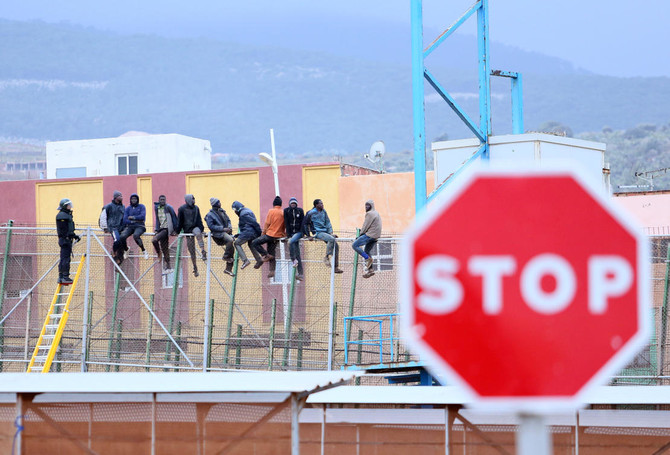
Would-be immigrants sit atop a border fence separating Morocco from the north African Spanish enclave of Melilla in the first attempt to jump in on February 19, 2015 since the camp on Mount Gurugu burned down. Morocco vowed further crackdowns on illegal migrants after rounding up hundreds of foreigners close to the Spanish enclave of Melilla, in a move criticized by local rights groups. (AFP)
Updated 06 January 2018
Follow

More than 200 migrants storm Morocco-Spain border

MADRID: More than 200 African migrants stormed over a high double fence between Morocco and the Spanish enclave of Melilla on Saturday, officials said, leaving some of them and a police officer injured.
A total of 209 people from sub-Saharan Africa seeking to get to Europe forced their way across the fence in the afternoon, the central government’s representative office in Melilla said in a statement.
The police officer who was injured was “attacked by an immigrant with one of the hooks they use to clamber up the fence” as he tried to stop them, the statement said, adding the implement cut his earlobe.
In order to get across, migrants often use hooks and shoes studded with nails.
Four of the migrants, meanwhile, were sent to hospital for minor injuries, it added.
Mobile phone footage broadcast by Spanish media showed a group of migrants running through the streets of the city.
They have since been taken to a migrant detention center.
The barrier is composed of two six-meter-high (20-feet-high) fences, with criss-crossing steel cables in between.
Melilla and Ceuta, another Spanish enclave nearly 400 kilometers (250 miles) away on the north coast of Africa, are often used as entry points into Europe for African migrants.
They have the only two land borders between Africa and the European Union.
Over the years, thousands of migrants have attempted to cross the 12-kilometer (7.5 mile) frontier between Melilla and Morocco, or the eight-kilometer border at Ceuta, by climbing the border fences, swimming along the coast or hiding in vehicles.
Spain is increasingly targeted by people desperate to reach Europe from Africa, with the number of migrants reaching the country in 2017 hitting a record high of nearly 22,900, according to EU border agency Frontex.
This was more than double the previous record set in 2016.


Bangladesh halts controversial relocation of Rohingya refugees to remote island

Updated 29 December 2025
Follow

Bangladesh halts controversial relocation of Rohingya refugees to remote island

  • Administration of ousted PM Sheikh Hasina spent about $350m on the project
  • Rohingya refuse to move to island and 10,000 have fled, top refugee official says

DHAKA: When Bangladesh launched a multi-million-dollar project to relocate Rohingya refugees to a remote island, it promised a better life. Five years on, the controversial plan has stalled, as authorities find it is unsustainable and refugees flee back to overcrowded mainland camps.

The Bhasan Char island emerged naturally from river sediments some 20 years ago. It lies in the Bay of Bengal, over 60 km from Bangladesh’s mainland.

Never inhabited, the 40 sq. km area was developed to accommodate 100,000 Rohingya refugees from the cramped camps of the coastal Cox’s Bazar district.

Relocation to the island started in early December 2020, despite protests from the UN and humanitarian organizations, which warned that it was vulnerable to cyclones and flooding, and that its isolation restricted access to emergency services.

Over 1,600 people were then moved to Bhasan Char by the Bangladesh Navy, followed by another 1,800 the same month. During 25 such transfers, more than 38,000 refugees were resettled on the island by October 2024.

The relocation project was spearheaded by the government of former Prime Minister Sheikh Hasina, who was ousted last year. The new administration has since suspended it indefinitely.

“The Bangladesh government will not conduct any further relocation of the Rohingya to Bhasan Char island. The main reason is that the country’s present government considers the project not viable,” Mizanur Rahman, refugee relief and repatriation commissioner in Cox’s Bazar, told Arab News on Sunday.

The government’s decision was prompted by data from UN agencies, which showed that operations on Bhasan Char involved 30 percent higher costs compared with the mainland camps in Cox’s Bazar, Rahman said.

“On the other hand, the Rohingya are not voluntarily coming forward for relocation to the island. Many of those previously relocated have fled ... Around 29,000 are currently living on the island, while about 10,000 have returned to Cox’s Bazar on their own.”

A mostly Muslim ethnic minority, the Rohingya have lived for centuries in Myanmar’s western Rakhine state but were stripped of their citizenship in the 1980s and have faced systemic persecution ever since.

In 2017 alone, some 750,000 of them crossed to neighboring Bangladesh, fleeing a deadly crackdown by Myanmar’s military. Today, about 1.3 million of them shelter in 33 camps in the coastal Cox’s Bazar district, making it the world’s largest refugee settlement.

Bhasan Char, where the Bangladeshi government spent an estimated $350 million to construct concrete residential buildings, cyclone shelters, roads, freshwater systems, and other infrastructure, offered better living conditions than the squalid camps.

But there was no regular transport service to the island, its inhabitants were not allowed to travel freely, and livelihood opportunities were few and dependent on aid coming from the mainland.

Rahman said: “Considering all aspects, we can say that Rohingya relocation to Bhasan Char is currently halted. Following the fall of Sheikh Hasina’s regime, only one batch of Rohingya was relocated to the island.

“The relocation was conducted with government funding, but the government is no longer allowing any funds for this purpose.”

“The Bangladeshi government has spent around $350 million on it from its own funds ... It seems the project has not turned out to be successful.”