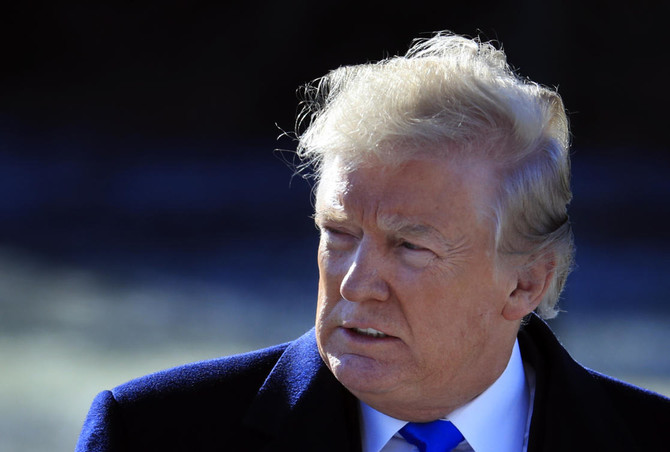
SAN DIEGO: The Trump administration has proposed spending $18 billion over 10 years to significantly extend the border wall with Mexico, providing one of its most detailed blueprints of how the president hopes to carry out a signature campaign pledge.
The proposal by Customs and Border Protection calls for 316 miles (505 kilometers) of additional barrier by September 2027, bringing total coverage to 970 miles (1,552 kilometers), or nearly half the border, according to a US official with direct knowledge of the matter.
It also calls for 407 miles (651 kilometers) of replacement or secondary fencing, said the official, who spoke to The Associated Press on the condition of anonymity because the plan has not been made public.
Trump has promised “a big, beautiful wall” with Mexico as a centerpiece of his presidency but offered few details of where it would be built, when and at what cost. His administration asked for $1.6 billion this year to build or replace 74 miles (118 kilometers) of fencing in Texas and California, and officials have said they also will seek $1.6 billion next year.
The 10-year plan, first reported by The Wall Street Journal, resulted from discussions with senators who asked the agency what it would take to secure the border, the official said.
It comes as the administration intensifies negotiations in Congress on a package that may include granting legal status to about 800,000 people who were temporarily shielded from deportation under an Obama-era program, Deferred Action for Childhood Arrivals.
Trump said last year that he was ending DACA but gave Congress until March to deliver a legislative fix.
The plan on border security came in response to a request by US Sen. Jeff Flake, said Jason Samuels, a spokesman for the Arizona Republican.
An administration official confirmed the document was prepared at the request of congressional negotiators and said funding for the wall and other security measures must be part of any legislative package on immigration. The official spoke on condition of anonymity because the plan has not been made public.
Homeland Security Secretary Kirstjen Nielsen told The Associated Press on Tuesday that the wall would be “first and foremost” in any package that includes new protections for DACA recipients. She also said the administration wanted to close “loopholes” on issues that include handling asylum claims and local police working with immigration authorities.
Nielsen called the $3.2 billion requests for fencing during the administration’s first two years a down payment.
“This is not going to get us the whole wall we need, but it’s a start,” she said.
Mexico has steadfastly rejected Trump’s demand that it pay for the wall and few doubt that US taxpayers will foot the bill if the wall is built.
The Customs and Border Protection document calls for a total of $33 billion in new border spending, including $18 billion for the wall, $5.7 billion for technology gear, $1 billion for road construction and maintenance and $8.5 billion for 5,000 new Border Patrol agents, 2,500 border inspectors and other personnel, the US official said.
The document doesn’t specify where the extended wall should be built.

Trump seeks $18 billion to extend border wall over 10 years
India accelerates free trade agreements against backdrop of US tariffs
- India signed a CEPA with Oman on Thursday and a CETA with the UK in July
- Delhi is also in advanced talks for trade pacts with the EU, New Zealand, Chile
NEW DELHI: India has accelerated discussions to finalize free trade agreements with several nations, as New Delhi seeks to offset the impact of steep US import tariffs and widen export destinations amid uncertainties in global trade.
India signed a Comprehensive Economic Partnership Agreement with Oman on Thursday, which allows India to export most of its goods without paying tariffs, covering 98 percent of the total value of India’s exports to the Gulf nation.
The deal comes less than five months after a multibillion-dollar trade agreement with the UK, which cut tariffs on goods from cars to alcohol, and as Indian trade negotiators are in advanced talks with New Zealand, the EU and Chile for similar partnerships.
They are part of India’s “ongoing efforts to expand its trade network and liberalize its trade,” said Anupam Manur, professor of economics at the Takshashila Institution.
“The renewed efforts to sign bilateral FTAs are partly an after-effect of New Delhi realizing the importance of diversifying trade partners, especially after India’s biggest export market, the US, levied tariff rates of up to 50 percent on India.”
Indian exporters have been hit hard by the hefty tariffs that went into effect in August.
Months of negotiations with Washington have not clarified when a trade deal to bring down the tariffs would be signed, while the levies have weighed on sectors such as textiles, auto components, metals and labor-intensive manufacturing.
The FTAs with other nations will “help partially in mitigating the effects of US tariffs,” Manur said.
In particular, Oman can “act as a gateway to other Gulf countries and even parts of Eastern Europe, Central Asia, and Africa,” and the free trade deal will most likely benefit “labor-intensive sectors in India,” he added.
The chances of concluding a deal with Washington “will prove to be difficult,” said Arun Kumar, a retired economics professor at the Jawaharlal Nehru University.
“With the US, the chances of coming to (an agreement) are a bit difficult, because they want to get our agriculture market open, which we cannot do. They want us to reduce trade with Russia. That’s also difficult for India to do,” he told Arab News.
US President Donald Trump has threatened sanctions over India’s historic ties with Moscow and its imports of Russian oil, which Washington says help fund Moscow’s ongoing war with Ukraine.
“President Trump is constantly creating new problems, like with H-1B visa and so on now. So some difficulty or the other is expected. That’s why India is trying to build relationships with other nations,” Kumar said, referring to increased vetting and delays under the Trump administration for foreign workers, who include a large number of Indian nationals.
“Substituting for the US market is going to be tough. So certainly, I think India should do what it can do in terms of promoting trade with other countries.”
India has free trade agreements with more than 10 countries, including comprehensive economic partnership agreements with South Korea, Japan, and the UAE.
It is in talks with the EU to conclude an FTA, amid new negotiations launched this year for trade agreements, including with New Zealand and Chile.
India’s approach to trade partnerships has been “totally transformed,” Commerce and Industry Minister Piyush Goyal said in a press briefing following the signing of the CEPA with Oman, which Indian officials aim to enter into force in three months.
“Now we don’t do FTAs with other developing nations; our focus is on the developed world, with whom we don’t compete,” he said. “We complement and therefore open up huge opportunities for our industry, for our manufactured goods, for our services.”